Is xhigh reasoning effort worth it for a coding agent? What SlopCodeBench 10/2026 and an 85-task Auto run measured
Tools in this post


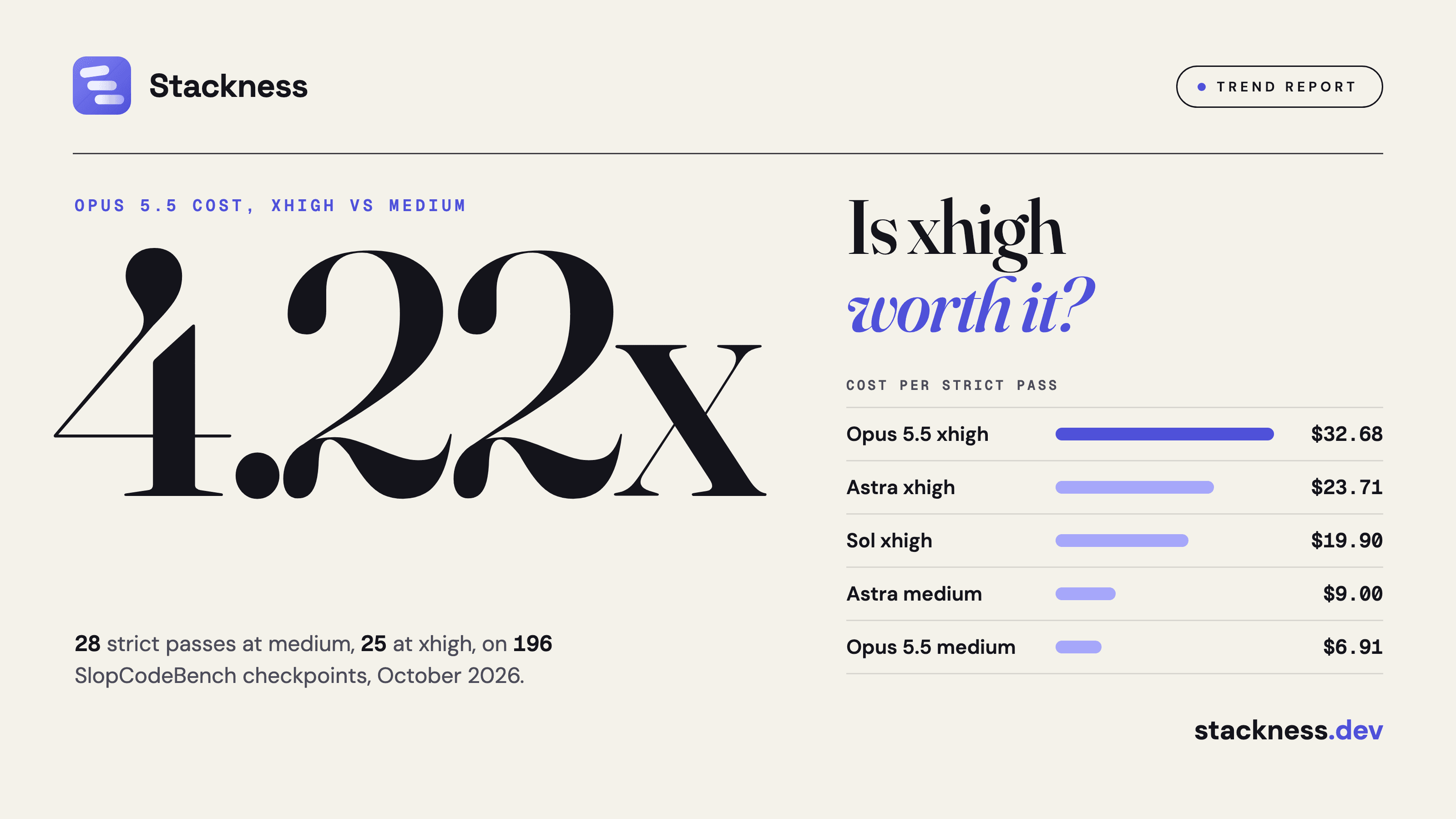
For most coding work, the public numbers say xhigh reasoning effort does not pay for itself on current models. In HumanLayer's SlopCodeBench run, published on 15 October 2026, Claude Opus 5.5 passed 28 of 196 checkpoints at medium effort and 25 at xhigh. The xhigh run cost 4.22 times as much: $817.04 against $193.47. Across the three models run at both levels, xhigh cost 2.11 to 4.22 times medium. Strict passes rose for one model and fell for two. Each setting ran once, so these are single measurements, not settled differences.
Xhigh cost 2.1 to 4.2 times medium and bought no reliable gain
SlopCodeBench 10/2026 ran three models at both medium and xhigh effort on the full benchmark: 36 problems and 196 checkpoints, where each checkpoint extends code the agent wrote at the previous one. A strict pass means every test category passes, regression tests included. The table is HumanLayer's, with cost per strict pass derived by me from its estimated cost.
| Model | Strict passes, medium → xhigh | Cost, medium → xhigh | Multiplier | $ per strict pass, medium → xhigh |
|---|---|---|---|---|
| Claude Opus 5.5 | 28 → 25 | $193.47 → $817.04 | 4.22x | $6.91 → $32.68 |
| GPT-6 Sol | 30 → 26 | $245.69 → $517.32 | 2.11x | $8.19 → $19.90 |
| GPT-6 Astra | 29 → 32 | $261.05 → $758.62 | 2.91x | $9.00 → $23.71 |
The "xhigh considered harmful" headline appears only in the post's title. The body is more careful: "This doesn't prove that more reasoning hurts coding. It says higher effort was not a reliable way to buy more strict passes in these runs." The costs are recorded inference cost, not invoices, and HumanLayer published no token counts or run times. GPT-6 Astra, OpenAI's top model, led the full table at 32 strict passes.
What does the reasoning effort setting change in a coding agent?
Reasoning effort tells the model how many output tokens to spend on a task: thinking, tool calls and the text it writes. Anthropic's effort docs call it "a behavioral signal, not a strict token budget". At higher effort, Claude may make more tool calls, explain its plan and write longer summaries. Claude offers low, medium, high, xhigh and max. Opus 5.5 defaults to medium in the API and in Claude Code.
OpenAI's reasoning docs list levels from none to max, depending on the model, and say of xhigh: "Only use when your evals show a clear benefit that justifies the extra latency and cost." Codex reads the setting from model_reasoning_effort. Anthropic's Opus 5.5 guide says the same thing: "Reserve xhigh and max for work where you've measured a quality gain." Thinking tokens are billed as output tokens: $20 per million on Opus 5.5 and $50 on GPT-6 Astra for prompts up to 272,000 tokens.
Opus 5.5 passed fewer checkpoints at xhigh than at medium
Opus 5.5 at xhigh passed three fewer strict checkpoints than at medium, 25 against 28, and spent $623.57 more to do it. Per checkpoint, it cost $0.99 at medium and $4.17 at xhigh. Its core pass rate, which counts only the main tests, also fell, from 73.98% to 71.94%.
Xhigh did produce cleaner code by one measure. On 28 matched problems, 77.75% of the xhigh run's lines were flagged by at least one of the benchmark's slop checks, against 94.25% for medium. The post calls that "close to ~5x cleaner". Neither the ratio of flagged lines (1.21) nor the ratio of unflagged lines (3.9) gives 5, and the post shows no metric that does. Commenters on Hacker News raised the noise: "When scores are ~15%, it's unclear how much is just in the noise."
A strict pass cost $6 to $9 at medium and $15 to $60 at xhigh
Across all ten campaigns in the SlopCodeBench table, every medium run cost between $6.16 and $9.00 per strict pass, and every xhigh run cost between $15.21 and $59.62. The cheapest was GPT-6.1 Sol at medium, with 29 passes for $178.51. The most expensive was Anthropic's Claude Fable 5.1 at xhigh, with 26 passes for $1,550.07; the first version of the post noted that Fable's cost metering had gaps.
GPT-6 Astra was the only model where xhigh bought more passes, and each extra pass cost $165.86. For the three models run at both levels, the price of a pass varied 1.3 to 1.6 times between models and 2.4 to 4.7 times between effort levels.
Caveman's Auto saved 54% mostly by running Opus at medium
Caveman's README claims Auto is "54% cheaper with Auto, same score" across "85 coding tasks vs Opus 5.5 at xhigh". The benchmark doc behind it is an interim run dated 3 October 2026, paused at 85 of 169 paired tasks from SWE-Interact and SWE-Together, one try per task in Claude Code. Auto resolved 43.7% against 44.3% for Opus 5.5 at xhigh, at $3.59 against $7.83 per attempt.
The doc explains the saving itself. Auto ran Opus 5.5 at medium on 87% of requests, Opus at high on 8% and Claude Sonnet 5.5 on 5%. In its words: "Most of the saving comes from lower effort (Opus xhigh to Opus medium or high), not from cheaper models." The score gap of 0.5 points has a 95% interval of −6.8 to +5.7 points, and median time fell from 35.2 to 15.9 minutes. Caveman sells the cloud service Auto runs on, ran the test itself and has not published the raw runs. The baseline it undercut on cost, xhigh on every request, is two levels above Opus 5.5's default.
Higher effort pays on hidden edge cases and first-try runs
Higher effort helped in two measured cases. In an observational study of 90 runs building one app, Opus 4.7 in Claude Code produced a perfect result on the first try in 5 of 18 runs at high and 16 of 18 at xhigh, for a median cost premium of 9% to 29%. The pooled mean score barely moved, from 41.0 to 41.8 of 42 points. The gain was in needing fewer corrections.
Anthropic's own analysis of Terminal-Bench 3.0, a public community-sourced benchmark, found that "higher effort is best for tasks with lots of hidden edge cases." Fable 5.1 passed 140 of 370 attempts at low and 214 at max. That compares the lowest effort level with the highest, not medium with xhigh. The docs point the same way: Claude Code suggests max for "finding security vulnerabilities", OpenAI suggests xhigh for "security and code review".
CursorBench and a real-repo replay flatten out above high
Other public measurements of Opus 5.5 show little gain from high to xhigh. CursorBench reports 52.5% at medium for $2.91 per task, 56.0% at high for $3.97, 56.0% at xhigh for $6.98 and 57.8% at max for $13.43. The page gives no task count or run date (CursorBench 4.0 dates from 10 September 2026) and warns that small differences "may not be statistically meaningful". Anthropic's launch post puts Opus 5.5 at 54.6% on FrontierCode at medium, against 54.4% at max.
paddo.dev replayed six real merged changes, 20 runs per level in total: Opus 5.5 got 13 clean runs at medium for $44.10 and 12 at xhigh for $139.79. The original SlopCodeBench paper ran every model but one at high and compared no effort levels, so the October numbers are the first published effort comparison on this benchmark that I could find.
Measure effort on your own repository
The public numbers show a pattern, but the decision depends on your own tasks. Replay 10 to 20 merged changes from their parent commits at two levels, and record pass, broken existing tests and cost for each run. In Claude Code, unset CLAUDE_CODE_EFFORT_LEVEL first, because it overrides the --effort flag:
unset CLAUDE_CODE_EFFORT_LEVEL
claude -p "$(cat task.md)" --effort medium --output-format json > medium-1.json
claude -p "$(cat task.md)" --effort xhigh --output-format json > xhigh-1.json
jq '.total_cost_usd' medium-1.json xhigh-1.json
total_cost_usd is a client-side estimate, and modelUsage breaks it down per model, subagents included. Codex reports tokens but no dollars:
codex exec -c model_reasoning_effort='"xhigh"' --json "$(cat task.md)" > xhigh-1.jsonlFrom each turn.completed event, price input_tokens minus cached_input_tokens at the input rate, cached_input_tokens at the cached rate and output_tokens at the output rate. Check one run to see whether reasoning_output_tokens is already inside output_tokens. Pin one model per comparison. Yong Yu estimated that telling 14.29% from 12.76% apart would take about 40 full SlopCodeBench campaigns per setting. A paired test on your own tasks, counting only the tasks where the two levels disagree, can show a large difference with a few dozen tasks; a gap of one or two points still needs hundreds.
Method and sample
Every SlopCodeBench figure here comes from HumanLayer's published tables, with one run per model and effort level, on harness versions and dates that differ between runs. The 196 checkpoints are not independent trials: each one builds on the code from the one before. The cost-per-pass figures are my arithmetic on HumanLayer's estimated cost. No tokens or run times were published, so no per-token cost can be derived. The Caveman figures are a vendor's interim result.
On Stackness, as of 27 October 2026, Claude Code is on 8 public stacks, Claude Opus on 4 and Codex on 2, bots removed and mine included (how I count). Stacks do not record effort settings. The AI tools developers list shows which agents people pair with which models.
Key numbers
- 4.22x: cost of Opus 5.5 at xhigh against medium on SlopCodeBench, 15 October 2026 (HumanLayer).
- 28 vs 25: Opus 5.5 strict passes of 196 checkpoints, medium vs xhigh, 15 October 2026 (HumanLayer).
- 2.11x to 4.22x: xhigh cost against medium across three models, 15 October 2026 (HumanLayer).
- $6.16 to $9.00: cost per strict pass for medium runs, against $15.21 to $59.62 for xhigh runs, 15 October 2026 (derived from HumanLayer).
- 0.46x: Caveman Auto's cost against Opus 5.5 at xhigh, 43.7% vs 44.3% resolved on 85 tasks, 3 October 2026 (Caveman).
- 5 of 18 vs 16 of 18: first-try perfect runs, Opus 4.7 at high vs xhigh, 5 September 2026 (arXiv 2607.02436).
New posts by email
About one email a week with what we published. No account needed.
One email to confirm first. Every email has a one-click unsubscribe.
Which of these do you use?
Nobody on Stackness runs SlopCodeBench yet. Tick what you use and be the first.