Model routing for coding agents: the plan and price numbers developers measured in September 2026
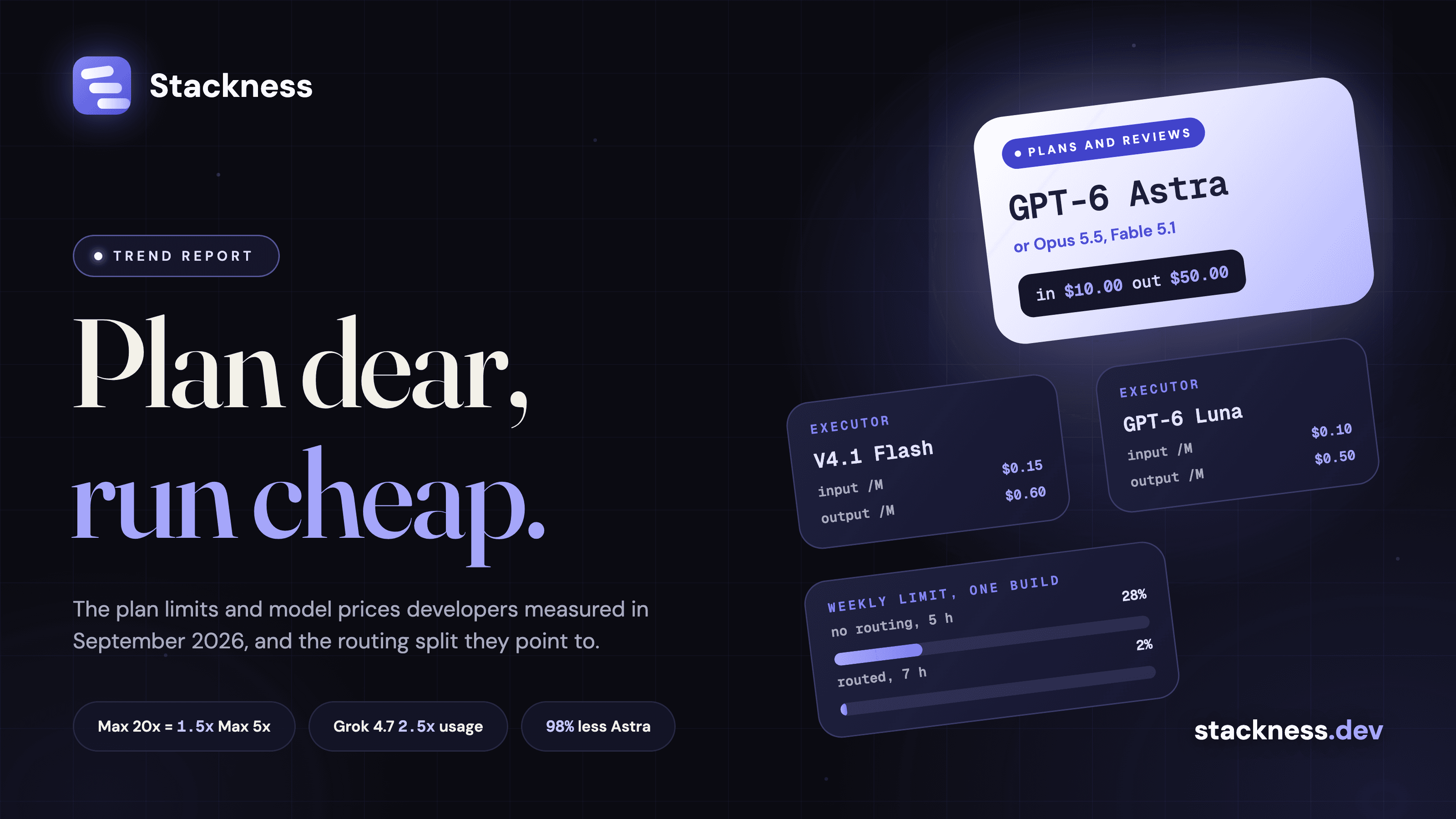
Developers cut coding agent bills in September 2026 by splitting the work. An expensive model plans and reviews, and a cheap one reads files, writes code and runs tests. The best documented setup, published on 20 September, has GPT-6 Astra plan and DeepSeek V4 Flash execute. Its author measured 98% less Astra usage and a cost per 1,000 lines of code that fell from $11.32 to about $0.30. That is one person's build, not a benchmark, but it is the clearest version of a pattern several others measured.
The pressure came from both sides in one week. On 14 September, Claude Code weekly limits dropped back from a promotion. On 22 September, Claude Opus 5.5 and GPT-6 shipped at lower prices. Below are the numbers, who measured them and how, and what breaks when the cheap model does the work. For the models on both sides of the split, see the LLMs developers keep in their stacks and which of them are trending this month.
What did developers measure about plan capacity in September 2026?
Weekly limits got tighter and less predictable, and the most expensive plans lost the most. Anthropic's promotion, which raised Claude Code weekly limits by 50%, ended on 13 September. From 14 September the limits sit 25% above the old level, a cut of about 17% from what people had got used to. One team measured Max 20x at about 1.5 times the weekly capacity of Max 5x, down from about 2.5 times in August.
| Measurement | Number | Who and how | Source |
|---|---|---|---|
| Claude Code weekly limits after 14 September | 1.25x the pre-May level, down from 1.5x | Anthropic support article | Anthropic |
| Max 20x vs Max 5x weekly capacity | 95 vs 65 session units, about 1.5x. It was 118 vs 47 on 23 August | One team's accounts, share of weekly limit used per session | r/ClaudeCode, 22 September |
| Grok 4.7 vs Grok 4.6 in Cursor | About 2.5x the usage for the same task | Minutes per 1% of the Ultra usage bar: 34 to 55 vs 101 to 133 | r/cursor, 21 September |
| Cursor tokens when the included usage ran out | Pro $20: 130M plus 160M. Pro+ $60: 1.1B plus 465M. Ultra $200: 4.2B at 81% plus 2.4B | One user's dashboard, three different months | r/cursor, 18 September |
| Codex Pro 20x | New sign-ups and upgrades paused from 10 September | News reports quoting the Codex lead | Not confirmed by an OpenAI statement |
Read the Max 20x figure with care. The post says the old ratio was "roughly 2.2×", but its own units give 2.5. The author also notes they measure Claude Code throughput only, and commenters point out that prompt caching can move the numbers a lot. The Grok test ran with the 500k context option on, which doubles Cursor's price per token. Both list prices are $2 in and $6 out per million tokens on xAI's pricing page, so whatever the gap is, it comes from how many tokens 4.7 spends.
What do the models cost per million tokens now?
The gap between a frontier model and a cheap one is now 50 to 100 times on input. That gap is what makes routing worth the setup. List prices on 25 September 2026, in dollars per million input, cached input and output tokens:
| Model | Input | Cached | Output | Typical slot |
|---|---|---|---|---|
| GPT-6 Astra | 10.00 | 1.00 | 50.00 | Planner |
| Claude Fable 5.1 | 10.00 | 0.25 | 50.00 | Planner |
| Claude Opus 5.5 | 4.00 | 0.20 | 20.00 | Planner or reviewer |
| GPT-6 Sol | 2.00 | 0.20 | 10.00 | Either |
| Claude Sonnet 5 | 2.00 | 0.20 | 10.00 | Executor |
| Grok 4.7 | 2.00 | 0.50 | 6.00 | Executor |
| Claude Haiku 4.5 | 1.00 | 0.10 | 5.00 | Executor for small tasks |
| DeepSeek V4.1 Flash, off-peak | 0.15 | 0.003 | 0.60 | Executor |
| GPT-6 Luna | 0.10 | 0.01 | 0.50 | Executor |
Sources: Anthropic, OpenAI, xAI and DeepSeek. DeepSeek doubles Flash prices during weekday peak hours. Opus 5.5 is 20% cheaper than Opus 5 on input. GPT-6 Luna costs half as much as GPT-5.6 Luna, which Simon Willison called "one of the cheapest models OpenAI have ever released". List prices are not the whole story. Anthropic notes that its newer tokenizer produces about 30% more tokens for the same text, and a cheap model that needs three attempts is not cheap.
What is the planner plus executor split, and which models fill each slot?
The planner reads the task, writes a design and splits it into briefs. Executors do the token-heavy part: searching files, writing code, running tests and reporting back. The planner then reviews each result, accepts it or sends it back. Planner tokens are few and expensive. Executor tokens are many and cheap.
The pairs people published this month:
- GPT-6 Astra plans, DeepSeek V4.1 Flash executes. In Codex, through the Astra Flash Orchestrator package and Codex Router, which lets Codex call outside models.
- Fable or Opus plan, Sonnet executes. In Claude Code, with subagents set to Sonnet.
- GPT-5.6 Sol plans, Terra subagents explore and implement, in Arize's write-up.
- Kimi K3 Max drives, with Opus 5 as a reviewing advisor. Also from Arize.
- Grok 4.6 plans, Composer 2.5 subagents execute. Among Cursor users on the $20 and $60 plans.
The agents already ship the switches. In Claude Code, opusplan uses Opus in plan mode and Sonnet for writing code. CLAUDE_CODE_SUBAGENT_MODEL sets the default subagent model, and a subagent's model field overrides it (model config docs). In Codex, agents.default_subagent_model does the same, and model_providers points a role at any OpenAI-compatible endpoint, including OpenRouter (config reference). OpenCode sets a model per agent as well.
How much does swapping the executor model save on a real build?
Between 30% and 98%, depending on how much of the work the cheap model takes and who is measuring. The 98% figure and Arize's $100 to $15 are single builds measured by the people who built them. The 70% monthly figure comes from someone who sells a router. Nobody has published a matched trial showing that quality stayed the same.
| Setup | Before | After | Measured by |
|---|---|---|---|
| Astra planner, DeepSeek V4.1 Flash executor, Codex | 28% of the weekly limit for a 5-hour build | 2% for a 7-hour build. Per 1,000 lines: $11.32 to $0.26 to $0.34 | The package author, one build, 20 September |
| Same, with Sonnet, Opus, Sol or Luna as executor | About 10% to 30% less Astra usage | The same author | |
| Daily bug-finder bot that opens a PR | About $100 per run on Opus 5 end to end | About $15 to $20 per run, routed | Arize, September |
| Whole-codebase security scan | $1,000 to $2,000 estimated on Fable 5 | About $100 with a cheap orchestrator, 50 to 60 subagents and a frontier advisor | Arize |
| Team routing by task type | $10,400 a month | $3,100 a month. PR rejection rate 12% to 11% | Bo Shen, who builds a router, July |
The Astra result depends on the price ratio. Astra costs 67 times as much as off-peak Flash on input and 83 times as much on output. Handing execution to Sonnet or Luna saved far less, because either the ratio was smaller or, by the author's account, the build "would stop frequently".
What breaks when the cheap model does the executing?
The same things that break with any delegated work, more often.
- Hallucinated code. "Flash is a really trash implementer that hallucinates," was one reply to the Astra post. Arize cites a Grok 4.5 hallucination rate that "roughly doubled", which it calls "fine for a subagent being supervised".
- Stalls. Luna and Sol as executors kept stopping mid-build in the Astra author's tests.
- Retries eat the saving. Arize: "A lower-priced model can still create a more expensive run." Unblocked makes the same point about misrouted tasks that need rework.
- The reviewer only sees what it is given. A planner that reviews a summary cannot catch what the summary leaves out.
- Cache misses. Resuming a long Claude Code session after the cache has expired reprocesses the whole context at full price. That is how one user burned a 5-hour window in under two minutes.
- No matched quality checks. Arize: "We did not run repeated, matched trials." None of the other write-ups ran one either.
How are teams pooling subscriptions?
With proxies that rotate between accounts, which may break the providers' terms. The Max 20x measurements came from a team that routes Claude reviews to whichever member's account has the most capacity left. TeamClaude pools Claude Max, ChatGPT and API accounts and rotates when one runs out. TokenLedger tracks the headroom on each account. Check the terms first. Since February 2026, Anthropic's legal and compliance page bars using Free, Pro or Max logins in third-party tools. Several people in the Max 20x thread came to a simpler conclusion: two Max 5x plans beat one Max 20x when the weekly limit is what stops you.
What does Stackness data show?
Very little yet, and I will not stretch it. As of 25 September 2026, after removing accounts that say they are bots, 4 public profiles list Claude Opus and 1 lists Claude Sonnet. One profile lists a planner-grade model, an executor-grade model and a local runtime together: Opus, Sonnet and Ollama. No profile lists GPT or Grok. Claude Code is on 9 profiles and Cursor on 8 (data sources). If you run a split like this, list both models in your stack. The tool pages then show which pairs people actually use.
Key numbers
- 98% less GPT-6 Astra usage with DeepSeek V4.1 Flash as executor, $11.32 to about $0.30 per 1,000 lines. One build, self-reported, 20 September 2026.
- 1.5x is Max 20x weekly capacity relative to Max 5x, down from about 2.5x on 23 August 2026. One team's accounts.
- 25% above the pre-May level is where Claude Code weekly limits sit from 14 September 2026, down from 50% during the promotion.
- 2.5x more Cursor usage for Grok 4.7 than Grok 4.6 on the same task, at identical list prices.
- $0.10 per million input tokens for GPT-6 Luna, half the price of GPT-5.6 Luna, from 22 September 2026.
- 67x is the input price ratio between GPT-6 Astra and off-peak DeepSeek V4.1 Flash.
- $100 to $15 to $20 per run for Arize's routed bug-finder bot.
Quick answers
How do developers cut AI coding agent costs with model routing? A frontier model plans and reviews, and a cheap model does the file reading, code writing and testing. Claude Code, Codex, Cursor and OpenCode all let you set a separate model for subagents.
How much does model routing save? Published results range from about 30% to 98% less frontier usage. The large numbers come from single builds measured by their authors, with no matched quality check.
Which model should execute? Whichever is cheap enough and does not stall on your code. This month people used DeepSeek V4.1 Flash, Sonnet 5, GPT-6 Luna, Composer 2.5 and Grok 4.6.
Is Max 20x still worth it over Max 5x? One team measured it at about 1.5 times the weekly capacity of Max 5x in September 2026, for twice the price. Several users now buy two Max 5x plans.
What is opusplan in Claude Code? A model setting that uses Opus in plan mode and switches to Sonnet to write the code. It is the simplest planner and executor split available without extra tools.
Why did my Claude Code limit disappear in minutes? Usually a cache miss. Resuming a long session after the cache expires reprocesses the full context at full price. Start a fresh session from a handoff note instead.
 Claude Code
 Claude Fable
 Claude Haiku
 Claude Opus
 Claude Sonnet
 Cursor
 DeepSeek V4
 Grok
Grok Ollama
 OpenAI Codex
 OpenCode
 OpenRouter