Kimi K3.1 Pro vs Opus 5.5 in a coding agent: price per task, speed and what the open weights change
Tools in this post


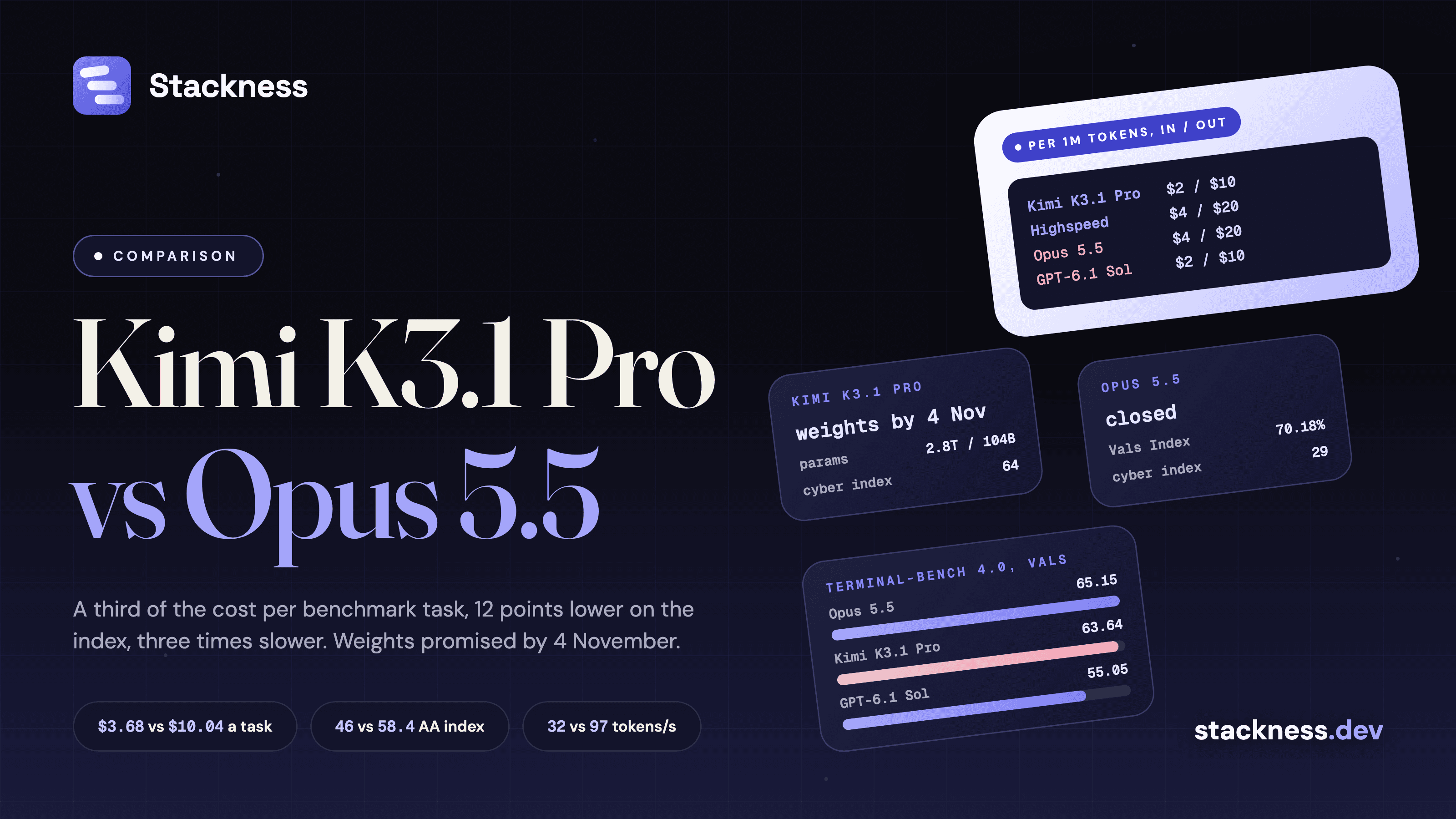
Kimi K3.1 Pro, released by Moonshot AI on 23 October 2026, costs about a third of Claude Opus 5.5 per benchmark task and scores lower. On Artificial Analysis's Intelligence Index v5.0, as of 30 October, Kimi K3.1 Pro scores 46 at $3.68 per task, Opus 5.5 scores 58.4 at $10.04, and GPT-6.1 Sol scores 54.5 at $1.27. Keep Opus 5.5 in the main slot of a coding agent if quality decides; give Kimi the long terminal runs, defensive security work and anything that has to move to your own hardware once the weights land, promised by 4 November.
Kimi K3.1 Pro vs Opus 5.5 for a coding agent, side by side
Kimi K3.1 Pro vs Opus 5.5 comes down to three rows of the table: price, independent scores and speed. Kimi charges half Opus's list price per token and used fewer tokens per benchmark task, so it cost about a third as much on both independent benchmarks. Opus scores higher on every independent general and coding index except Artificial Analysis's Terminal-Bench 4.0 run, and it streams three times faster.
| Kimi K3.1 Pro | Claude Opus 5.5 | GPT-6.1 Sol | |
|---|---|---|---|
| Input / output, per 1M tokens | $2 / $10 | $4 / $20 | $2 / $10 |
| Cached input | $0.20 | $0.20 | $0.10 |
| Context window | 1,048,576, no surcharge | 1M, no surcharge | 1,050,000; 2x input, 1.5x output over 272K |
| Fast tier | Highspeed, $4 / $20 | Fast mode, $8 / $40 | Fast $4 / $20, Ultrafast $12 / $60 |
| AA Intelligence Index v5.0 | 46.0 | 58.4 | 54.5 |
| AA cost per index task | $3.68 | $10.04 | $1.27 |
| Vals Terminal-Bench 4.0 | 63.64% at $4.57 a test | 65.15% at $13.20 | 55.05% at $1.72 |
| Measured output speed (AA) | 32.1 tokens/s | 96.6 tokens/s | 81.1 tokens/s |
| Weights | Promised by 4 November 2026 | Closed | Closed |
Prices from the Moonshot, Anthropic and OpenAI pricing pages; scores from Artificial Analysis and Vals AI; all read on 30 October 2026.
GPT-6.1 Sol is in the table as the price reference. It has the same list price as Kimi, scores higher on the Artificial Analysis index and costs a third as much per task there, because it used 64 million output tokens to run the index against Kimi's 110 million. If the only reason to leave Opus is cost, Sol is the first alternative to price.
Kimi K3.1 Pro costs a third of Opus 5.5 per benchmark task, more in Claude Code
Kimi K3.1 Pro's per-task cost is 37% of Opus 5.5's on the Artificial Analysis index and 35% on Vals AI's Terminal-Bench 4.0 run, a wider gap than the 2x list price because Kimi spent fewer tokens: 16.57 million per Terminal-Bench test against Opus's 28.27 million. In Bito's sessions inside Claude Code, the one test in a production coding agent, Kimi cost 79% of Opus.
| Who measured | Harness and task | Kimi K3.1 Pro | Opus 5.5 |
|---|---|---|---|
| Artificial Analysis | Intelligence Index v5.0, max effort | $3.68 a task | $10.04 |
| Vals AI | Terminal-Bench 4.0, mini-swe-agent, 66 tasks, 3 runs | $4.57 a test, 49 min | $13.20, 64 min |
| Bito | Its own tasks inside Claude Code, 8 long sessions | $4.28 a long session, 28.2 min | $5.42, 17.2 min |
Bito's gap is the narrowest: Kimi wrote about 98,000 output tokens per long session and took longer. Its Kimi runs were on launch day, its Opus runs earlier at the default medium effort, and Opus 5.5 also judged the results. Agent sessions are mostly cache reads, and both models charge $0.20 per million for those, so on a long, cache-heavy run the per-token gap shrinks towards the difference in output tokens.
Opus 5.5 scores higher on general and coding indexes
Opus 5.5 leads Kimi K3.1 Pro on the Artificial Analysis Intelligence Index (58.4 to 46.0), the Vals Index (70.18% to 62.52%) and Bito's Claude Code tasks (87 to 72 out of 100). Bito's verdict: "Kimi K3.1 Pro doesn't match either Claude model on agentic coding." The exception is Terminal-Bench 4.0, where the two independent runs disagree.
Artificial Analysis has Kimi ahead on Terminal-Bench 4.0, 67.2 to 59.6. Vals AI, running the bash-only mini-swe-agent harness and averaging three runs, has Opus ahead, 65.15% to 63.64%. Moonshot's own launch figure, run in the Claude Code harness, is 65.7 for Kimi against 66.4 for Opus, with the Opus number copied from Anthropic's posts or the public leaderboard. On long terminal tasks, the two are close enough that the harness decides.
Moonshot's launch post reports no SWE-bench Verified or SWE-bench Pro score; its headline coding numbers are Terminal-Bench, SWE-Marathon (51.7 against Opus's 46.3) and its internal Kimi Code Bench. Kimi scored 55 on Artificial Analysis's older index v4.3.2 at launch, fourth of 215 models. Artificial Analysis moved to v5.0 by 30 October and Kimi now sits at 46, 21st of 57 models.
Opus 5.5 streams three times faster; Highspeed narrows the gap
Kimi K3.1 Pro is the slowest of the three models: Artificial Analysis measured 32.1 output tokens per second from Moonshot's API, against 96.6 for Opus 5.5 and 81.1 for GPT-6.1 Sol. On a long agent turn that is the difference between waiting one minute and three. The Highspeed tier, kimi-k3.1-pro-highspeed, doubles the price and is sold as "2-3×" faster.
OpenRouter measured less than Moonshot claims: a one-week average of 57 tokens per second on Highspeed against 31 on the standard endpoint, about 1.8x, with end-to-end latency of 12.6 seconds against 19.2. Highspeed doubles input, cache writes and output but not cache reads. Re-pricing Artificial Analysis's per-task breakdown for Kimi at Highspeed rates gives $5.26 a task instead of $3.68, 43% more, still about half of Opus.
Kimi K3.1 Pro does defensive security work that Opus 5.5 refuses
Moonshot removed cyber-related data from K3.1 Pro's training "for the open-weight release", and says its cyber capability "remains behind that of frontier proprietary models that have been publicly available for at least three months". Moonshot's claim is about building exploits. On defensive tasks, which the Artificial Analysis Cyber Index measures and which leave exploit-building out, Kimi K3.1 Pro scored 64% through the API and Opus 5.5 scored 29%.

The Artificial Analysis Cyber Index on 23 October 2026. Screenshot of the Artificial Analysis post on X by Artificial Analysis.
Artificial Analysis reported that "Kimi K3.1 Pro encounters no safety refusals", while 36% of Opus 5.5's attempts ended in safety blocks. Moonshot's own internal test shows the removal cost something: 81.0 on its xdev-bench-hard against 90.5 for the same model trained without the removal. Whether the 4 November weights are the same checkpoint as the API model is not stated. For a security reviewer agent, Kimi is the model that finishes the task; check your provider's terms for that use either way.
The open weights move Kimi K3.1 Pro off Moonshot's API, onto a rack
Moonshot says on its launch post that "Full model weights will be released by Nov 4, 2026"; as of 30 October, the moonshotai Hugging Face organisation has no K3.1 repository. The model has 2.8 trillion parameters with 104 billion active, per Moonshot's announcement on X, and no licence has been announced. Kimi K3 shipped under an MIT-style licence with conditions for very large commercial users.
For K3, the vLLM recipe asks for "At least 8x GB300", so self-hosting is a data-centre job, not running a model on your own machine. What the weights change for most teams is the provider list: as of 30 October, OpenRouter lists only Moonshot as a provider. Third-party serving can be worse than the vendor's, as Vals found with Kimi K3 scoring 60.6% on legal tasks through Baseten against 75.8% through Moonshot, so test a new host before moving traffic.
Switching Claude Code or OpenCode to Kimi K3.1 Pro
Claude Code switches to Kimi K3.1 Pro through Moonshot's Anthropic-compatible endpoint, https://api.moonshot.ai/anthropic, with the env block of ~/.claude/settings.json per Moonshot's guide. Moonshot warns that "Configuring only some of the variables makes the corresponding scenarios fail silently": every model slot has to point at a Kimi model.
{
  "env": {
    "ANTHROPIC_BASE_URL": "https://api.moonshot.ai/anthropic",
    "ANTHROPIC_AUTH_TOKEN": "<your Kimi API key>",
    "ANTHROPIC_MODEL": "kimi-k3.1-pro",
    "ANTHROPIC_DEFAULT_OPUS_MODEL": "kimi-k3.1-pro",
    "ANTHROPIC_DEFAULT_SONNET_MODEL": "kimi-k3.1-pro",
    "ANTHROPIC_DEFAULT_HAIKU_MODEL": "kimi-k3.1-pro",
    "ANTHROPIC_DEFAULT_FABLE_MODEL": "kimi-k3.1-pro",
    "CLAUDE_CODE_SUBAGENT_MODEL": "kimi-k3.1-pro",
    "CLAUDE_CODE_AUTO_COMPACT_WINDOW": "1000000",
    "CLAUDE_CODE_EFFORT_LEVEL": "max"
  }
}
The guide's own example still names kimi-k3[1m]; its test request uses kimi-k3.1-pro, and it warns that effort below max "may reduce quality". The API unlocks only after a top-up of at least $1. Two things behave differently from Anthropic's API: cache_control markers inside messages are ignored, so caching is automatic with a five-minute default (a one-hour tier needs a top-level cache_control), and effort has three levels (low, high, max) against Opus's five. Thinking is always on, as it is on Opus 5.5. The general pitfalls of running Claude Code on another provider apply too.
OpenCode has a built-in Moonshot AI provider: opencode auth login, pick Moonshot AI, then choose kimi-k3.1-pro from /models. models.dev, which OpenCode reads its model list from, lists both kimi-k3.1-pro and the Highspeed variant. Switching back costs nothing in files. Mid-conversation switching does not work cleanly: Anthropic's thinking blocks are readable only by the model that wrote them and a few others, and the API drops the rest.
On Stackness, as of 30 October 2026, Claude Opus is on 4 real public stacks and Kimi K3 on 1, with bots removed (how I count). The LLMs developers list in their stacks are still led by the closed models.
Pick Kimi K3.1 Pro if, pick Opus 5.5 if
Pick Kimi K3.1 Pro if:
- Cost per task matters more than the last 12 points of the Artificial Analysis index.
- The agent runs long terminal tasks, where Vals AI and Moonshot have the two within two points and Artificial Analysis has Kimi ahead.
- You need defensive security work done without refusals.
- You plan to self-host or move to another provider once the weights land.
Pick Opus 5.5 if:
- The main slot does the hardest work and quality decides.
- You wait on the agent and want three times the output speed.
- You rely on Anthropic features Kimi handles differently: explicit cache markers and five effort levels.
- You use Claude Code with a Claude subscription and do not want a second provider.
If you only want a cheaper main slot, price GPT-6.1 Sol first: same list price as Kimi, a higher index score and a lower measured cost per task.
New posts by email
About one email a week with what we published. No account needed.
One email to confirm first. Every email has a one-click unsubscribe.
Which of these do you use?
Nobody on Stackness runs GPT yet. Tick what you use and be the first.