Composer 2.5 vs Grok 4.7 vs Opus 5.5 in Cursor: which slot each model keeps, priced per task
Tools in this post

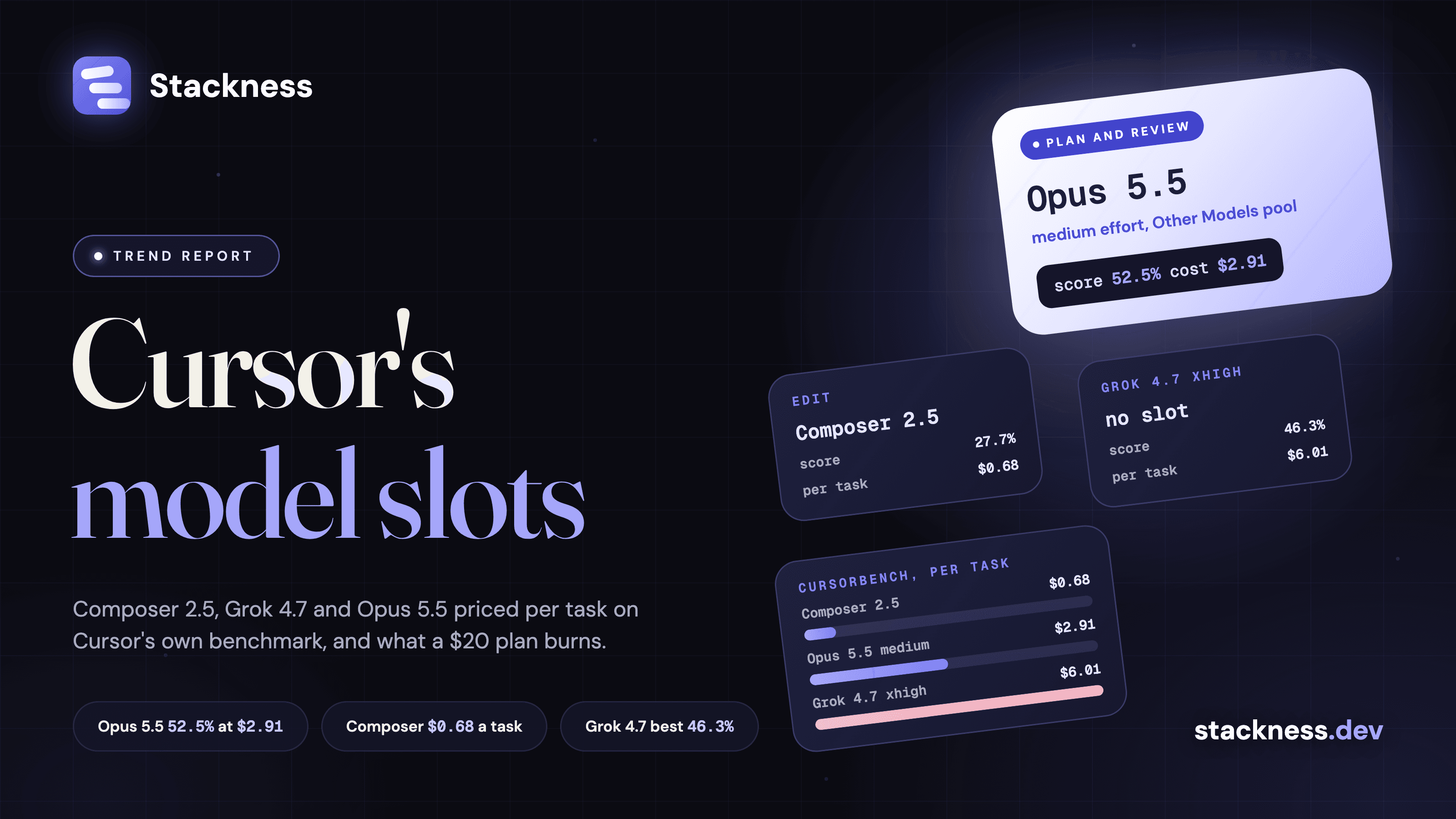
Composer 2.5 vs Grok 4.7 in Cursor, as of 5 October 2026: Composer 2.5 is the cheap editor, and Grok 4.7 loses its slot to Claude Opus 5.5 on Cursor's own benchmark. On CursorBench 4.0, Composer 2.5 scores 27.7% at $0.68 a task and Grok 4.7 scores 33.1% to 46.3% at $1.58 to $6.01. Claude Opus 5.5 at medium effort scores 52.5% at $2.91, above every Grok 4.7 setting. Grok and Composer draw from Cursor's subsidised pool, which is Grok's main argument.
The September price cut was Anthropic's. Opus 5.5 is 20% cheaper per token than Opus 5 and 60% cheaper on cache reads. Grok 4.7 kept Grok 4.6's price, and Composer 2.5's price dates from May. This follows the model routing post, which measured Grok 4.7's usage in Cursor, and the Sonnet 5.5 vs Opus 5.5 post.
What does each Cursor model cost per million tokens in October 2026?
Composer 2.5 costs $0.50 in and $2.50 out, Grok 4.7 $2 and $6, Opus 5.5 $4 and $20, per Cursor's pricing page on 5 October. Cursor makes the Fast tier the default for both of its own models, and Composer 2.5 Fast costs six times the standard input price. Opus 5.5 has the cheapest cache read of the three.
| Model | Pool | Input | Cache read | Output |
|---|---|---|---|---|
| Composer 2.5 | Cursor Models | $0.50 | $0.20 | $2.50 |
| Composer 2.5 Fast, the default | Cursor Models | $3.00 | $0.50 | $15.00 |
| Grok 4.7 | Cursor Models | $2.00 | $0.50 | $6.00 |
| Grok 4.7 Fast, default on Pro and up | Cursor Models | $4.00 | $1.00 | $12.00 |
| Claude Opus 5.5 | Other Models | $4.00 | $0.20 | $20.00 |
| Claude Sonnet 5.5 | Other Models | $2.00 | $0.20 | $10.00 |
Opus 5.5 and Sonnet 5.5 also charge $5 and $2.50 per million for cache writes. Simon Willison's table of 22 September matches these rates for Opus 5.5 and Grok 4.7.
Three billing rules change the arithmetic:
- Long context. Cursor bills Grok 4.7 at 2x once input passes 256k tokens. xAI's own API applies 2x to the whole request from a 200k prompt. The vendors disagree on the threshold.
- Token rate. On Teams and Enterprise, third-party models add $0.25 per million. Cursor's own models are exempt.
- Auto. "All Auto modes bill at the list price of the model each request is routed to."
Composer 2.5 or Grok 4.7: which one are Cursor users keeping, and why?
Composer 2.5, for execution. The r/cursor thread of 1 October is titled It seems many if not most in this sub prefers Composer over Grok, and the replies give two reasons. Composer is cheap and does scoped edits without wandering. Grok 4.7 rewrites working code and spends more tokens than 4.6. Grok keeps a smaller following as a planner and orchestrator.
| Composer 2.5 | Grok 4.7 | Opus 5.5 | |
|---|---|---|---|
| Built by | Cursor, on Moonshot's Kimi K2.5 checkpoint | SpaceXAI with Cursor, "Jointly trained" | Anthropic |
| Released | 18 May 2026 | 21 September 2026 | 22 September 2026 |
| Context in Cursor | 200k | 256k, 500k long context | 300k default, 1M max |
| Sold outside Cursor | No | xAI API and Grok Build, Fast only in Cursor and Grok Build | Anthropic API and Claude plans |
What users report, all self-reported:
- u/Phantomcloud_admin, 30 September, at extra high effort: Grok "completely recreated the button function which I not ask for and even changed it's functionality to a dropdown menu".
- u/legacyfather, same thread: it "removed the PUT method on my S3 bucket cors allowed methods list, and didn't even say anything".
- u/adidaks, 1 October: "switched the planning to Opus and execution to Composer... composer is much cheaper than Grok for execution."
- On the Cursor forum, one user measured Grok 4.7's cache hit rate at "only around 73%" over about 8M tokens, against "90-91%" on Grok 4.6.
- For Grok, u/dischernia: "Grok 4.7 as orchestrator is great very little token usage."
One known bug matters for the planner split. Cursor staff confirmed on 24 September that a subagent set to Grok 4.7 "runs on Auto instead".
SpaceX completed its acquisition of Cursor on 14 August, and OpenAI plans to cut Cursor off on 12 November and gives it no new models, so GPT-6 Sol and Luna are not in Cursor at all. CursorBench is Cursor's benchmark, and it still ranks the model Cursor co-trained below Anthropic's.
Where does Opus 5.5 still earn its price inside Cursor?
In planning, review and hard debugging, where it scores more per dollar than Grok. On CursorBench 4.0, Opus 5.5 at low effort scores 43.7% for $1.17 a task, level with Grok 4.7 at high effort, 43.9% for $4.69. Users put Opus in the planner seat and give scoped edits to Composer. On a Cursor plan it draws the Other Models pool at the API price.
CursorBench 4.0, run by Cursor, costs at list price, read on 5 October:
| Model and effort | Score | Cost per task | Points per dollar |
|---|---|---|---|
| Opus 5.5 high | 56.0% | $3.97 | 14 |
| Opus 5.5 medium | 52.5% | $2.91 | 18 |
| Sonnet 5.5 high | 47.8% | $1.67 | 29 |
| Grok 4.7 extra high | 46.3% | $6.01 | 8 |
| Grok 4.7 high | 43.9% | $4.69 | 9 |
| Opus 5.5 low | 43.7% | $1.17 | 37 |
| Grok 4.7 medium | 41.6% | $3.49 | 12 |
| Sonnet 5.5 medium | 39.2% | $0.70 | 56 |
| Grok 4.7 low | 33.1% | $1.58 | 21 |
| Composer 2.5 | 27.7% | $0.68 | 41 |
Two things follow at list price. Every Grok 4.7 setting has an Opus 5.5 setting that scores within 0.2 points or higher for less money. And Sonnet 5.5 at medium scores 11.5 points above Composer 2.5 for about the same cost per task, so Composer wins the editor seat on the subsidised pool, not on the benchmark.
Cursor's page warns that "small differences may not be statistically meaningful", does not say whether Fast or standard rates were applied, and its token counts cannot reproduce its costs unless they leave out cached input. Cursor also disclosed that Grok 4.5's training data accidentally included an earlier snapshot of the Cursor codebase, and says that data is gone from later models.
Users who pay for Opus inside Cursor describe the same split. One forum user: "After Opus reviews the code, it finds 10-15 problems in simplest features" that Grok wrote. The dissent, from u/Machine2024: no difference between Opus 5.5 and Composer 2.5 "that worth that x20 pay difference" for clear instructions. The cost shock, from u/ComprehensiveAd1855 on Ultra: three agents on Opus 5.5 over dinner left the Other Models pool 41% used.
The split, written down as a note for AGENTS.md or a team wiki (not a Cursor setting):
plan     claude-opus-5.5    medium, high for unfamiliar code
review   claude-opus-5.5    or sonnet-5.5 high, 42% of opus-5.5 high's cost per task
edit     composer-2.5       standard speed when latency allows, Fast costs about 4.7x
grok     orchestration only, and not as a subagent model until the Auto bug is fixed
What do users report burning from a 20 dollar plan in a month?
Cursor does not publish the size of either pool, so every number is a self-report. The clearest comes from u/Machine2024 on an annual Pro plan, about $16 a month: roughly 3,000 Composer 2.5 requests used 40% of the Cursor Models pool in September. A last week on Composer Fast, Grok 4.7 and Opus 5.5 took the month to 70%. His dashboard shows 1B tokens, all included.
| User, date | Plan | Models | Reported usage |
|---|---|---|---|
| u/Machine2024, 1 October | Pro, annual | Composer 2.5, then Fast, Grok 4.7, Opus 5.5 | 3,000 requests at 40%, month closed at 70%, $0 on-demand |
| u/coderlogic, 1 October | Pro, annual | Not stated | 25% of monthly tokens in the first week |
| u/Certain-Diet-10, 3 October | Pro+ $60 | Composer 2.5, Grok 4.6 | "Have yet to hit limits" |
| u/FearlessConfusion00, 28 September | Ultra | Mostly Grok 4.6 | About 3B tokens, gone in two weeks |
| u/ComprehensiveAd1855, 3 October | Ultra, €200 | Opus 5.5 | Other Models 41% used after 3 agent prompts |
A floor on that first month's value: if every one of the 1B tokens were a cache read at the cheapest rate in his mix, $0.20 per million, it would still be $200 at list price on a $16 plan. That assumes Cursor's token total includes cache reads, which the dashboard does not say. Cursor's own [sizing guide](https://cursor.com/docs/models-and-pricing) puts daily agent users at "$60-$100/mo total usage". Third-party estimates of Ultra's pool range from $200 to about $500 and do not agree with each other.
When does a Cursor subscription stop being the cheapest route to these models?
When most of your tokens go to Opus 5.5 or another third-party model. Cursor bills those from the Other Models pool at the vendor's API price, so at best it matches the API, and Claude Pro or Max with Claude Code is the usual comparison. For Composer 2.5 and Grok 4.7 Fast there is no cheaper route: neither is sold anywhere else except Grok Build.
The model, for one illustrative agent task at list price:
cost per task = uncached_in × p_in + cached_in × p_cache_read + out × p_out

task: 200k input tokens, 160k of them cached, 40k uncached, 15k output| Model | Cost per task | Tasks per $20 |
|---|---|---|
| Composer 2.5 | $0.090 | 223 |
| Grok 4.7 | $0.250 | 80 |
| Sonnet 5.5 | $0.262 | 76 |
| Composer 2.5 Fast | $0.425 | 47 |
| Opus 5.5 | $0.492, $0.532 with cache writes | 41 |
| Grok 4.7 Fast | $0.500 | 40 |
Identical token counts are not realistic, since CursorBench shows models spending very different amounts per task. The table still shows one thing: under Cursor's Fast defaults, Opus 5.5 costs about what Grok 4.7 does per task, because its $0.20 cache read undercuts Grok Fast's $1.00.
The break-even cannot be computed from official data. Cursor does not publish pool sizes, and Anthropic does not publish token allowances for Claude Pro ($20, or 17amonthannually), Max5x(100) or Max 20x ($200). Users split. u/Defensex: Claude's "$20 plan seems to give me way more work than my $200 cursor plan." u/only1nameleft: "the cursor limits are still better than claude, but it is very close". And u/huuaaang, with 52 points: "You don't use Cursor for the models. You use it for the integrated IDE."
The rule that does follow from the price pages:
mostly Composer 2.5 or Grok 4.7    Cursor Pro or Pro+, nothing else sells them cheaper
mostly Opus 5.5 or Sonnet 5.5      Cursor bills API price: compare Claude Pro or Max with Claude Code
GPT-6 Sol, GPT-6 Luna, GPT-6.1     not in Cursor: OpenAI API or Codex
GPT-5.6 inside Cursor              loses access on 12 November 2026, per OpenAI
On Stackness, as of 5 October 2026, 8 real profiles list Cursor and 8 list Claude Code, and 4 list both. Five list Claude Opus, 3 of them alongside Cursor, and none lists Grok (data sources). The numbers are small. The LLMs developers are adding on Stackness show the momentum.
Key numbers
- 27.7% at 0.68 * *ataskforComposer2.5, * * 46.36.01 for Grok 4.7 extra high and 52.5% at $2.91 for Opus 5.5 medium on CursorBench 4.0, read 5 October 2026 (Cursor).
- $0.50 / 2.50 * *, **2 / 6 * *and * *4 / $20 per million input and output tokens for Composer 2.5, Grok 4.7 and Opus 5.5 in Cursor, 5 October 2026 (pricing).
- 6x: Composer 2.5 Fast's input price against standard, and Fast is the default.
- 3,000 Composer 2.5 requests for 40% of the Cursor Models pool on an annual Pro plan, September 2026, self-reported (r/cursor).
- 12 November 2026: OpenAI's shutoff date for its models in Cursor (OpenAI).
- 8 real Stackness profiles list Cursor, 4 of them alongside Claude Code, and 0 list Grok, as of 5 October 2026 (data sources).
Quick answers
Composer 2.5 vs Grok 4.7 in Cursor: which is better? For scoped edits, Composer 2.5: it costs $0.68 a task on CursorBench 4.0 and users report it stays on task. Grok 4.7 scores higher, 33.1% to 46.3% against 27.7%, but Opus 5.5 beats every Grok setting for less money on the same benchmark.
Did Cursor cut model prices in September 2026? Not for its own models. Grok 4.7 launched at Grok 4.6's price and Composer 2.5's price dates from May. The cut was Anthropic's: Opus 5.5 is 20% cheaper per token than Opus 5.
How much does a $20 Cursor plan get you? Cursor does not say. One annual Pro user reports about 3,000 Composer 2.5 requests for 40% of the Cursor Models pool in a month, with 1B tokens included and nothing billed on demand.
Is Opus 5.5 cheaper in Cursor or in Claude Code? Per token it costs the same: Cursor bills Opus 5.5 at Anthropic's API price, plus $0.25 per million on Teams. Whether a Claude subscription goes further depends on limits neither company publishes.
Can I use GPT-6 in Cursor? No. OpenAI stopped providing new models to Cursor after the SpaceX acquisition, and its GPT-5.6 models are scheduled to leave on 12 November 2026.
Tools in this post


 and 1 more from this post
Use any of these tools?
Put them on a Stackness profile, say how you use each one and see who pairs them the same way. It takes a couple of minutes.