Manage multiple coding agents from one workspace: Orca, Offrun, Pi pod and four other options compared
Tools in this post


As of 12 October 2026, seven options cover the distinct ways to manage several coding agents from one workspace, out of 73 agent management tools on the community list agentmgmt.dev. Two of them launched on Hacker News this month, Pi pod on 2 October and Offrun on 3 October, and Orca passed 90,000 GitHub stars. For the common case, two or more agents such as Claude Code and OpenAI Codex on one laptop, the pick is Orca: MIT-licensed, on macOS, Windows and Linux, with a git worktree per agent and each account's usage limits on one screen.
An agent fleet console sits above the harness, the worktree and the sandbox
An agent fleet console is the screen that lists every coding agent you have running, shows which one is working, waiting for you or done, and lets you jump into any of them. It launches the harness you already use instead of replacing it. Offrun's FAQ puts it in one line: "Does Offrun replace Claude Code or Codex? No. It runs them."
Each layer under the console is a separate choice:
| Layer | Job | Examples |
|---|---|---|
| Harness | Runs the model loop and the tools | Claude Code, Codex, OpenCode, pi |
| File isolation | Gives each agent its own checkout and branch | Git worktrees |
| Execution isolation | Limits what the agent's commands can reach | Claude Code's Bash sandbox, containers, VMs |
| Fleet console | Shows state across agents, sometimes quota | Orca, Offrun, Herdr, Conductor |
A quota view, each account's session and weekly limits, is a fifth and smaller piece. The coding agent harness post covers the bottom layer, and the govern agent fleets move the rules a team sets on top.
What does a fleet console add over git worktrees?
A fleet console adds state, and git worktrees add separate files. git worktree add gives each agent its own branch and working directory on one repository, so two agents stop overwriting each other's edits. A worktree does not tell you which agent stopped at a permission prompt, which one finished or which account ran out of its weekly limit, and it is a directory boundary, not a security boundary.
Claude Code's worktree docs add that a worktree is a fresh checkout without your .env files. Most consoles detect a blocked agent by reading the screen: Herdr's docs mark an agent blocked only when the screen matches a known approval or question prompt, and an unknown prompt "may initially show as idle instead of blocked". Unless the agent reports its own state, a console guesses from the terminal.
I run Stackness tasks in up to four worktrees, each with its own Postgres database, Redis database and ports and its own Claude Code session, the git worktrees for parallel task execution move. The worktrees keep the sessions out of each other's files. Seeing which one waits on me is the console's job.
Do developers run more than one coding agent at once?
Many developers use several AI coding tools, but no published source has measured how many run several agent sessions at the same time. In the Pragmatic Engineer's 2026 tooling survey of 906 newsletter readers, fielded in January and February, 70% said they use two to four AI tools and 15% five or more. Using four tools is not the same as running four agents in parallel.
JetBrains' agent adoption research and the Stack Overflow 2026 survey report each agent's share and ask nothing about parallel use, and I found no vendor figure.
On Stackness, as of 12 October 2026, 13 real profiles list at least one coding agent and 6 of them list two or more, mine included (data sources). Four of the six pair Claude Code with Cursor. None lists Orca, Offrun or Conductor. The numbers are small, and listing two agents does not mean running them at once. The agents sit in the AI coding tools developers list.
How I picked the seven
I kept fleet consoles that shipped a release in the last two months and show adoption in stars or installs, one per shape: the three launches, Anthropic's own view, a commercial Mac app, a terminal multiplexer and the do-it-yourself baseline. agentmgmt.dev, run by Manuel Meurer, went from 68 tools on 3 October to 73 on 12 October, so the list moves weekly.
I left out Vibe Kanban, whose company shut down in April 2026, and live projects such as Paseo and Superset that repeat a shape already here. Stars and releases are from the GitHub API on 12 October.
Seven ways to run coding agents side by side
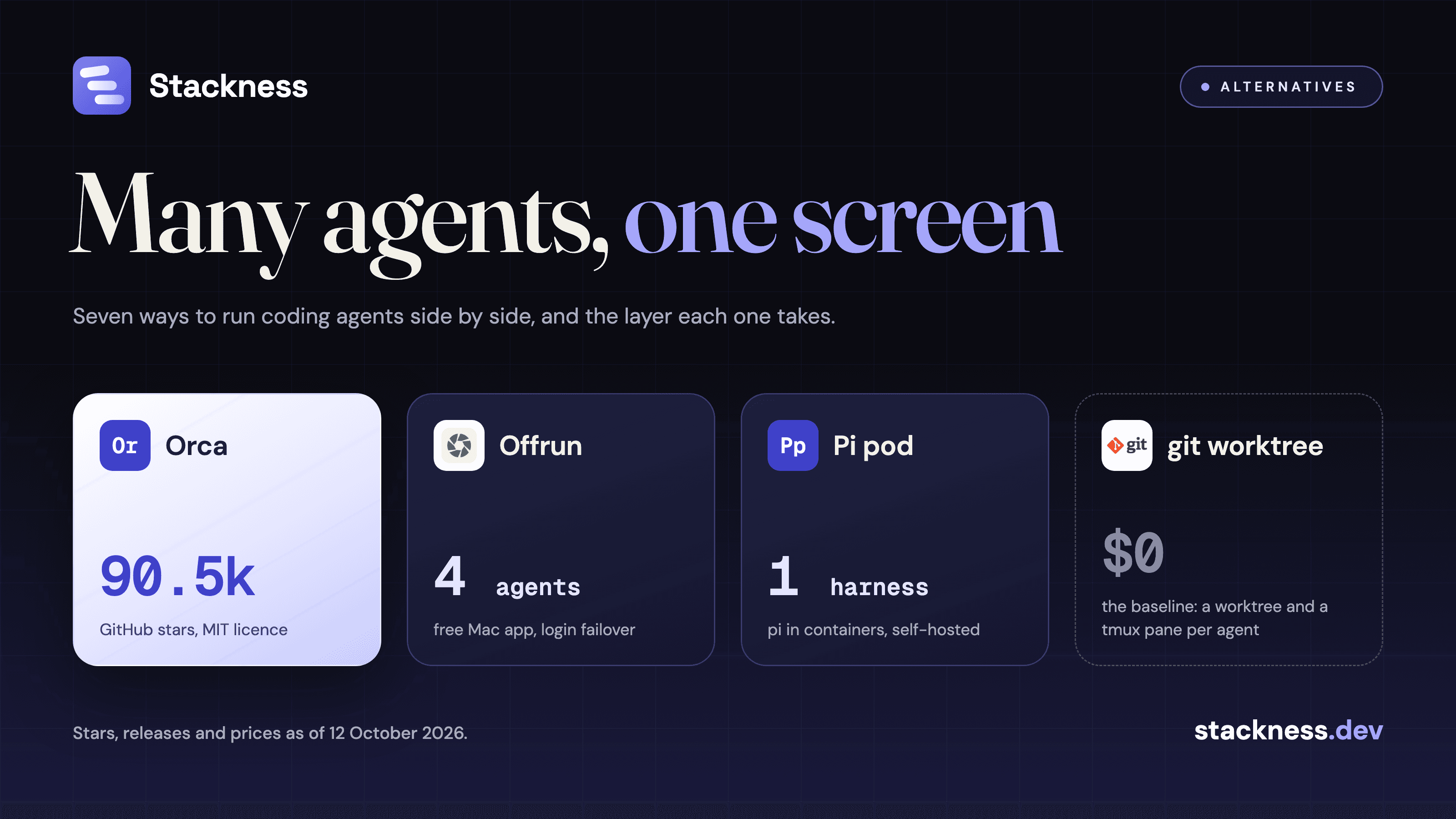
The seven are Orca, Offrun, Pi pod, Claude Code's agent view, Conductor, Herdr and plain worktrees with tmux. They differ in which harnesses they run, whether they isolate execution or only files, and whether they show quota.
Orca
- Runs: any CLI agent; the README names Claude Code, Codex, Cursor, GitHub Copilot, OpenCode, pi, Grok and about 30 more
- Isolation: a git worktree per task; SSH hosts;
orca servein beta; cloud VMs on Vercel Sandbox, Fly, Modal or Docker, marked experimental - Quota view: yes, 5-hour, daily and weekly windows for 11 providers, with account switching
- Licence and price: MIT, free; macOS, Windows and Linux, plus iOS and Android companions
- Latest: v1.4.224, 10 October; 90,520 stars
Orca is a desktop agent development environment from Stably AI, a Y Combinator company: terminals, VS Code's editor, a browser and a diff viewer around your agents. Its usage tracking warns at 80% of a window, and its costs come from a local price table, "not the provider's bill". Telemetry is on by default, with an opt-out.
When to pick it: you run two or more different harnesses on one machine and want status and quota in one window. The agent development environment post covers the category.
Offrun
- Runs: Claude Code, Codex, the Google Antigravity CLI and Grok Build; pi and OpenCode announced
- Isolation: a git worktree per agent, under
.worktreesin the repo - Quota view: yes, session and weekly usage per login, and a chat moves to a login with room left when one hits its limit
- Licence and price: proprietary, free; Apple Silicon Macs on macOS 14 or later
- Latest: 6.1.0, 4 October
Offrun is a Mac app from Founderly, Inc., renamed from Offloop on 25 September. Its maker wrote on Hacker News that other tools focus on the agent in the loop and Offrun on the human in the loop. Windows, Linux, a cloud version, a mobile app and Herdr integration are announced, not shipped. The download page says Apple Silicon only; the maker wrote on the same thread that Intel works too.
When to pick it: you hold several subscriptions per agent and want the app to fail over between logins.
Pi pod
- Runs: pi only, one pinned version
- Isolation: one container per session on your own Linux server; "the isolation boundary is the host kernel"
- Quota view: no; its status shows where a pod's files are, not whether the agent is blocked
- Licence and price: AGPL-3.0, free to self-host; the hosted service is "coming soon"
- Latest: v0.1.18, 12 October; 159 stars; 1,502 npm downloads of the CLI in the week to 11 October
Pi pod is a self-hosted server, sandbox service and CLI from one developer, launched on Hacker News on 2 October. The server needs a Linux host with 8 GB of RAM and Docker Compose. Its docs warn that any code in a pod can read the pod's API keys and OAuth tokens, and the phone apps ship as source only. Pi pod is an execution layer for one harness, not a console across several; the durable agent harness post covers pi itself.
When to pick it: you run pi and want its sessions off your laptop, on a machine you control.
Claude Code agent view
- Runs: Claude Code sessions only; other tools join as MCP servers
- Isolation: a dispatched session moves into a worktree under
.claude/worktrees/before it edits; optional Bash sandbox, Seatbelt on macOS and bubblewrap on Linux - Quota view: no;
/usageshows the current account only - Licence and price: proprietary, included with Pro, Max, Team, Enterprise and API access
- Latest: Claude Code 2.1.296, 9 October; research preview since 11 May
claude agents opens one screen for every background Claude session, with needs input and ready for review grouped above working, and claude agents --json hands the same state to scripts (docs). The view reads state from the harness itself, so it does not guess from the screen.
When to pick it: every agent you run is Claude Code.
Conductor
- Runs: Claude Code, Codex, Cursor and OpenCode
- Isolation: a branch, worktree and run environment per workspace; local agents run without a sandbox; cloud workspaces run in Vercel Sandbox
- Quota view: none in the docs
- Licence and price: proprietary; free locally, Pro $50 a month, Teams $60 a user a month (pricing); Mac only
- Latest: 0.90.0, 2 October
Conductor is a Mac app from Melty Labs. Its cloud workspaces (8 vCPU, 16 GB of RAM) keep running after the laptop closes, and the Pro tier pays for their hours.
When to pick it: a team on Macs that wants hosted sandboxes and shared workspaces.
Herdr
- Runs: integrations for 18 agents, among them pi, Claude Code, Codex, Copilot CLI, OpenCode and Cursor Agent; any other CLI in a pane
- Isolation: optional worktrees and remote machines over SSH; no sandbox
- Quota view: none in the docs
- Licence and price: Apache-2.0, free; Linux and macOS, Windows in beta
- Latest: v0.9.3, 29 September; 43,607 stars; 18,239 Homebrew installs in 30 days
Herdr is a terminal multiplexer that reads each pane and marks every agent working, blocked, idle or done. It ships as one Rust binary that runs in your own terminal, and agents can drive it through its CLI and socket API. The first question under Offrun's launch was how it differs from Herdr.
When to pick it: you live in the terminal, work over SSH or run Linux.
Git worktrees and tmux
- Runs: anything
- Isolation:
git worktree addper task and a tmux pane per agent - Quota view: none
- Licence and price: open source, free
- Latest: Claude Squad v1.0.20, 20 August, wraps this setup in a TUI (AGPL-3.0, 8,592 stars), and dmux does the same under MIT
Claude Code's docs suggest this baseline for sessions you start yourself, and pi's homepage suggests it in place of sub-agents. Sessions survive a detach, and any state you want to see, you script.
When to pick it: two or three agents you can keep track of without another app.
Sandboxes and quota views are separate choices from the console
A sandbox limits what an agent's commands can reach, and a quota view shows how much of each account's limit is left. Neither comes with every fleet console. Execution isolation works at three levels: per command, as in Claude Code's Bash sandbox; per session container, as in Pi pod; and per workspace VM, as in Conductor's cloud and Orca's experimental cloud VMs.
Containers share the host kernel, as Pi pod's docs say. For quota, only Orca and Offrun build it in, and everyone else pairs a console with CodexBar, a Mac menu bar app (MIT, 22,416 stars) with countdowns for each provider's session and weekly windows, or ccusage, which reads Claude Code's local logs and had 324,715 npm downloads in the week to 11 October.
The seven side by side
The seven split on two questions: do they run more than one harness, and do they show quota. Only Orca and Offrun do both, and only Orca does it on three desktop platforms under an open source licence.
| Option | Harnesses | Isolation | Quota view | Licence | Platforms | Price |
|---|---|---|---|---|---|---|
| Orca | Any CLI agent | Worktree, SSH, cloud VM (experimental) | Yes, 11 providers | MIT | macOS, Windows, Linux | Free |
| Offrun | 4, two announced | Worktree | Yes, per login, with failover | Proprietary | Apple Silicon Mac | Free |
| Pi pod | pi | Container on your server | No | AGPL-3.0 | Linux server | Free to self-host |
| Claude Code agent view | Claude Code | Worktree, Bash sandbox | Own account, via /usage |
Proprietary | Where Claude Code runs | Claude plan or API |
| Conductor | 4 | Worktree, cloud sandbox | No | Proprietary | Mac | Free, Pro $50 a month |
| Herdr | 18 integrations, any CLI | Optional worktree, SSH | No | Apache-2.0 | Linux, macOS, Windows beta | Free |
| Worktrees and tmux | Any | Worktree | No | Open source | Any | Free |
Which one for which setup
- Two or more harnesses on one laptop: Orca.
- Several logins per agent on an Apple Silicon Mac: Offrun, for the login failover.
- Only Claude Code: its own agent view,
claude agents. - Terminal, SSH or Linux: Herdr, plus CodexBar or ccusage for quota.
- pi on a server you own: Pi pod, on a machine of its own.
- A Mac team that wants hosted sandboxes: Conductor Pro.
- Two or three agents and no new app: git worktrees and tmux, or Claude Squad on top.
Tools in this post
 Git
Git Herdr
Herdr Cursor
 Conductor
 Vibe Kanban
 Paseo
Paseo Superset
 Google Antigravity
 dmux
dmux CodexBar
 ccusage


 and 16 more from this post
Use any of these tools?
Put them on a Stackness profile, say how you use each one and see who pairs them the same way. It takes a couple of minutes.