What is an agent development environment, and does it take the IDE slot or sit beside it?
An agent development environment (ADE) is an app built around tasks that coding agents run, not files you edit. Each task gets an agent, its own git worktree or sandbox, a terminal and a diff to review. Warp introduced the term in this sense on 24 June 2025, and by September 2026 at least eight products describe themselves that way. JetBrains Air is one of them, and its 22 September 2026 announcement was mostly a rebrand.
The open question for your stack is whether an ADE replaces the IDE or sits beside it. The vendors disagree, JetBrains changed its own answer between March and September, and on Stackness no real profile lists an ADE yet.
What is an agent development environment, and how is it different from an IDE?
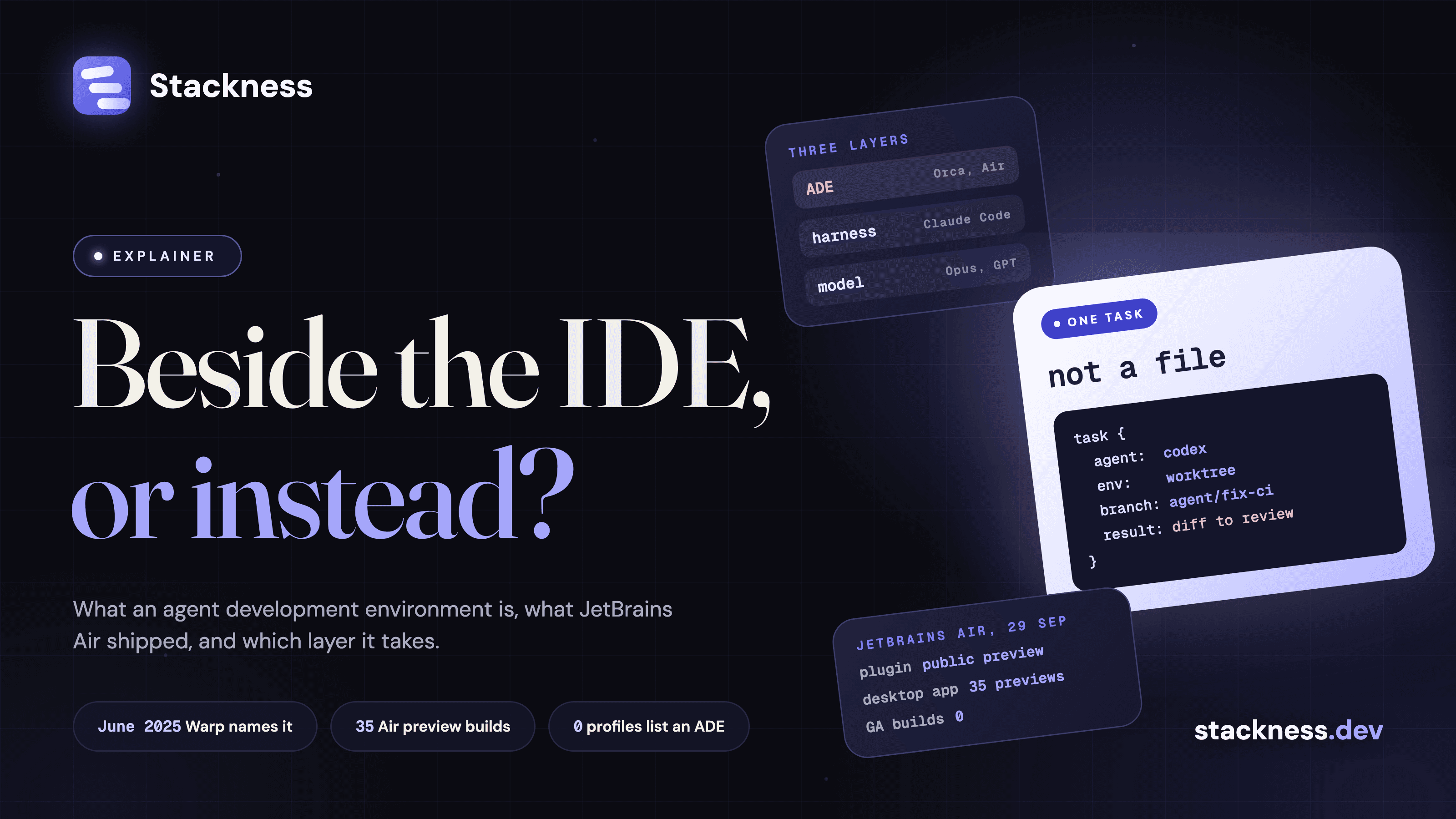
An IDE is organised around a file you edit. An ADE is organised around a task an agent runs: Superset puts it as "the primary object is a task with an agent, an environment, a branch, and a result". Your job moves from typing to assigning work and reviewing it. Most ADEs still include an editor, as an escape hatch rather than the main screen.
The term has two meanings, which is why search results mix them:
| Date | Who | What they meant |
|---|---|---|
| September 2024 | Letta | A visual tool for building and debugging agents |
| 24 June 2025 | Warp 2.0 | "The first Agentic Development Environment", for coding with agents |
| 9 March 2026 | JetBrains Air | "An agentic development environment for delegating coding tasks to multiple AI agents" |
| By June 2026 | Orca | "Agent Development Environment (ADE)", replacing "the worktree IDE" |
| 22 September 2026 | JetBrains | Air becomes "a system of products" that "cannot be just another agent or development environment" |
The coding sense now dominates, but not every project filed under it belongs there. Of the five that surfaced in developer feeds in the same week as JetBrains' announcement, only Orca calls itself an ADE. Rune is "a full-featured IDE and terminal multiplexer" with its own agent. RocketRide is an AI data-pipeline engine that calls itself an "AIDE". AgentVerse-OS is a container setup with two commits.
How does an ADE differ from a coding agent harness?
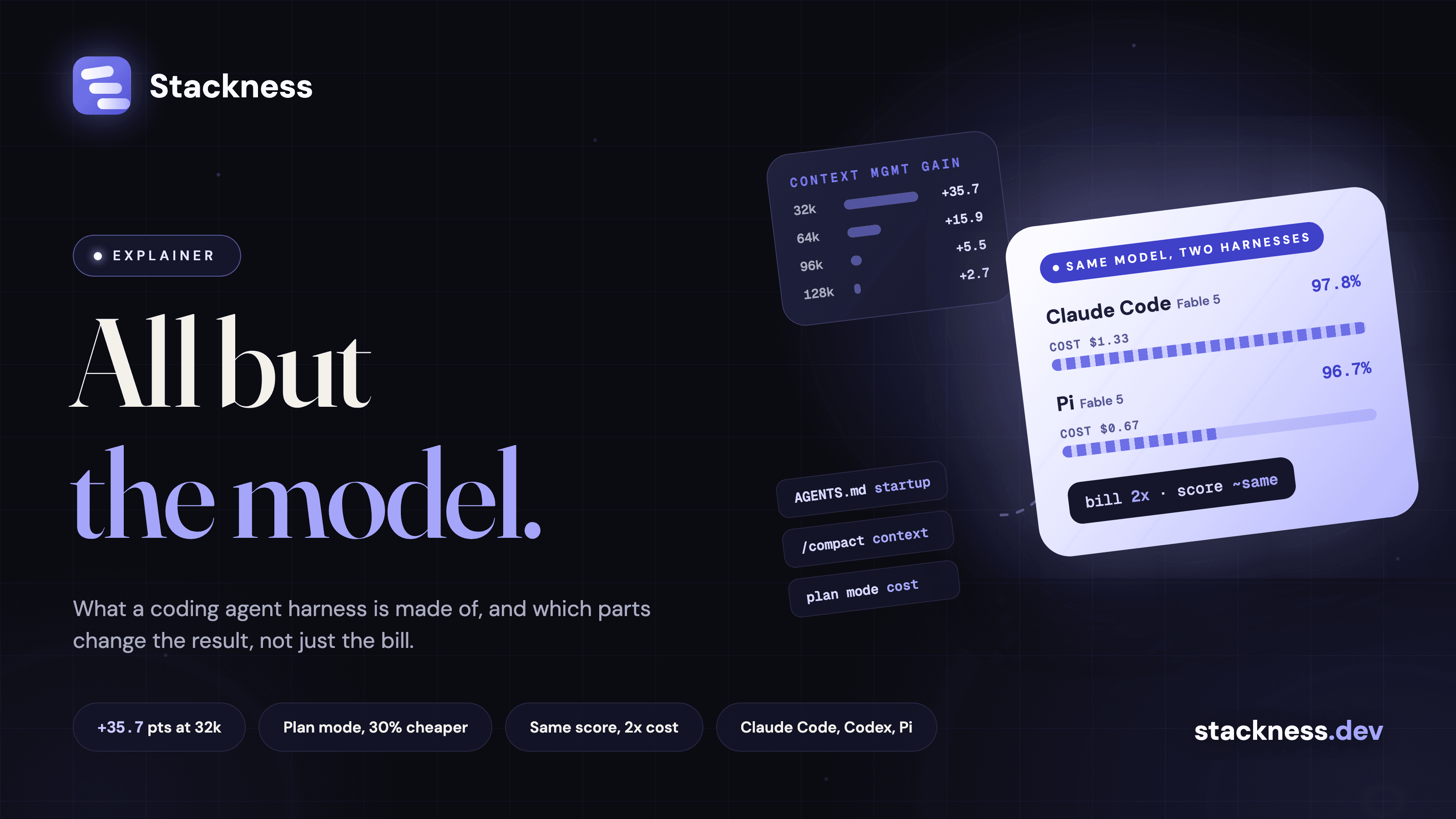
The harness is the loop around a model. Claude Code, Codex and OpenCode decide what the model sees, which tools it calls and when work continues. An ADE runs one or more harnesses. It creates the worktree, keeps a terminal attached to each task and shows you the diff. Model, harness and ADE are three layers.
Superset gives an example: "Codex decides which files to change and commands to run. Superset creates the worktree, keeps the terminal and workspace attached to the task, and presents the diff for review." JetBrains draws the same line: in Air, "you choose the harness and configure it with a model". The harness post covers why that inner layer changes results. The research on harnesses, from Birgitta Böckeler to two recent arXiv papers, does not mention ADEs at all.
Some products bundle layers. Warp has built-in agents, Rune ships its own, and JetBrains has Junie. The layer matters for billing, too. Anthropic's terms do not let a third party route requests through a user's Claude Pro or Max plan, and JetBrains' docs say its Claude agent needs Anthropic API billing.
What did JetBrains Air announce on 22 September, and what is still a claim?
Mostly a rebrand. "Air" went from the name of one standalone preview app to an umbrella for several products, three of them renamed. The lead product for individuals is a free public-preview plugin that runs agents inside JetBrains IDEs, and it has been available since 6 August. The announcement has no prices, platforms or dates, and says some products "will be introduced as the system develops".
| Product | Formerly | Status on 29 September 2026 |
|---|---|---|
| Air in JetBrains IDEs | The "Air Alpha" plugin | Public preview. Free plugin, 6,795 downloads, rated 4.06 by 18 users |
| Air Teams | Named in March | Business customers only, no published price |
| Air Governance | JetBrains Central | Early access. Business tier $20 per seat per month, free during early access |
| Air Gateway | JetBrains Central CLI | Early access. Runs Claude Code, Codex and Junie CLI "through one JetBrains account", on JetBrains AI credits |
| Air Context | JetBrains Context | Early access, free. Claims "up to 68% agent turn savings" with no method published |
| Mobile, cloud runs | New | "Coming soon", and a gradual rollout |
JetBrains has stopped promoting the standalone desktop app, without saying it is discontinued. Its release API lists 35 preview builds since 1 December 2025, the latest on 28 September, and no general release. air.dev now redirects to a page with no desktop download, and the Air Teams post says "developers don't need another standalone app".
The Claude story is the other gap between claim and product. On 19 August JetBrains published "New in Air: Claude Subscriptions", then retitled the post without that section by 24 August. On the Hacker News thread (74 points, 120 comments), a JetBrains product person wrote that they "hit a hard stop with Anthropic". It was the most repeated complaint in the thread.
Does an ADE replace your editor or sit beside it?
Mostly beside. JetBrains in March, Augment, Superset, OpenAI's Codex app and Google Antigravity all describe a hand-off to your editor for the work an agent should not do alone. Warp 2.0, Orca and Lanes pitch the ADE as a replacement. JetBrains moved in September from "beside the IDE" to "inside the IDE".
| Position | Who | In their words |
|---|---|---|
| Beside | JetBrains, March 2026 | "Air handles the agent-powered development; your IDE handles the rest" |
| Beside | Superset | "The practical setup is often an IDE plus an ADE" |
| Beside | Google Antigravity | Separate Manager and Editor windows, with "instantaneous handoffs" |
| Replace | Warp 2.0 | "No reason to spend your day in an interface built for hand-editing code" |
| Replace | Orca | "Is Orca a Cursor alternative? Yes" |
| Inside | JetBrains, September 2026 | "Bringing the foundational agentic experience into JetBrains IDEs" |
Augment Code adds a threshold: an ADE pays off at "tasks that touch 10+ files or 2+ repos, or require 3+ parallel agents". It publishes no data for that number.
On Stackness, as of 29 September 2026, 8 real public profiles list a terminal coding agent: Claude Code, Codex or OpenCode (data sources). Four of them also list an editor from the editors and IDEs developers list on Stackness, such as Cursor or VS Code. I am one of those four. The other four list no editor at all, and none of the eight lists an ADE. A stack shows what someone chose to show, so a missing editor may only mean it was not worth listing. People list agents, and nobody lists an ADE yet.
Which parts of the stack does an ADE absorb: terminal, CI, or review?
The terminal, the worktree and the first pass of review. Every ADE in this post embeds a terminal and gives each task its own worktree or sandbox. Most add a diff view where your comments go back to the agent. None claims to replace a CI system. They read your checks and hand failures back to the agent.
| Layer | Absorbed? | Evidence |
|---|---|---|
| Terminal | Yes | Orca ships xterm and node-pty in its code. Air runs CLI agents in an editor tab |
| Worktrees and sandboxes | Yes, the core feature | Orca, Air, the Codex app and Conductor give each task a worktree |
| Review | Partly | Line comments on diffs in Orca, the Codex app and Air |
| CI | Reads it | Orca reads GitHub checks. Conductor shows "CI and status checks" |
| Issue tracking | Connects to it | Orca has Linear, Jira and GitHub clients in its code |
| Editor | Kept as a fallback | Orca bundles the Monaco editor |
The Orca rows come from reading its code, not from running it, so they show that a feature exists, not how well it works.
What do you need in place before an ADE is worth adding?
Tests and CI the agent can run, an isolation boundary you trust, an instruction file, and time to review. An ADE runs more agents at once, and each one still needs checking. Superset's own advice: "You probably do not need one if you run a single coding agent occasionally and review every edit as it happens."
- Fast feedback. The 2025 DORA report, a survey of nearly 5,000 professionals, found that "AI doesn't fix a team; it amplifies what's already there". Without "strong automated testing" and "fast feedback loops", more change volume means more instability.
- A real sandbox. Orca pre-fills
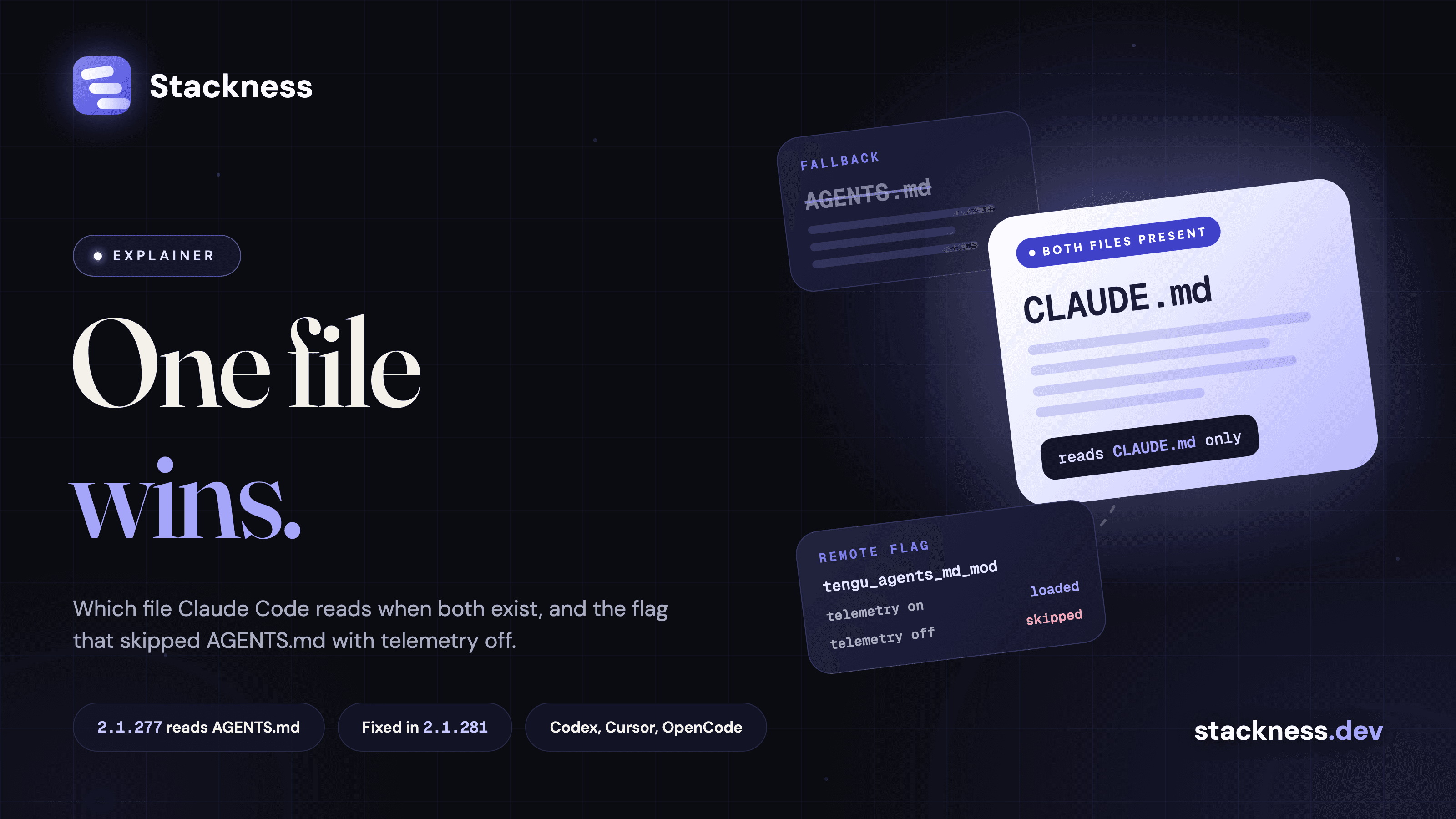
--dangerously-skip-permissionsfor Claude and the equivalent flag for other agents on every new launch, because "worktrees are disposable". Its repository docs add: "A worktree is an isolated checkout, not a security sandbox." Switch to manual permissions or run agents in a container. - An instruction file. Every agent in an ADE reads the repository's instructions first. The AGENTS.md vs CLAUDE.md post covers which file each one reads.
- Review capacity. Simon Willison: "the natural bottleneck on all of this is how fast I can review the results." JetBrains says the same in its announcement: "Code becomes cheaper to generate but more expensive to verify."
Key numbers
- 24 June 2025: Warp 2.0 launches as "the first Agentic Development Environment" (Warp).
- 22 September 2026: JetBrains turns Air into a family of products and renames 3 existing ones.
- 35 preview builds of the standalone Air app since 1 December 2025, and 0 general releases (JetBrains release API, 29 September 2026).
- 6,795 downloads of the Air plugin, rated 4.06 by 18 users (JetBrains Marketplace, 29 September 2026).
- 81,486 GitHub stars for Orca, created 17 March 2026 (29 September 2026).
- 4 of 8 real Stackness profiles with a terminal coding agent list no editor, and 0 list an ADE, as of 29 September 2026.
Quick answers
What is an agent development environment? An app built around tasks that coding agents run, each with its own worktree or sandbox, a terminal and a diff to review. An IDE is built around the file you edit.
Is an ADE the same as an agentic IDE? Not quite. An agentic IDE adds agents to an editor. An ADE puts the agent's task at the centre and keeps an editor on the side. Some vendors use the two terms interchangeably.
Is JetBrains Air an IDE? Air is now a family of products. Its lead product is a free plugin for JetBrains IDEs, and the standalone desktop app is still in preview with no general release.
Can I use my Claude subscription in JetBrains Air? Not for the built-in Claude agent. JetBrains' docs say it needs Anthropic API billing, and JetBrains staff said Anthropic's policies blocked subscription support.
Do I need an ADE? Not if you run one agent and review each edit as it happens. It starts to pay when you regularly run two or more agents on one repository and lose track of their branches.
Who coined the term ADE? In the coding sense, Warp on 24 June 2025, as far as I can find. Letta used "Agent Development Environment" earlier for a tool that builds and debugs agents.
 Augment Code
 Claude Code
 Conductor
 Cursor
 Google Antigravity
 JetBrains Air
 Junie
Junie Letta
Letta
 OpenAI Codex
 OpenCode
 Orca
Orca Rocketride
 Rune
Rune Superset
 Visual Studio Code
 Warp
Warp