Microsoft-Decision-1 vs Jev: price per decision, latency, accuracy and what switching costs


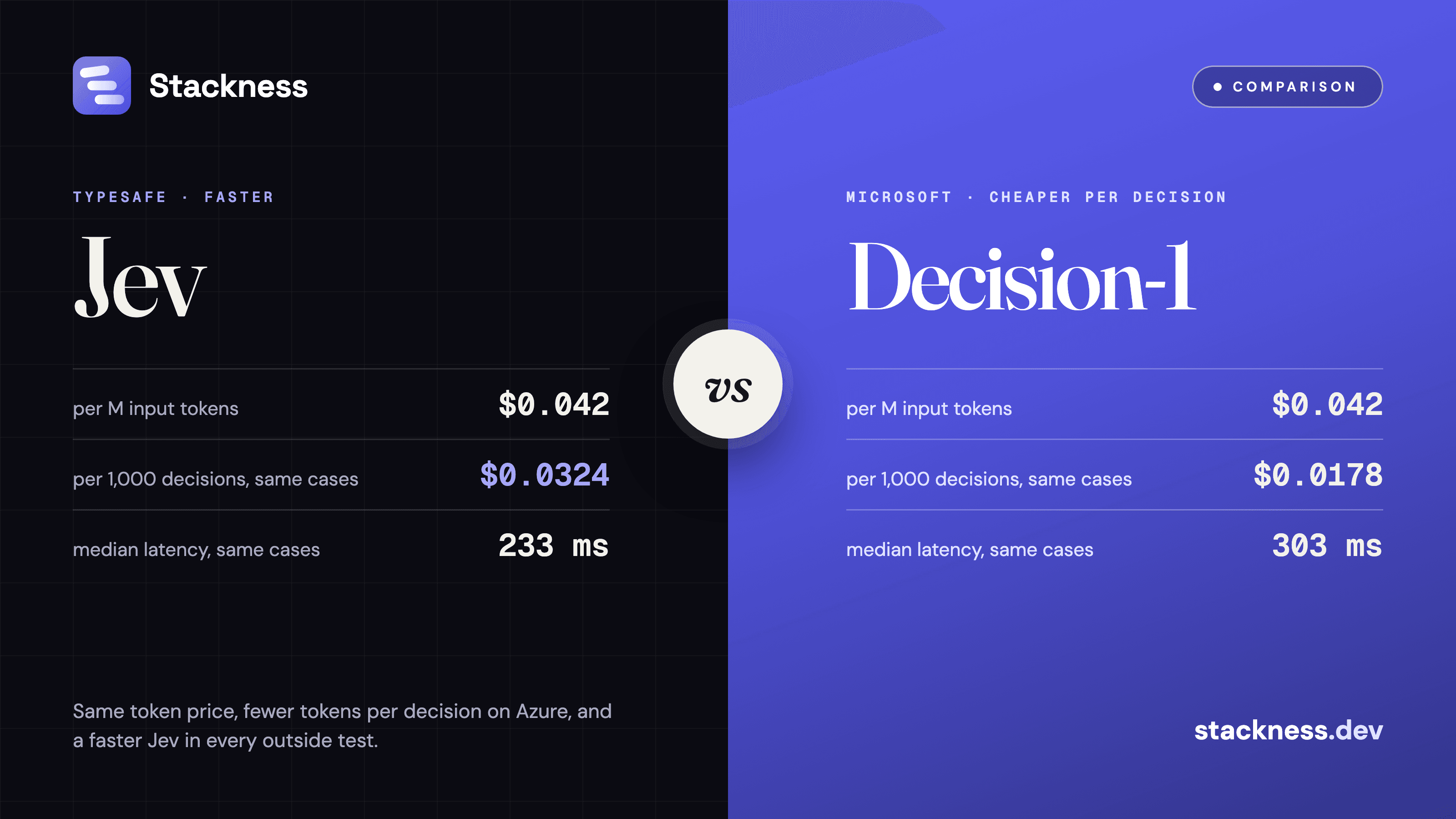
As of 17 October 2026, keep Jev when latency matters, and pick Microsoft-Decision-1 when you already run on Azure, need inference kept in an Azure data zone, or pay mostly per decision. Both list $0.042 per million input tokens with free output, but Azure counts fewer tokens for the same request: on one 500-case harness, Microsoft-Decision-1 cost $0.0178 per 1,000 decisions against $0.0324 for Jev. Jev answered faster in every independent test. Accuracy is close: the larger independent indexes put Jev a few points ahead, and the one controlled head-to-head could not separate them.
Microsoft-Decision-1 vs Jev vs OpenAI Decisions at a glance
Microsoft-Decision-1 joins Jev, launched on 15 September, and the OpenAI Decisions API, in public beta since 6 October, in the same slot. It copies Jev's request format and price, has half Jev's default context and no image input, and is listed as Preview in Microsoft Foundry.
| Microsoft-Decision-1 | Jev (TypeSafe AI) | OpenAI Decisions API | |
|---|---|---|---|
| Status | Preview in Foundry, launched 9 October | jev-1.13.0 and jev-1.14.0 | Public beta since 6 October |
| Endpoint | POST {resource}/providers/microsoft/v1/systemone |
POST /v1/systemone |
POST /v1/decisions |
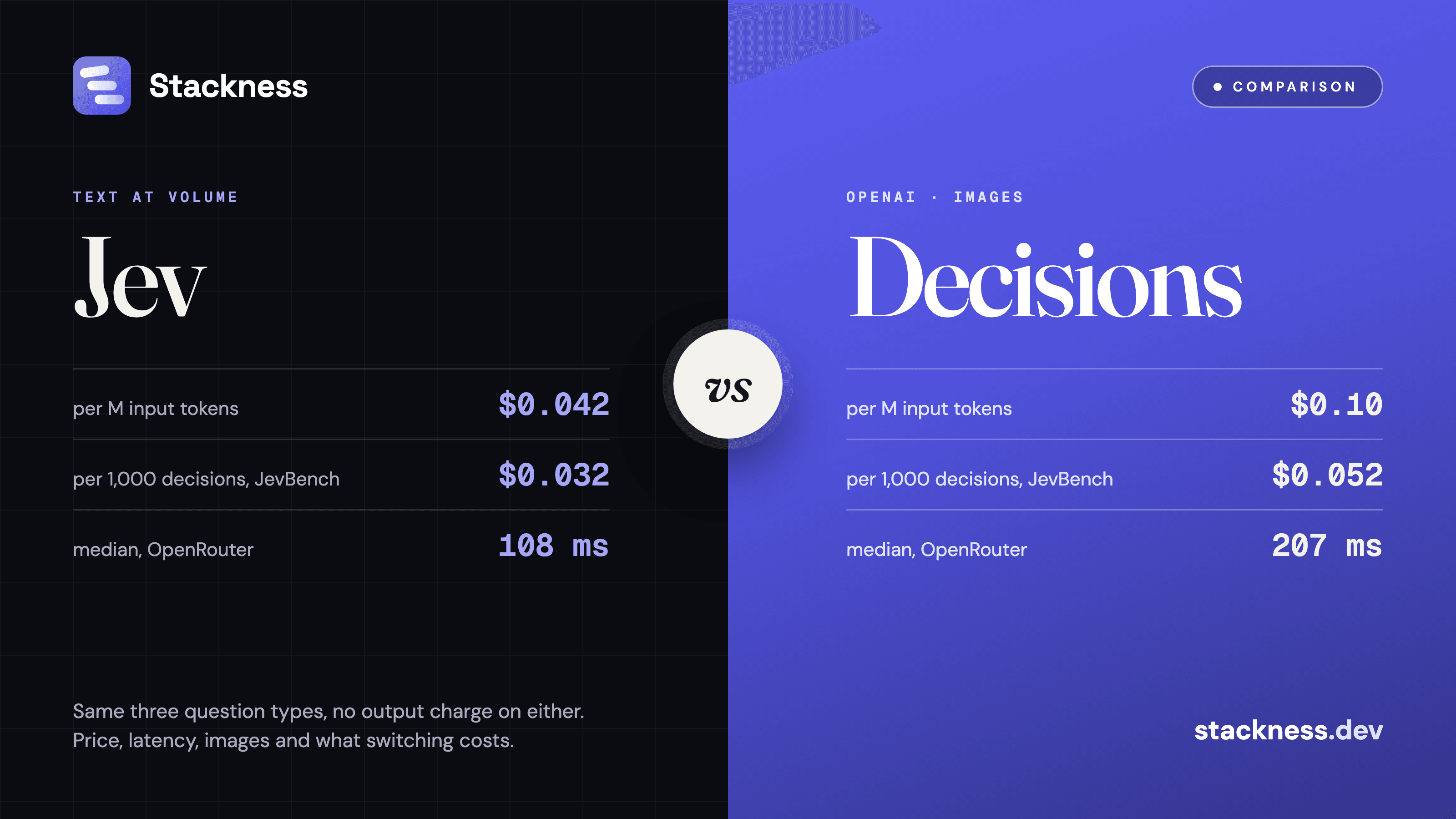
| Input price per 1M tokens | $0.042 | $0.042 | $0.10 |
| Output price | Free | Free | None |
| Per 1,000 decisions, same 500 cases | $0.0178 | $0.0324 | $0.0611 |
| Median latency, same 500 cases | 303 ms | 233 ms | 214 ms |
| Context | 32,768 tokens | 64k, 262k behind an experimental header | GPT-6 Luna's window |
| Images | No | Experimental | Yes |
| Base model | Post-trained Qwen3.5-9B, weights not released | Not disclosed | GPT-6 Luna |
| Data location | Azure data zone deployments in selected regions | No regions published | US and EU residency |
Sources: Microsoft Learn, Azure retail prices API, Foundry model card, TypeSafe models and images, OpenAI Decisions guide, and Kartik Anand's decision-api-benchmark for the two measured rows, all read on 17 October 2026.
What is Microsoft-Decision-1?
Microsoft-Decision-1 is a decision-scoring model in Microsoft Foundry: given a state and a question with fixed answer options, it returns a calibrated probability for each option in one pass instead of generating text. Microsoft announced it on 9 October 2026 as a post-trained Qwen3.5-9B; its Foundry launch post pitches it for "simple, repeatable, and time-sensitive decisions".
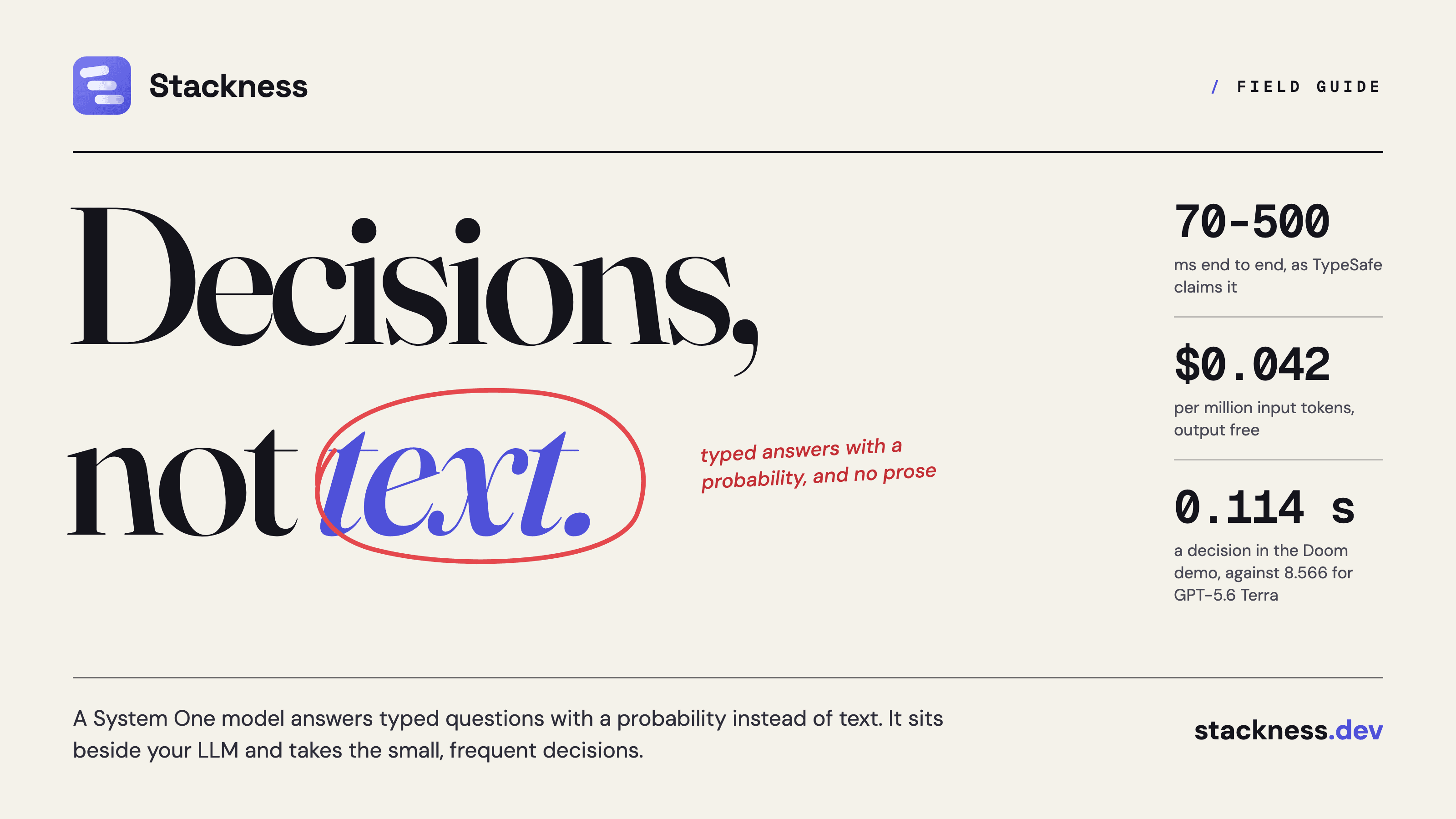
Decision scoring is the same job Jev and the OpenAI Decisions API do, with the same three question types as Jev: noul for yes or no, choice for one option from a set, and score for a level on an ordered scale. The System One explainer covers the slot. Microsoft says it will "soon rebase it on other models, including Microsoft AI (MAI) and OpenAI", with no date. The weights are not released.
Microsoft added Jev to its own benchmark table after launch
Microsoft's benchmark table, as updated on 10 October, claims the highest accuracy across 36 benchmarks, 83.5% against Jev's 82.3%, and an 85 ms median latency. Jev's accuracy and calibration were not in the first version. Wayback Machine captures show them added between 03:18 and 04:13 UTC on 10 October, with a note that the post "was updated from the original to add benchmarks for Jev on accuracy and calibration".
| Model | Accuracy, 36 benchmarks | Median latency | Calibration, 100 = perfect |
|---|---|---|---|
| Microsoft-Decision-1 | 83.5% | 85 ms | 92.2 |
| Jev 1.13.0 | 82.3% | 240 ms | 93.7 |
| OpenAI Decisions (GPT-6 Luna) | 79.4% | 300 ms | 89.9 |
The edit also moved Microsoft-Decision-1 from second to third on calibration. Three things the table does not show:
- Which benchmarks. Microsoft names none of the 36 and gives no formula for its calibration score.
- Like-for-like latency. Its own footnote says the 85 ms was "measured through Foundry in the same region". The other rows come from JevBench, which for self-hosted models adds an assumed
2 × measured + 150 ms. H2O-Lightning-4B, the model Microsoft calls 2.5 times slower, was measured at 29 ms on its GPU and shown as 210 ms. - A price comparison with Jev or OpenAI. The cost chart compares only with GPT-6 Sol, a general model.
Microsoft-Decision-1 bills fewer tokens for the same decision
Microsoft-Decision-1 and Jev both list $0.042 per million input tokens, confirmed for Microsoft in Azure's retail prices API across 37 regions, with output free. Price per decision still differs, because Microsoft's Qwen-based tokenizer counts fewer tokens for the same request. Every independent run put Microsoft-Decision-1 at 0.55 to 0.74 times Jev's cost per decision.
| Who measured | Microsoft-Decision-1 | Jev | OpenAI Decisions | Ratio to Jev |
|---|---|---|---|---|
| Kartik Anand, 500 cases via OpenRouter, 10 October | $0.0178 (423 tokens) | $0.0324 (773 tokens) | $0.0611 (611 tokens) | 0.55 |
| JevBench, 16 October board | $0.019 | $0.032 | $0.052 | 0.60 |
| Artificial Analysis Decision Index | $0.0307 | $0.0415 | $0.0789 | 0.74 |
At a million decisions a month on Anand's cases, that is $17.80 against $32.40, so the saving matters only at volume. Tokens per decision depend on your prompts; count them on your own traffic before trusting any of these ratios.
Jev answered faster than Microsoft-Decision-1 in every outside test
Nobody outside Microsoft has reproduced the 85 ms median. Outside measurements of Microsoft-Decision-1 range from about 190 ms to 688 ms depending on the route and the client's location, and in every test that timed both models on the same route, Jev was faster.
- Artificial Analysis: 207 ms against Jev 1.13's 127 ms.
- OpenRouter over one week to 17 October: 0.25 seconds median against 0.14 seconds for Jev 1.13.
- Anand's harness from Columbus, Ohio: 303 ms against 233 ms.
- JevBench, measured natively on Foundry: 459 ms against 0.24 seconds for Jev.
In the Artificial Analysis and JevBench runs the two models took different routes, so part of those gaps may be routing; in Anand's harness and OpenRouter's own stats both went through the same hop. Microsoft's in-region number may hold for an app running in the same Azure region, which Microsoft has not named.
Accuracy is close, independent tests lean Jev, and option order favours Microsoft
On accuracy, the independent tests split. JevBench puts Jev 1.13 ahead on intelligence, 63.6 to 57.2, and on calibration, 90.6 to 84.4. Artificial Analysis puts Jev ahead, 57.5 to 53.8. Anand found Jev 1.7 points ahead on macro-F1 with a 95% interval of -1.8 to +5.2, "not statistically separable". jev-ai.pro, a site that sells Jev access, found Microsoft-Decision-1 slightly ahead on two tests.
Microsoft-Decision-1 is steadier when the options are reordered. In Anand's harness, it gave the same route across all six option orders 97.2% to 97.6% of the time, against 91.6% to 91.8% for Jev and 64.2% for OpenAI Decisions. Microsoft claims zero flips when options are shuffled, yet its own docs warn that scores "can change based on how you phrase or order questions and options".
Thresholds do not carry over. With the confidence thresholds Anand had tuned for Jev, Microsoft-Decision-1 sent about 50 cases per run to unnecessary manual review, against one or two for Jev. The benchmark post covers how to set them on your own data.
A cheap general model still has a job when the decision needs words
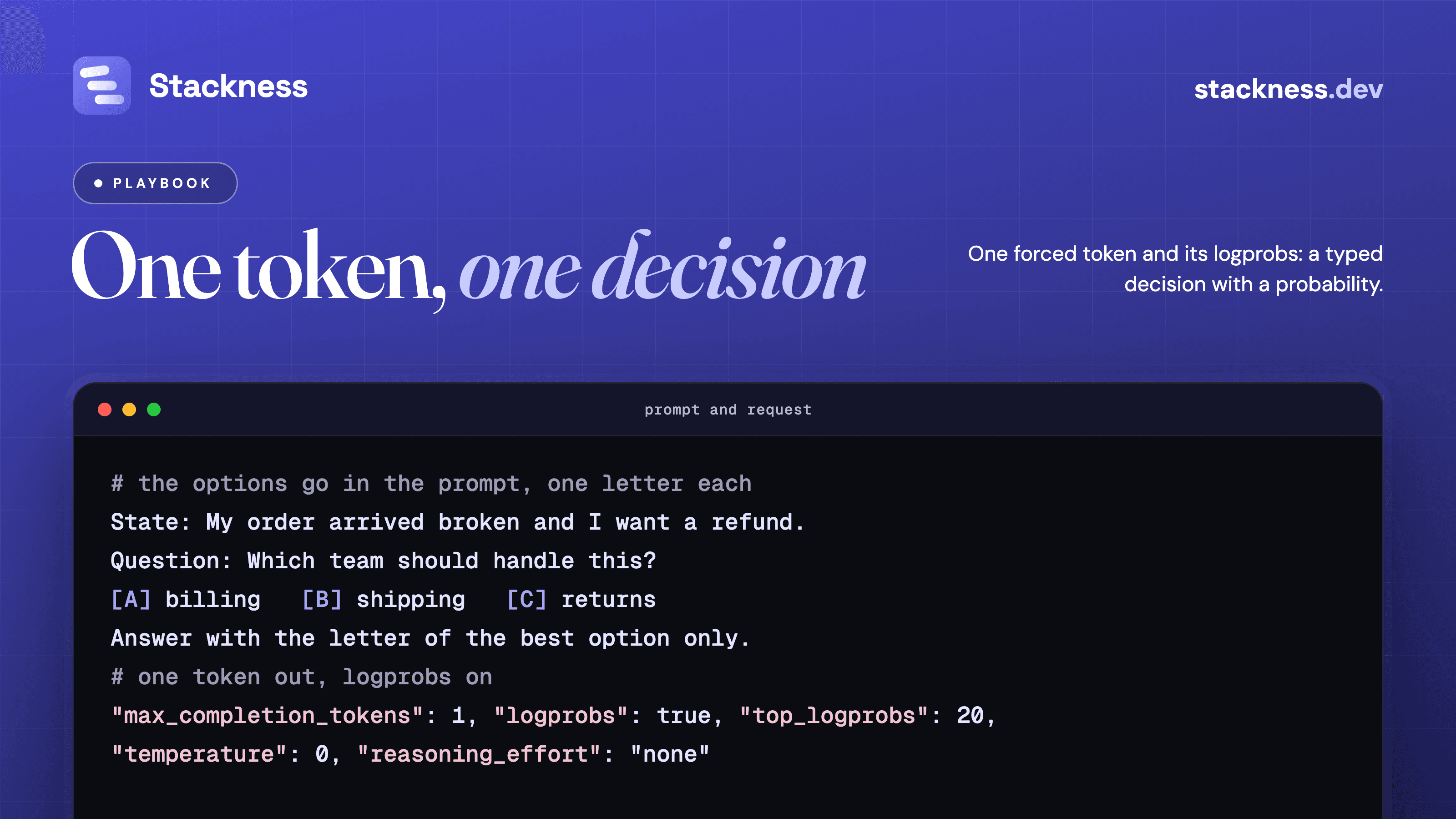
A general model such as Gemini 3.5 Flash-Lite still has a place next to a decision model when the answer has to include arguments or a reason, or when the prompt is loose. Mike Swift of Major League Hacking measured this on 8 October, before Microsoft-Decision-1 launched.
Swift's router picks a deterministic checker for each eval check or hands it to an LLM judge. Out of the box Jev made three dangerous calls on eight real checks and Flash-Lite none. One added sentence took Jev from 35 false-positive runs to 0. Swift still uses Flash-Lite, but behind Jev: a decision model returns the checker's name "And stops", so Flash-Lite writes the arguments only for the checks that need them.
Swift's cost table, per 1,000 checks, billed through OpenRouter: Jev handing off to Flash-Lite only when arguments are needed cost $0.10, Flash-Lite alone $0.52, and Jev alone about three cents. Flash-Lite lists at $0.30 per million input tokens, about seven times the decision models' rate, plus $2.50 per million output tokens. The logprobs post covers getting typed answers from a general model.
Switching between Jev and Microsoft-Decision-1 is a URL change and a threshold retune
Moving a Jev integration to Microsoft-Decision-1 changes the URL, the authentication and the model field, and keeps the request body. Both take a state, a questions map keyed by your names, and the same noul, choice and score types with the same criteria fields. Moving either one to the OpenAI Decisions API rewrites the body.
An example request in the shape both docs describe:
{
  "model": "jev-1.13.0",
  "state": "The API returns 500 on every call.",
  "questions": {
    "team": {
      "type": "choice",
      "instructions": "Which team should handle this ticket?",
      "criteria": {
        "billing": "Payments, invoices and refunds",
        "engineering": "Errors, outages and bugs",
        "support": "How-to questions and account help"
      }
    }
  }
}
What changes for Microsoft-Decision-1:
- URL.
https://api.typesafe.ai/v1/systemonebecomes{your Foundry resource}/providers/microsoft/v1/systemone. - Auth. A TypeSafe bearer key becomes an Entra ID token or an
api-keyheader. - Model.
jev-1.13.0becomes your Foundry deployment name. - Limits. Inputs over 32,768 tokens fail, and images are not accepted.
- Thresholds. Retune them on labelled data; Microsoft's docs say to "validate it against labeled examples before you automate a gate".
Microsoft does not document a sample response or a confidence field, and publishes no limits on questions per request or options per choice. Gateways hide the URL difference: OpenRouter serves all three as typesafe/jev-1.13, microsoft/microsoft-decision-1 and openai/gpt-6-luna-decisions, which is how Anand ran the comparison. The OpenAI Decisions vs Jev post has the body rewrite for OpenAI.
On Stackness, one public profile lists Jev as of 17 October 2026 (mine), and none yet list Microsoft-Decision-1 or the OpenAI Decisions API (data sources). On OpenRouter's decision rankings for the week to 16 October, Jev 1.13 served 1.05 billion requests and Microsoft-Decision-1 19.5 million. The AI tools developers list page shows where the slot sits in real stacks.
Pick Jev if, pick Microsoft-Decision-1 if
Pick Jev if:
- each decision sits in a user-facing path where 100 ms matters
- your inputs run past 32,768 tokens
- you want the most independent benchmark data behind your choice
- you need images, even behind an experimental flag
Pick Microsoft-Decision-1 if:
- you already run on Azure and want Entra ID auth and Azure billing
- inference has to stay in an Azure data zone
- you make millions of decisions a month and the cost per decision decides
- answers should move as little as possible when options are reordered
Pick the OpenAI Decisions API if you need image input without a flag or OpenAI's data terms, as the earlier comparison covers. Pick a general model like Flash-Lite if the decision has to come with arguments or a reason.
New posts by email
About one email a week with what we published. No account needed.
One email to confirm first. Every email has a one-click unsubscribe.
Which of these do you use?
Nobody on Stackness runs Microsoft-Decision-1 yet. Tick what you use and be the first.