OpenAI Decisions API vs Jev: price per decision, latency, images and what switching costs
Tools in this post


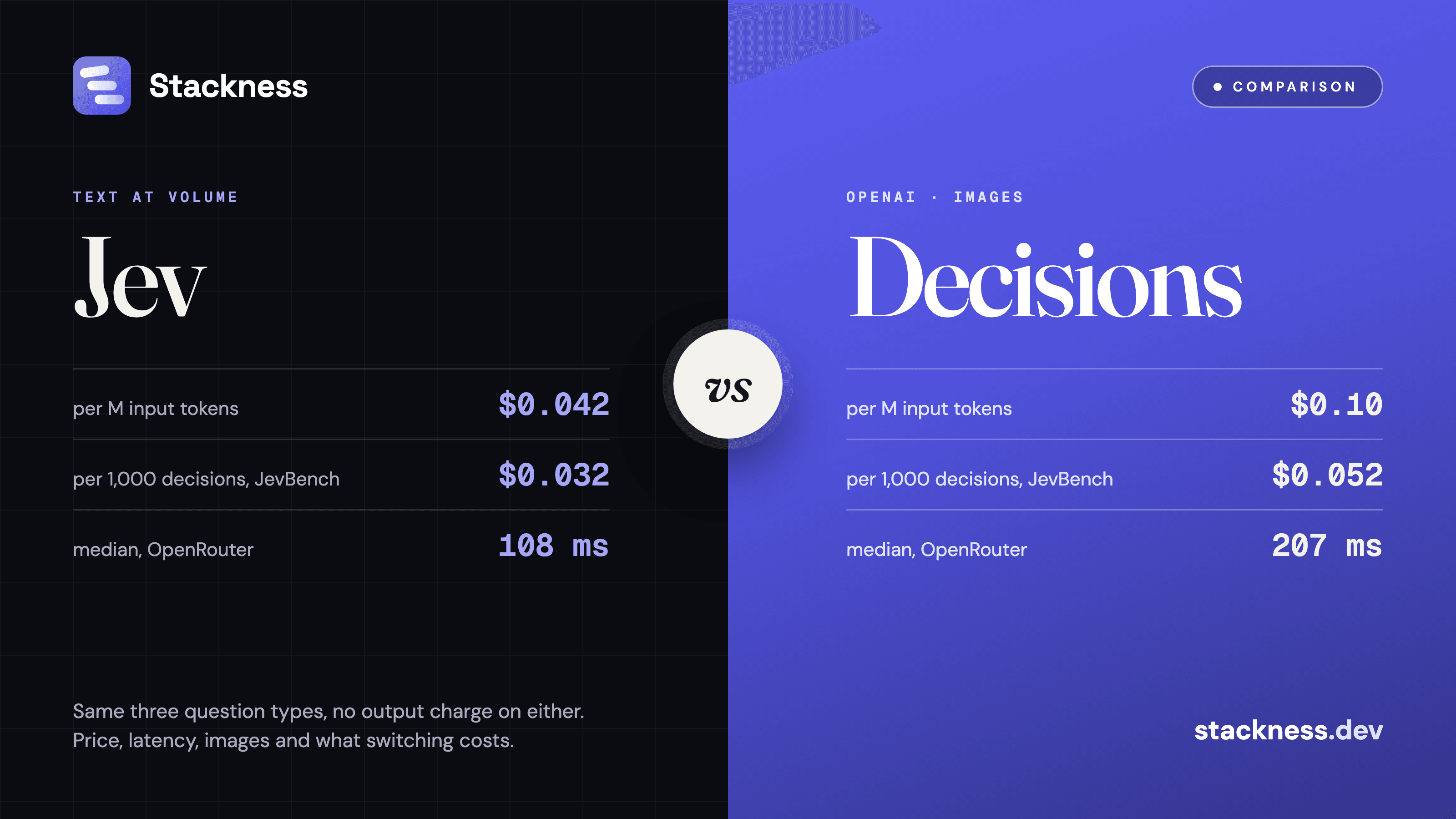
For text decisions at volume, Jev is the better pick as of 15 October 2026: it lists $0.042 per million input tokens against $0.10 for the OpenAI Decisions API, and on the one benchmark that has run both, on overlapping item sets, it cost $0.032 per 1,000 decisions against $0.052, with a faster median response. Pick OpenAI Decisions when you need image input that is not behind an experimental flag, OpenAI's US or EU data residency, HIPAA or zero data retention under an OpenAI agreement you already have, or inputs longer than Jev's 64k default. Neither API charges for output tokens.
OpenAI announced the Decisions API at DevDay on 29 September 2026 and opened it as a public beta on 6 October, running on GPT-6 Luna. TypeSafe AI launched Jev on 15 September. Both answer the same three kinds of question: yes or no, one choice from a fixed set, and a score on a scale. The System One explainer covers what that slot is; this post is the choice between the two vendors.
OpenAI Decisions API vs Jev at a glance
| OpenAI Decisions API | Jev (TypeSafe AI) | |
|---|---|---|
| Status | Public beta since 6 October | jev-1.13.0 stable, jev-1.14.0 preview since 14 October |
| Endpoint | POST /v1/decisions |
POST /v1/systemone |
| Input price per 1M tokens | $0.10; 2x above 272K tokens; +10% for regional processing | $0.042, same rate for long context |
| Output price | None | None |
| Question types | predicate, choice, score; any answer can be a refusal |
noul, choice, score; experimental box for images |
| Images | Yes, in the beta | Experimental, behind a request header |
| Context | Luna's 1,050,000-token window; 1 to 200 questions per request | 64k per request and 32k per question; 262k with an experimental header |
| Data terms | ZDR and HIPAA for eligible customers; residency in the US and Europe | Not trained on customer data; ZDR for enterprise via sales; no region options published |
| Local fallback | None | Local servers that speak its request format |
Sources: OpenAI Decisions guide, API reference, GPT-6 Luna model page, TypeSafe models, TypeSafe API, Jev 1.14 post, all read on 15 October 2026.
OpenAI's Decisions price appears only in the Decisions guide. The main pricing page lists GPT-6 Luna at its general rates, $0.10 in and $0.50 out, which overstates what a decision costs. TypeSafe has no pricing page; the price is in the docs.
OpenAI Decisions costs 1.6 times Jev per decision
OpenAI Decisions lists 2.4 times Jev's price per input token, but a decision is billed in tokens, and the two models count tokens differently, so the gap per decision is smaller. On JevBench, a one-person project by Benchmark Heaven, Jev 1.13 cost $0.032 per 1,000 decisions on 5 October and OpenAI Decisions cost $0.052 on 6 October: OpenAI cost 1.6 times as much.
Working back from those costs at list price, Jev was billed about 762 input tokens per decision on its 1,500 items and OpenAI about 520 on its 592, which share only the 300 public items. At one million decisions a month, that is $32 against $52. If your prompts are longer, the gap scales with them: at 1,000 tokens per decision and equal token counts, it is $42 against $100.
Two caveats from the JevBench board: OpenAI was measured on a 600-item subset on the first day of the beta, against 1,500 items for Jev, and the scores were adjusted to compare. It is the only matched test I found. The widely quoted "13.6x faster and 2.7x cheaper" result from Tessl (23 September) predates the Decisions API. It compared Jev with GPT-6 Luna writing its reasoning as a chat judge, and Tessl sells the CLI that runs both.
Jev answers faster in every measurement so far
Jev's median response is about half of OpenAI Decisions' in OpenRouter's live data: 108 to 120 ms against 207 to 211 ms over its rolling 30-minute window, in two reads on 15 October covering about 2.4 million Jev requests and 63,000 OpenAI ones. The tail gap is wider, about 340 ms against 1,290 ms at the 99th percentile, per the Jev and GPT-6 Luna Decisions pages.
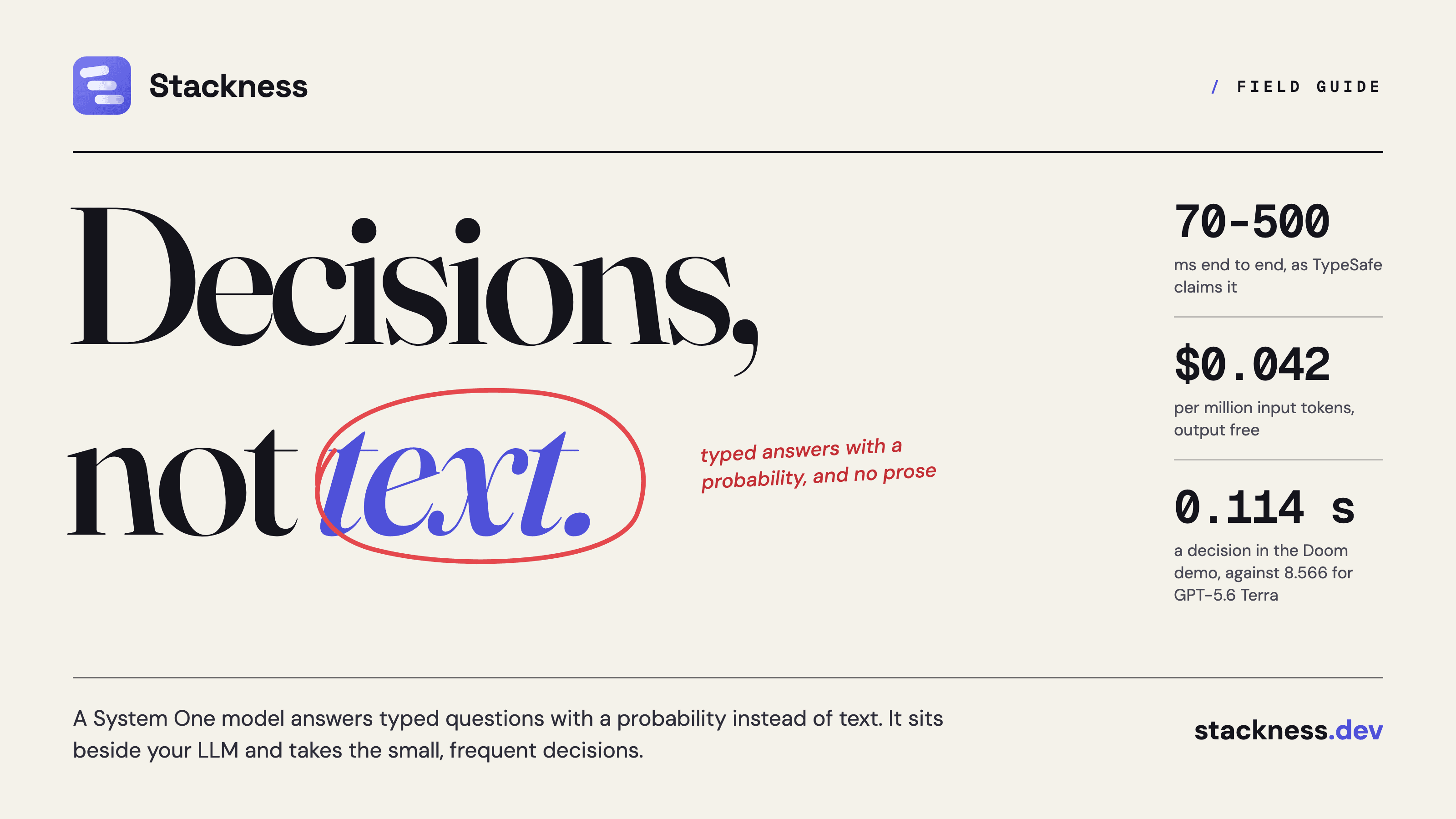
JevBench, timing end to end from one host, measured a median of 0.24 s for Jev and 0.30 s for OpenAI. The vendors' own numbers are not comparable with these or with each other. OpenAI's DevDay slide shows 150 ms against 1.6 s for the regular GPT-6 Luna API with no test conditions given, and its guide says "about 10x faster than the Responses API". TypeSafe's launch post says 70 to 500 ms end to end, measured from laptops on the US West Coast.
Both are calibrated about the same; Jev scores higher
JevBench scores calibration, whether a 0.9 probability is right about 90% of the time, at 90.6 for Jev and 90.1 for OpenAI Decisions, close enough to call level. On chance-corrected accuracy, which JevBench calls intelligence, Jev scored 63.6 and OpenAI 56.9. OpenAI's weakest type was yes or no questions, at 20.6 on the sealed set.
The confidence numbers look alike too. OpenAI publishes no formula for its confidence field, but the examples in its guide and in Simon Willison's plugin README match TypeSafe's published formulas to two decimal places. That is my inference from three examples, not something OpenAI states. TypeSafe also publishes a list of known weak spots per version: counting and arithmetic, date comparisons, long state full of irrelevant detail. OpenAI publishes no equivalent.
OpenAI Decisions takes images in its beta; Jev's are experimental
Image input is the clearest functional difference. OpenAI Decisions accepts images in the beta, up to 128 per request; the guide says to send them as base64 data URLs, though the API reference also allows public HTTPS URLs. When Simon Willison released his plugin on 6 October, he wrote: "Unlike Jev, the new gpt-6-luna decision model supports image input".
Eight days later, Jev 1.14 added image input behind the TypeSafe-Danger-Zone-Images: true header on both 1.13 and 1.14, and its images page says images "aren't yet up to our standards to call ready for production". Its own docs still disagree: the System One page says text only, while the images page documents PNG and JPEG input. OpenAI's image input is part of a public beta that it expects to reach general availability "in the coming weeks", but TypeSafe is the one that tells you not to rely on its images in production.
OpenAI Decisions fits where OpenAI's data terms already apply
If your company already sends data to OpenAI under a signed agreement, Decisions inherits it. OpenAI's guide says the endpoint supports zero data retention and HIPAA for eligible customers, with data residency in the United States and Europe. TypeSafe says Jev is not trained on customer data and offers zero retention to enterprise customers through sales, but publishes no regions and no retention period in its data processing terms.
Long inputs point the same way. Jev reads 64k tokens per request by default and 262k with an experimental header that TypeSafe calls "slower and less accurate". Decisions runs on Luna's 1,050,000-token window, billed at double rate above 272K. OpenAI also returns a per-question refusal and accepts agent traces (messages and tool calls) as input, which suits a check over an agent's last step.
What switching between Jev and OpenAI Decisions costs
The two APIs ask the same questions in different shapes, and neither accepts the other's requests. Moving code means renaming fields, changing how answers are keyed and retuning thresholds, because the probabilities come from different models even when the formulas match.
| OpenAI Decisions | Jev | |
|---|---|---|
| Input field | input |
state |
| Questions | Array; answers come back in order | Map keyed by your id |
| Yes or no | predicate, answer probability |
noul, answer noul, with no confidence |
| Choice options | choices: [{value, description}] |
criteria: {option: description} |
| Score levels | levels: [{label, description}], no documented maximum |
criteria array, 2 to 10 levels |
| SDK call | client.decisions.create (Python 3.26.0, JS 7.30.0) |
client.system_one (typesafe-sdk) |
Pin the model version before you tune a threshold. TypeSafe's docs say to send the version ID rather than jev-latest, which moves to 1.14 around 21 October. Then rerun your labelled examples on the new vendor, as OpenAI's guide also tells you to.
Gateways remove most of the code change. Vercel AI Gateway serves an OpenAI-compatible /v1/decisions that "any decision model on AI Gateway can answer, not just OpenAI's", plus a TypeSafe-compatible API and a fallback that reruns the decision on another model when an answer is uncertain. OpenRouter's alpha /api/alpha/decisions serves both models in Jev's request shape. In LLM, Simon Willison's command-line tool, llm-typesafe and llm-openai-decisions put both behind the same llm -m command. OpenClaw documents a decisionModel role for both, but its TypeSafe plugin is unpublished. One naming trap: Ollaya's local /v1/decisions uses Jev's request shape, not OpenAI's.
The decision slot does not always need either API
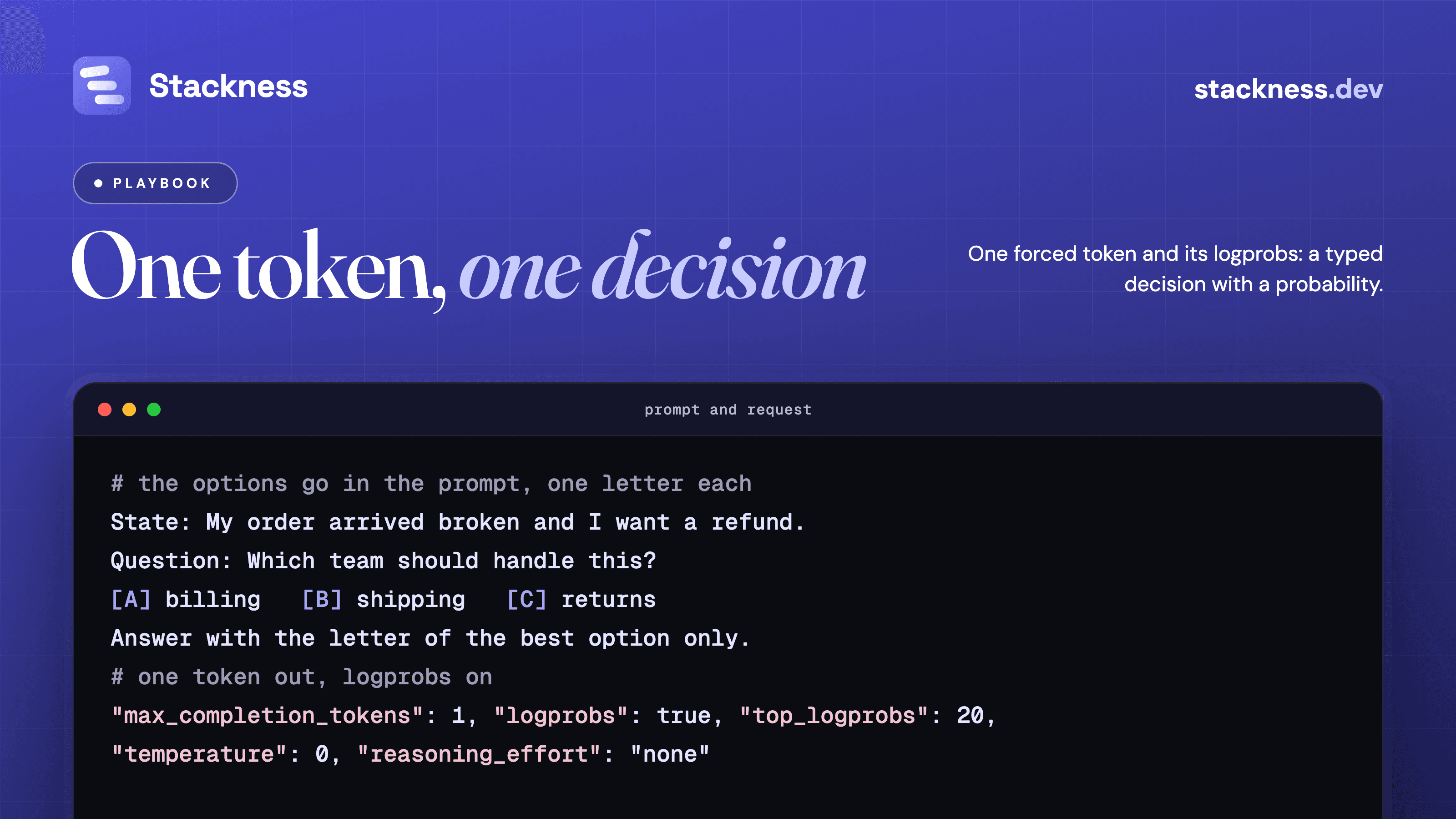
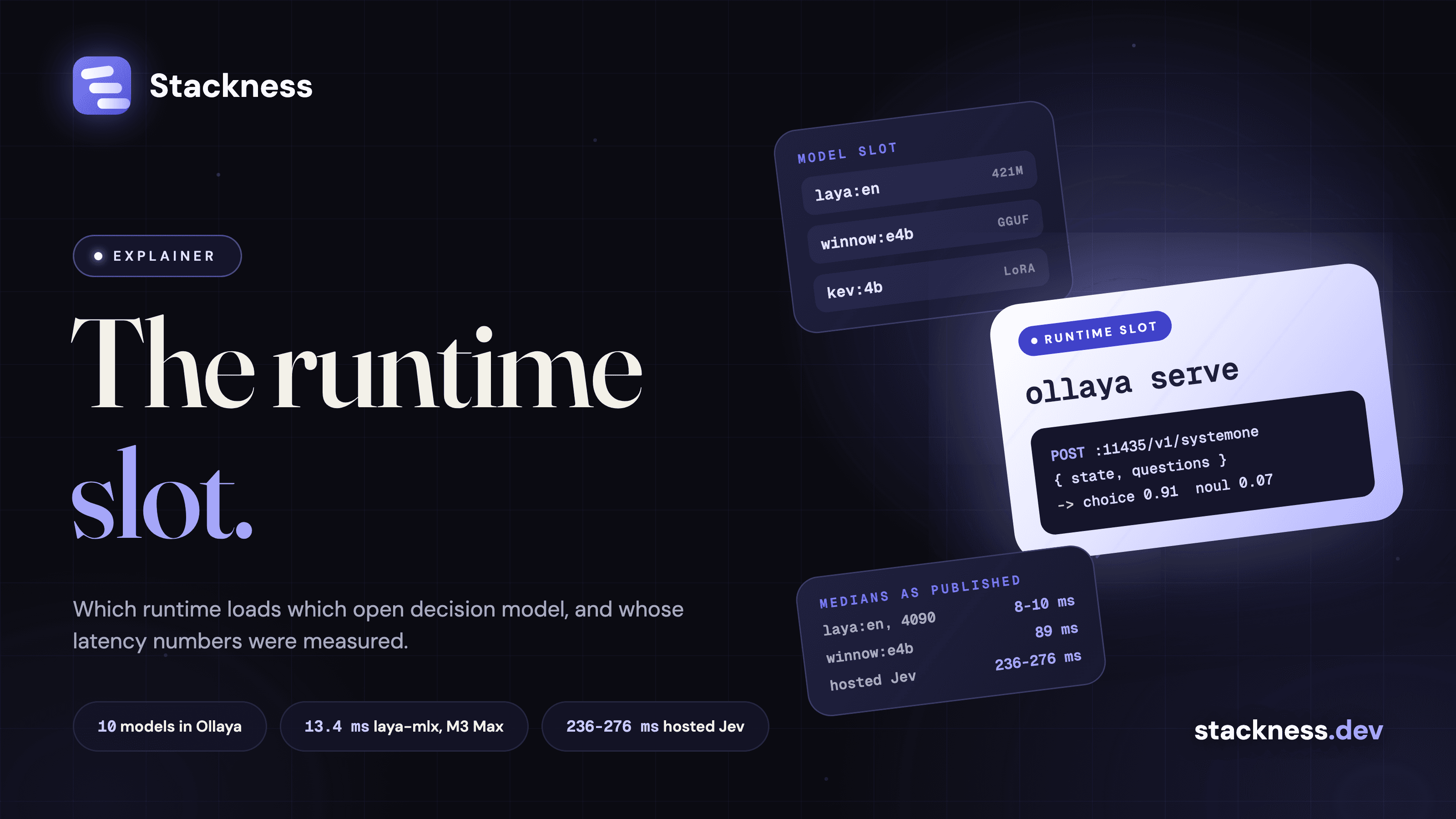
Some decision calls are better served by neither vendor. If accuracy on hard items matters more than price, plain GPT-6 Luna through the chat API scored 96.9 on JevBench intelligence at medium reasoning effort, for about 3.5 times Jev's cost and a 1.8 s median, about seven times Jev's 0.24 s. The one-token logprobs recipe gives typed answers from the same model with reasoning off, a setting JevBench did not measure. If data must stay on your hardware, Ollaya serves Laya and Kev behind Jev's request format, which makes Jev the vendor with a local exit. Ollaya's own numbers show the limit: Laya's base checkpoints are near chance on typed decisions, and its choice accuracy drops on questions with more than about 20 options. The local runtime post covers the setup.
Usage on OpenRouter leans hard one way: Jev 1.13 handled 1.08 billion decision requests in the week to 14 October against 26.5 million for GPT-6 Luna Decisions, whose count was up 652% on its launch week, per OpenRouter's decision model rankings. On Stackness, as of 15 October 2026, one public profile lists Jev and none list Laya or Ollaya (data sources), so these are early stacks in the LLMs developers list.
Pick Jev if, pick OpenAI Decisions if
Pick Jev if:
- your decisions are text, and volume makes the per-decision price gap matter
- the p99 latency of an agent step matters more than the median
- you want published confidence formulas, a per-version list of weak spots and version pinning
- you want a local server with the same request format as an exit
Pick OpenAI Decisions if:
- you decide from images and do not want an experimental flag in the request
- you need US or EU residency, HIPAA or zero retention under an OpenAI agreement you already have
- your inputs run past 64k tokens
- you want per-question refusals, or to feed agent traces in as input
- one vendor and one bill matter more than the price gap
Which of these do you use?
Nobody on Stackness runs OpenAI Decisions API yet. Tick what you use and be the first.