Claude Haiku 5.5 vs GPT-6 Luna cost per task: the 100k cliff, the tokenizer and which calls each one should take
Tools in this post


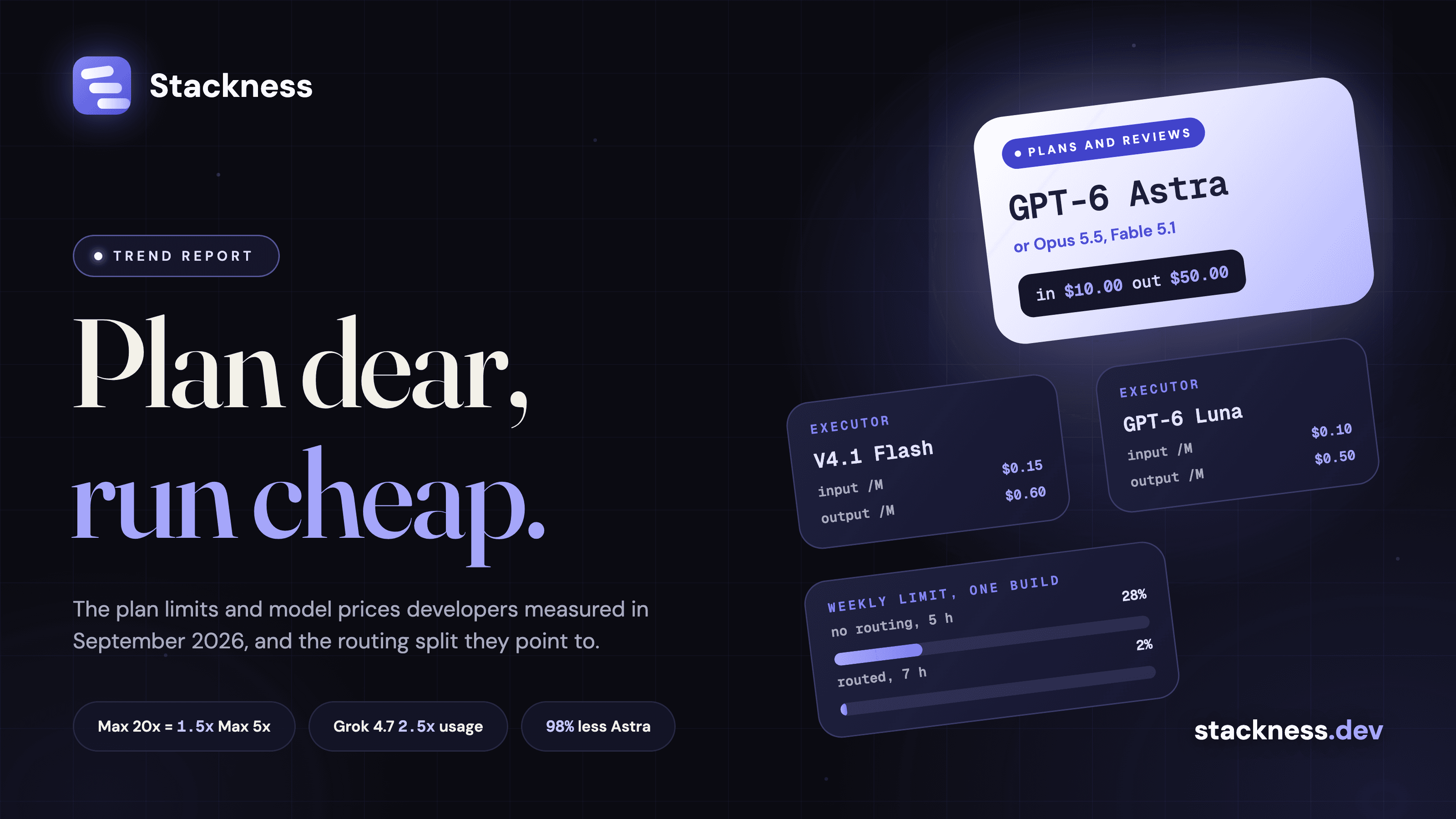
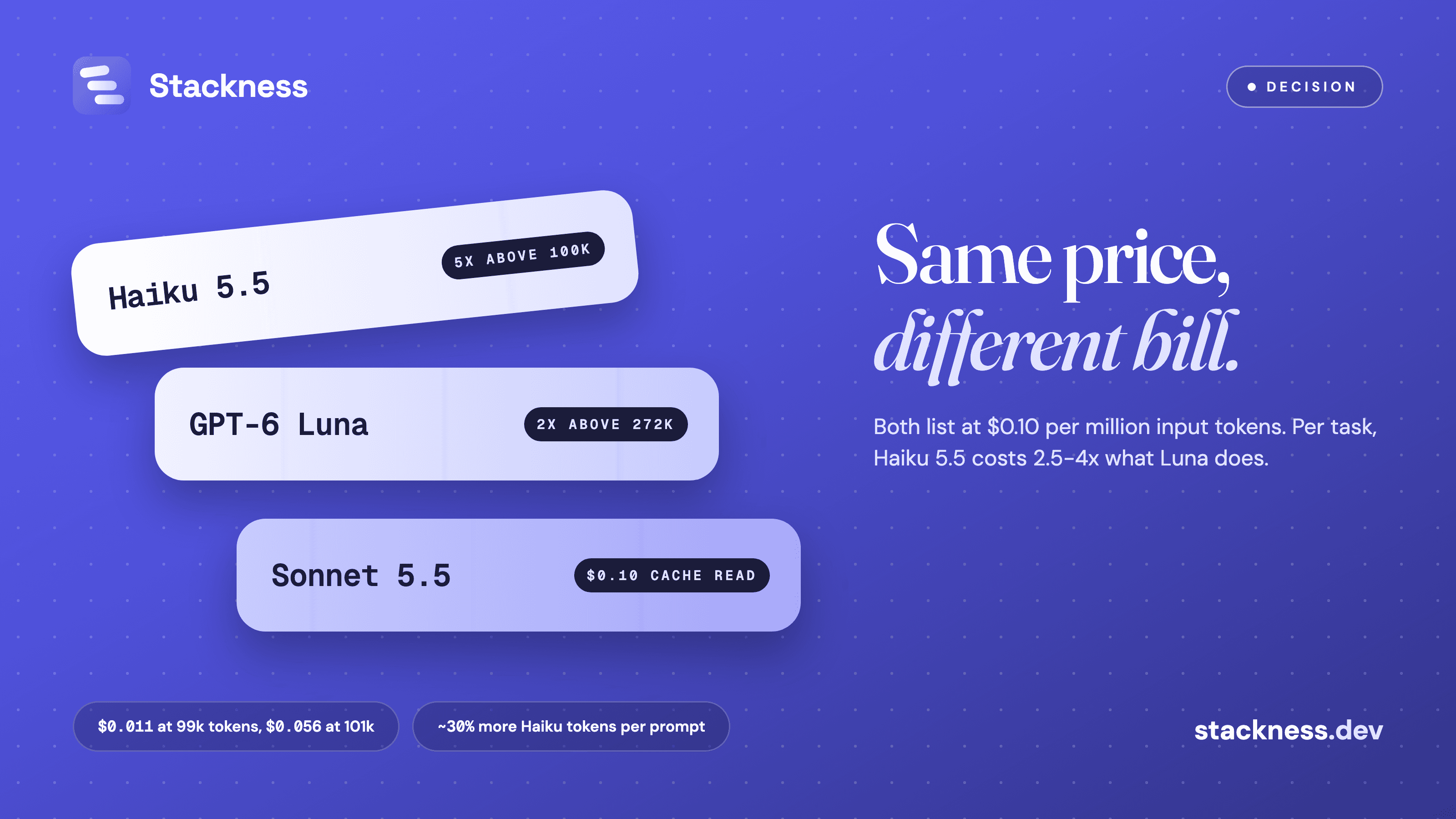
As of 13 October 2026, Claude Haiku 5.5 and GPT-6 Luna both list at $0.10 per million input tokens and $0.50 per million output, yet Haiku costs 2.5 to 4 times as much per task in Artificial Analysis's runs. My recommendation: put bulk classification, extraction and anything that can grow past 100,000 tokens on Luna, and give Haiku 5.5 the coding and terminal subagent calls that stay well under that line. The condition is prompt size, because above 100,000 tokens every Haiku rate goes up five times.
What does Claude Haiku 5.5 cost, and where does the price step up?
Claude Haiku 5.5 shipped on 7 October 2026 at $0.10 input and $0.50 output per million tokens for prompts up to 100,000 tokens, and $0.50 and $2.50 above that, according to Anthropic's pricing page. The whole request moves to the higher tier, output and cache reads included, and cached tokens count toward the 100,000.
Haiku 5.5 is the only current Claude model with a long-context surcharge; every other model from Claude 4.6 on bills its full 1M window at one rate. Against Haiku 4.5 ($1 / $5), it is 90% cheaper per token under the line and 50% cheaper above it.
| Per million tokens | Input | Cache read | Output | Price steps up at | What it commits you to |
|---|---|---|---|---|---|
| Claude Haiku 5.5 | $0.10, then $0.50 | $0.01, then $0.05 | $0.50, then $2.50 | 100,000 prompt tokens (5x) | Watching prompt size; new 400 errors for Haiku 4.5 code |
| GPT-6 Luna | $0.10, then $0.20 | $0.01, then $0.02 | $0.50, then $0.75 | 272,000 input tokens (2x / 1.5x) | Effort none for function calls on Chat Completions |
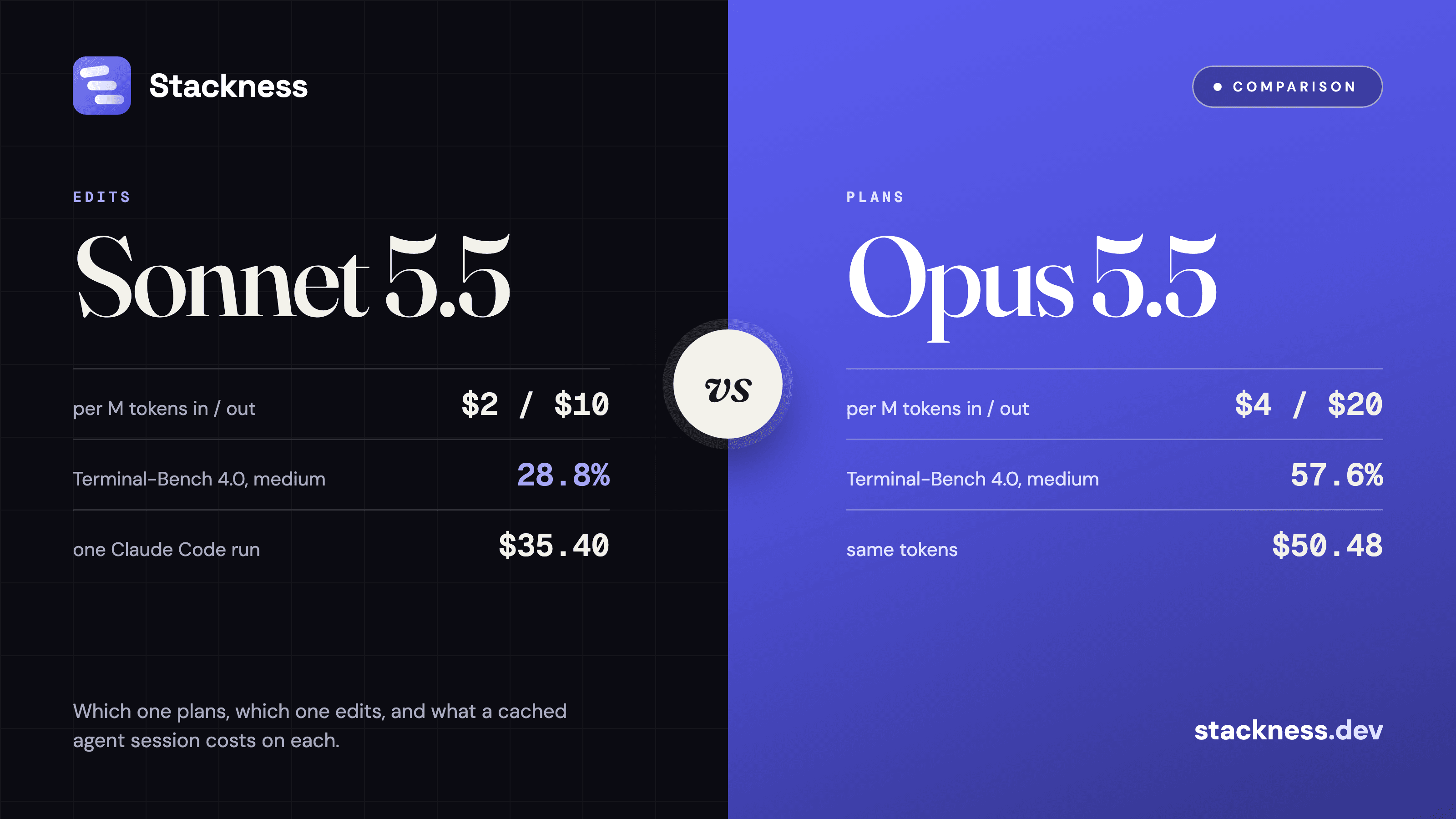
| Claude Sonnet 5.5 | $2.00 | $0.10 (was $0.20) | $10.00 | No tier | 20x Haiku's rates on everything but cache reads |
| DeepSeek V4.1 Flash | $0.15 off-peak, $0.30 peak | $0.003 / $0.006 | $0.60 / $1.20 | No tier | Peak-hour pricing; MIT weights you can host |
Prices from Anthropic, OpenAI and DeepSeek, read 13 October 2026.
Four calls decide the cheap-model bill
The cheap-model slot in an agent stack handles four kinds of call: a subagent that searches files, a classifier or router, a summariser fed a long log, and a long agent run whose context keeps growing. At list prices Haiku 5.5 and Luna cost the same on the first two and diverge by three to five times on the last two, because those cross 100,000 tokens.
I priced each call from the list rates above, without batch discounts, using the same token count for both models, which flatters Haiku (see the tokenizer below).
| Call | Haiku 5.5 | GPT-6 Luna | Sonnet 5.5 | DeepSeek off-peak |
|---|---|---|---|---|
| Subagent file search, 40k in, 2k out | $0.0050 | $0.0050 | $0.100 | $0.0072 |
| Classifier, 2k in, 50 out, per million calls | $225 | $225 | $4,500 | $330 |
| Summarise a 150k-token log, 2k out | $0.080 | $0.016 | $0.32 | $0.024 |
| 25-turn agent run, prompt grows from 20k to 188k | $0.204 | $0.060 | $0.961 | $0.050 |
Both expensive Haiku rows can be pulled back under the line. Splitting the log into two 75,000-token chunks plus a short merge call costs $0.017, and compacting the agent run whenever the prompt passes 90,000 tokens brings it to $0.062, about level with Luna. The line is sharp: a 99,000-token prompt with 2,000 tokens out costs $0.011, and at 101,000 it costs $0.056.
The new tokenizer adds about 30% to every Haiku 5.5 prompt
Claude Haiku 5.5 counts the same text as roughly 30% more tokens than Haiku 4.5, according to Anthropic's What's new page, which adds that "the exact increase depends on the content". Simon Willison measured "around 1.25x" on one long prompt on launch day and called it "a hidden price increase".
Simon used his Claude Token Counter, which calls Anthropic's token counting API, and did not publish the text or the counts. No per-content measurement for Haiku 5.5 exists yet. The same tokenizer arrived with Opus 4.7, where Claude Code Camp's counts ranged from 1.13x on dense JSON to 1.47x on technical English docs, with TypeScript at 1.36x. Coding subagent prompts sit at the high end; JSON classifier traffic sits at the low end.
Two consequences matter for the slot:
- The cliff moves closer. A prompt that was 77,000 tokens on Haiku 4.5 is about 100,000 on Haiku 5.5. Against Haiku 4.5, the per-text input price falls 87% under the line but only 35% above it.
- The comparison with Luna is not per token. The only cross-vendor count I found is DataCamp's: 24 invoices came to 51,961 tokens on Haiku and 30,098 on Luna, about 1.73x. That is one workload.
To recount your own prompts, the llm-anthropic plugin for Simon Willison's LLM CLI added llm anthropic count in version 0.30, which calls the same API.
Haiku 5.5 costs five times Luna between 100,000 and 272,000 tokens
Between 100,000 and 272,000 prompt tokens, Claude Haiku 5.5 charges $0.50 input and $2.50 output per million while GPT-6 Luna stays at $0.10 and $0.50. Above 272,000 the gap narrows to 2.5x on input and 3.3x on output, because Luna's own tier only doubles input and raises output by half. Both models accept about a million tokens of context.
Anthropic's launch page says 90% of Haiku 4.5 requests stayed at or under 100,000 tokens, and calls Haiku 5.5 "especially good value" there. That holds for bounded subagent prompts, not for agent loops that pile up tool output: 13 of the 25 turns in my example ran above the line. On Hacker News, minimaxir called 100,000 "absurdly low" while others said it is plenty for subagents; both are right, for different calls.
Haiku 5.5 scores higher on terminal work and costs 2.5-4x Luna per task
Claude Haiku 5.5 leads GPT-6 Luna on agentic coding benchmarks but writes far more output to get there. Anthropic's launch table gives Terminal-Bench 4.0 at 39.2% against 16.4%; Artificial Analysis measured 32.8% against 12.6% at max effort. At max effort, Artificial Analysis counted 440M output tokens for Haiku's index run against 140M for Luna.
That verbosity is where the per-task gap comes from. Artificial Analysis's cost per index task, Haiku against Luna:
| Effort | Haiku 5.5 | GPT-6 Luna |
|---|---|---|
| Low | $0.02 | $0.0045 |
| Medium (Haiku's default) | $0.05 | $0.02 |
| Max | $0.21 | $0.07 |
Vals AI measured $2.99 per test for Haiku at max effort against $0.43 for Luna, with Haiku ranked 18th of 47 on its index and Luna 28th. Both Vals pages disagree with their own update boxes, so treat the ranks loosely. Neither model has a SWE-bench Verified score yet.
Anthropic positions Haiku 5.5 for "classification, routing, extraction, and subagent tasks" and keeps "complex agentic coding" on Claude Sonnet 5.5, which scores 70.6% on Terminal-Bench 4.0. Haiku earns its higher per-task cost where terminal and browser skill decides the result. Classifiers gain nothing from the extra reasoning, and Haiku thinks at medium effort by default, so set effort low or switch thinking off (allowed at high effort or below).
Cheaper Sonnet 5.5 cache reads make the warm session the cheap choice above 100k
On 7 October Anthropic halved Claude Sonnet 5.5's cache reads from $0.20 to $0.10 per million tokens, which it says makes Sonnet "around 20% cheaper to run on most long-running work". My 25-turn example saves 20.1%. The cut also changes routing: above 100,000 tokens, staying in a warm Sonnet session can cost less than handing the context to a cold Haiku subagent.
Sonnet's cache read now equals Haiku's uncached input price, so under 100,000 tokens a cold Haiku call always wins: an 80,000-token cached prefix with 5,000 new tokens and 2,000 out costs $0.041 on warm Sonnet and $0.0095 on cold Haiku. Above the line it flips. With a 150,000-token cached prefix, the same call costs $0.048 on warm Sonnet and $0.083 on cold Haiku, before Haiku pays its own cache write at the long-context rate. Warm Sonnet wins when 0.4 times the cached tokens exceeds twice the new tokens plus 7.5 times the output.
So a step that needs the parent's whole long context stays on Sonnet. A fresh, bounded question goes to the small model. A routing setup like those in the September model routing numbers that sends every subagent call to the cheap tier by role alone now loses money on the long ones.
Where does DeepSeek V4.1 Flash fit against the hosted cheap tier?
DeepSeek V4.1 Flash, released on 10 September 2026, is the open-weight option in the slot: MIT-licensed weights on Hugging Face, a 1M context, and a flat API price of $0.15 input and $0.60 output off-peak, doubling in peak hours (01:00-04:00 and 06:00-10:00 UTC on weekdays). It has no long-context tier, so it undercuts Haiku 5.5 on any prompt over 100,000 tokens.
Artificial Analysis gives it an index score of 39, one point above Luna at max effort, but $0.27 per task at peak prices, because it is even more verbose than Haiku. Its cache hits cost $0.003, the cheapest of the four. It also serves an Anthropic-format endpoint next to the OpenAI one, so a harness built for Claude can point at it. The dgt.is post that reached the Hacker News front page is one developer's account, with no measurements. Pick it for long-context batch work you can run off-peak, or when the weights must be yours.
Haiku 5.5 shipped on 7 October and breaks Haiku 4.5 code
Everything in this memo has shipped: Haiku 5.5 on five platforms on 7 October, the Sonnet cache cut the same day, Luna on 22 September, DeepSeek V4.1 Flash on 10 September. Haiku 5.5's API rejects things Haiku 4.5 accepted, and its independent benchmark numbers come from its first week.
Haiku 5.5 returns a 400 for temperature, top_p, top_k, budget_tokens and assistant prefill, per the migration guide. Structured outputs are not available for it on Amazon Bedrock, and its thinking blocks only work in the account that produced them. A routing proxy such as Weave Router can switch providers per call, but its "40-70%" savings claim is the vendor's own, and its README says Apache-2.0 from version 0.2.24 while older coverage describes the Elastic License.
What would change this recommendation
Four changes would move the line between Haiku 5.5 and GPT-6 Luna: Anthropic raising or removing the 100,000-token threshold, an independent tokenizer measurement on code that shows a smaller gap than DataCamp's 1.73x, Artificial Analysis re-running its agentic benchmarks on Haiku, and OpenAI changing Luna's 272,000-token tier.
OpenAI's Luna announcement returned an error when I tried to read it, so Luna's vendor benchmarks are second-hand here.
What I would do
- If your cheap calls are bounded subagent prompts under about 80,000 tokens (Haiku's count, leaving room for the tokenizer), give coding and terminal subagents to Haiku 5.5 and pin the model in the subagent's definition rather than letting it inherit the parent's.
- If the calls are classification, extraction or routing at volume, use Luna with reasoning effort
none, or Haiku with effort low and a cached system prompt; both cost $90 per million calls with a 1,500-token cached prompt. - If a call can grow past 100,000 tokens, send it to Luna, or chunk and compact it to stay under the line on Haiku. The context post covers when to compact.
- If a step needs the parent's long cached context, keep it in the warm Sonnet session.
- If the work is long-context batch, or the weights must be self-hostable, run DeepSeek V4.1 Flash off-peak.
Price the slot per task, not per token, the way the HY3 outreach move prices a workflow at about $0.02 per contacted company. Every one of the language models developers list in their stacks deserves that test before it takes a slot.
Which of these do you use?
Nobody on Stackness runs GPT yet. Tick what you use and be the first.