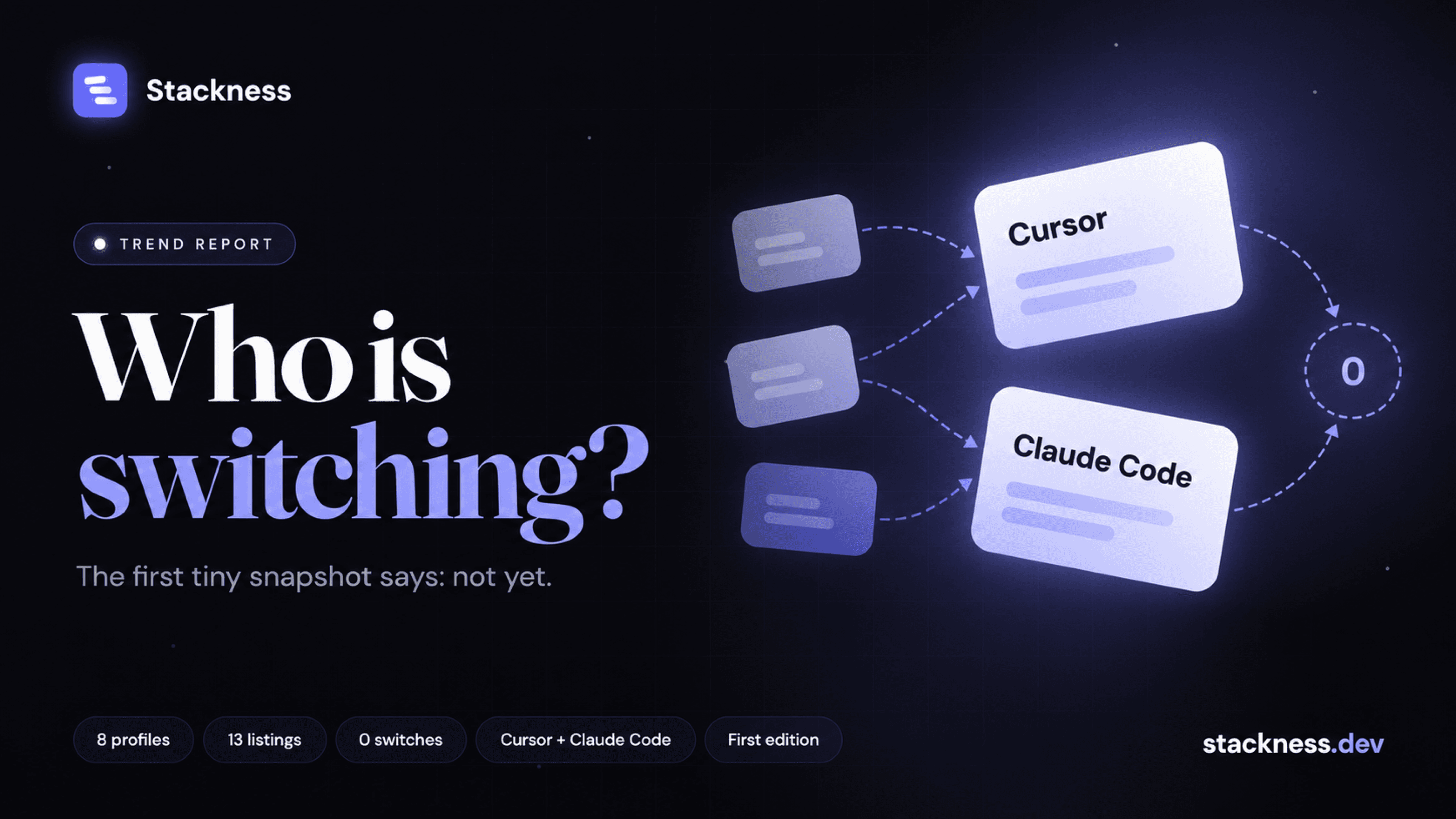
Which AI coding tools are developers switching to?
There is a grand data-report answer to this question, with arrows flying between tools and a chart that makes someone in a newsletter say "huh". Then there is the answer our data can support today: not yet.
As of 17 September 2026, Stackness does not have enough declared departures to say developers are switching from one AI coding tool to another. Cursor and Claude Code were tied at five listings each across eight real public profiles in this sample. Not one of the 13 AI coding tool entries had an end date. The most common pairing was Claude Code plus Cursor, not one replacing the other.
This is the first article in a series we will refresh as Stackness grows. For now, the dataset is less "state of the industry" and more "a spreadsheet that could still get a table for one at a restaurant". It is tiny and self-selecting, and it should be read as a preview of the analysis rather than market share. We removed four profiles whose bios explicitly identify them as bots or test accounts. Only four of the remaining 13 entries had a self-reported start month, and one Claude Code date predates the product's February 2025 research preview, so we excluded that date from switch matching. Small numbers are not a footnote here. They are the main character.
What the data can say is still useful: the first Stackness profiles are adding agentic tools beside their existing editor or assistant, and almost nobody has recorded taking one away. More importantly, this first edition establishes the questions, definitions and scorecard we will return to when the arrows finally have somewhere to go.
AI coding tool adoption in September 2026
We checked public stack entries for Cursor, Windsurf, Claude Code, GitHub Copilot, Codex, Aider, Cline and Zed. After removing labelled test accounts, here is the baby version of the scorecard future editions will carry:
Cursor: 5 active human profiles. Four entries were added to Stackness in September, with no declared stops. It is tied for the largest footprint in this sample.
Claude Code: 5 active human profiles. Three entries were added in September, with no declared stops. It is tied with Cursor and often used beside it.
GitHub Copilot: 1 active human profile. The entry arrived in September and remains active. That is presence, not a direction.
Windsurf: 1 active human profile. The entry arrived in September and remains active. Its owner also lists Cursor, Claude Code and Copilot.
Zed: 1 active human profile. The entry arrived in September and remains active. It is listed beside Cursor, not instead of it.
Aider: 0 active human profiles. It is in the catalog, but nobody in the cleaned sample lists it yet.
Codex: not tracked. There was no matching Stackness catalog entry on the snapshot date, so this is not a zero-adoption result.
Cline: not tracked. There was no matching Stackness catalog entry on the snapshot date, so this is not a zero-adoption result either.
"Added to Stackness" means the profile entry was created on Stackness during September. It does not mean the developer first adopted the product that month. Ten of the 13 entries arrived after 1 September, mostly because the people and their profiles are new. The start-date field is the better adoption signal, but only three plausible dates survived validation. We could draw a monthly adoption curve from that, but it would mostly be decorative geometry.
These counts deliberately differ from the raw totals on some tool pages. Public tool pages include clearly labelled test profiles; this analysis does not.
Which AI coding tools are being added?
Cursor and Claude Code are the only tools with more than one real profile in the cohort. Each appears on five of eight profiles, or 62.5 percent. Together they account for ten of the 13 active listings.
That tie matters more than an attempt to rank them first and second. Cursor's Agent works inside an AI-first editor and can explore a codebase, edit multiple files and run commands. Claude Code is terminal-first and works alongside an editor. Their surfaces overlap, but they are not identical. A developer can use Cursor for the editing loop and Claude Code for repository-wide or terminal-heavy work without treating the choice as permanent.
The long tail is one listing each for GitHub Copilot, Windsurf and Zed. GitHub Copilot now spans inline suggestions, chat, agentic work and pull requests. Windsurf centres its agentic experience on Cascade. Zed's Agent Panel can run its native agent or external agents inside the editor. The old categories of "autocomplete tool", "AI editor" and "coding agent" increasingly overlap, which makes a single-winner comparison less useful.
Codex and Cline are conspicuous gaps, not zero-adoption results. Both are active coding agents, but neither had a matching Stackness catalog entry when we took the snapshot. Codex works across local and cloud surfaces, while Cline offers IDE, terminal and desktop workflows. We will add them to future snapshots once the catalog can track them cleanly.
Which AI coding tools are being dropped?
None, in this dataset. The drop chart is gloriously boring: zero all the way across.
Every one of the 13 human tool entries was active on 17 September. There were no end dates for Cursor, Claude Code, GitHub Copilot, Windsurf, Aider or Zed, so there were no observed switches to match.
That does not prove perfect retention. An empty end-date column can mean a tool is still in use, or simply that its owner has not updated the profile. It also means claims such as "developers are leaving GitHub Copilot for Cursor" or "Windsurf users are moving to Claude Code" are not supported by this Stackness snapshot. We need a person to record both the tool they stopped and the tool they started before calling it a switch.
Cursor vs Windsurf is not yet a switch story
Searches for "Cursor vs Windsurf" usually assume a developer must pick one AI code editor. The Stackness sample does not support that assumption. There is one human Windsurf listing, and that same profile also lists Cursor, Claude Code and GitHub Copilot.
One profile cannot settle a product comparison, despite the heroic effort of many comparison pages on the internet. It does illustrate why switch data is harder than signup data. Trying Windsurf does not necessarily mean abandoning Cursor. Adding Claude Code does not necessarily mean cancelling Copilot. Developers can split work by repository, employer, model, interface or task, and an active listing only says the tool remains part of the stack.
For a genuine Cursor-to-Windsurf switch, we would need a Cursor end month and a Windsurf start month on the same profile. We found no such pair in either direction.
What developers run together
Three of the eight profiles list more than one tool from the cohort:
Two list Claude Code and Cursor together. This is the only pairing that appears more than once.
One lists Claude Code, Cursor, GitHub Copilot and Windsurf together.
One lists Cursor and Zed together.
These pairings overlap because the four-tool profile contributes several combinations. They are not four separate groups of people.
The practical pattern is an editor plus an agent, or several agents with different strengths. Cursor and Windsurf put the agent in an editor. Claude Code, Aider and Codex can live in the terminal. Copilot follows a developer across the IDE and GitHub. Zed can host its own agent and external ones. The "best AI coding tool" may therefore be a small set of tools with clear jobs rather than one subscription expected to do everything.
That is also what we saw in the August developer tools roundup: the harness around the model is becoming as important as the model. Project instructions, permissions, tests, checkpoints, code review and context management shape the result. Those are workflow choices, not leaderboard positions.
How developers use AI coding agents
The current sample is too small to rank workflows, but the products themselves now cluster into three useful shapes:
AI-first editors. Cursor, Windsurf and Zed keep chat, diffs, code navigation and agent actions close to the file being edited.
Terminal-first coding agents. Claude Code, Codex and Aider work naturally with shell commands, tests, git and repository-wide tasks.
Assistants embedded in an existing platform. GitHub Copilot and Cline meet developers in editors and can extend into multi-step agent work without requiring a new primary editor.
These are not hard borders. Cursor has a CLI, Codex has IDE and cloud surfaces, Copilot has a cloud agent, and Zed can run external agents. The useful question is less "Which model wins?" and more "Where do I want the agent to work, what can it change without approval, and how will I review what it did?"
When comparing Cursor vs Windsurf, Claude Code vs Codex, or GitHub Copilot vs Cursor, test the same real task in each tool. Look at repository navigation, multi-file edits, terminal access, permission controls, model choice, context handling, test execution, diff review and total cost. Benchmarking a toy autocomplete prompt tells you very little about an agentic coding workflow.
How we counted AI coding tool switches
The snapshot uses public Stackness profile data as of 17 September 2026. The method is intentionally strict:
Start with Cursor, Windsurf, Claude Code, GitHub Copilot, Codex, Aider, Cline and Zed.
Find every public profile that lists a matching catalog tool.
Remove profiles whose public bios say they are bots, generated users or temporary test accounts.
Count an active listing when its stack entry has no end date.
Count a switch only when one tool's declared end month matches another tool's declared start month on the same profile.
Count co-use when two tools are both listed on the same profile, without interpreting that as a preference.
Codex and Cline had no matching catalog entries, so they are marked "not tracked" rather than zero. Aider was present in the catalog and had zero public listings. We excluded one impossible Claude Code start date from date matching because it predates the product's announcement. The broader Stackness data sources page explains the difference between organic profile data and imported popularity history.
This method has obvious limits. Profiles are self-reported, dates are optional, inactive users may not record that they stopped using something, and Stackness is young. The sample is useful for testing the method, finding questions and spotting early patterns. It is not representative of all software developers, and putting a percent sign after a tiny number does not make it less tiny.
We will refresh this analysis quarterly. Future editions will keep the same core sections: additions, departures, matched switches, tools used together and a dated methodology. As more people record start and end months, the scorecard can become a flow chart, the pairings can become trends, and a switch can become something more substantial than a hypothetical arrow waiting patiently backstage.
Until then, the honest answer to "Which AI coding tools are developers switching to?" is that Stackness sees additions and combinations, but no measurable switch yet. That may be a modest opening result, but it gives the series a clean baseline. Every future switch starts from zero.
Key numbers
8 real public profiles after removing four labelled test accounts.
13 active AI coding tool listings across the tracked cohort.
5 listings each for Cursor and Claude Code.
3 of 8 profiles use more than one tool from the cohort.
2 profiles list Claude Code and Cursor together, the most common pair.
0 declared tool stops.
0 date-matched switches.
3 of 13 entries have a plausible self-reported start month.
1 first edition, with plenty of room for the numbers to grow up.
Quick answers
Which AI coding tool is gaining the most users? In this small Stackness sample, Cursor and Claude Code are tied with five active human profiles each. Cursor had four profile entries added to Stackness in September and Claude Code had three, but those are profile creation events, not verified first-use dates.
Are developers switching from GitHub Copilot to Cursor? Not in the dated data. The one real profile in this cohort that lists GitHub Copilot also lists Cursor, Claude Code and Windsurf, and has not recorded stopping any of them.
Are developers switching from Cursor to Windsurf? We found no Cursor-to-Windsurf or Windsurf-to-Cursor switch. The only human Windsurf profile also lists Cursor.
Do developers use Cursor and Claude Code together? Yes. Two of eight real profiles list both, making it the most common AI coding tool pair in the sample.
What is the difference between an AI coding assistant and an AI coding agent? An assistant usually responds with suggestions or answers while a developer drives each step. An agent can plan and carry out several steps using tools such as file search, editing, the terminal and tests. Most leading products now offer some of both.
Is this AI coding tool market share? No. It is a snapshot of self-reported public Stackness profiles, with a very small sample and optional dates. It should not be extrapolated to the wider developer population.
 Aider
Aider Claude Code
 Cursor
 GitHub Copilot
 Windsurf
 Zed
Zed