Entire's Trail vs the pull request: what the agent-first git forge changes and where it sits next to GitHub
Tools in this post


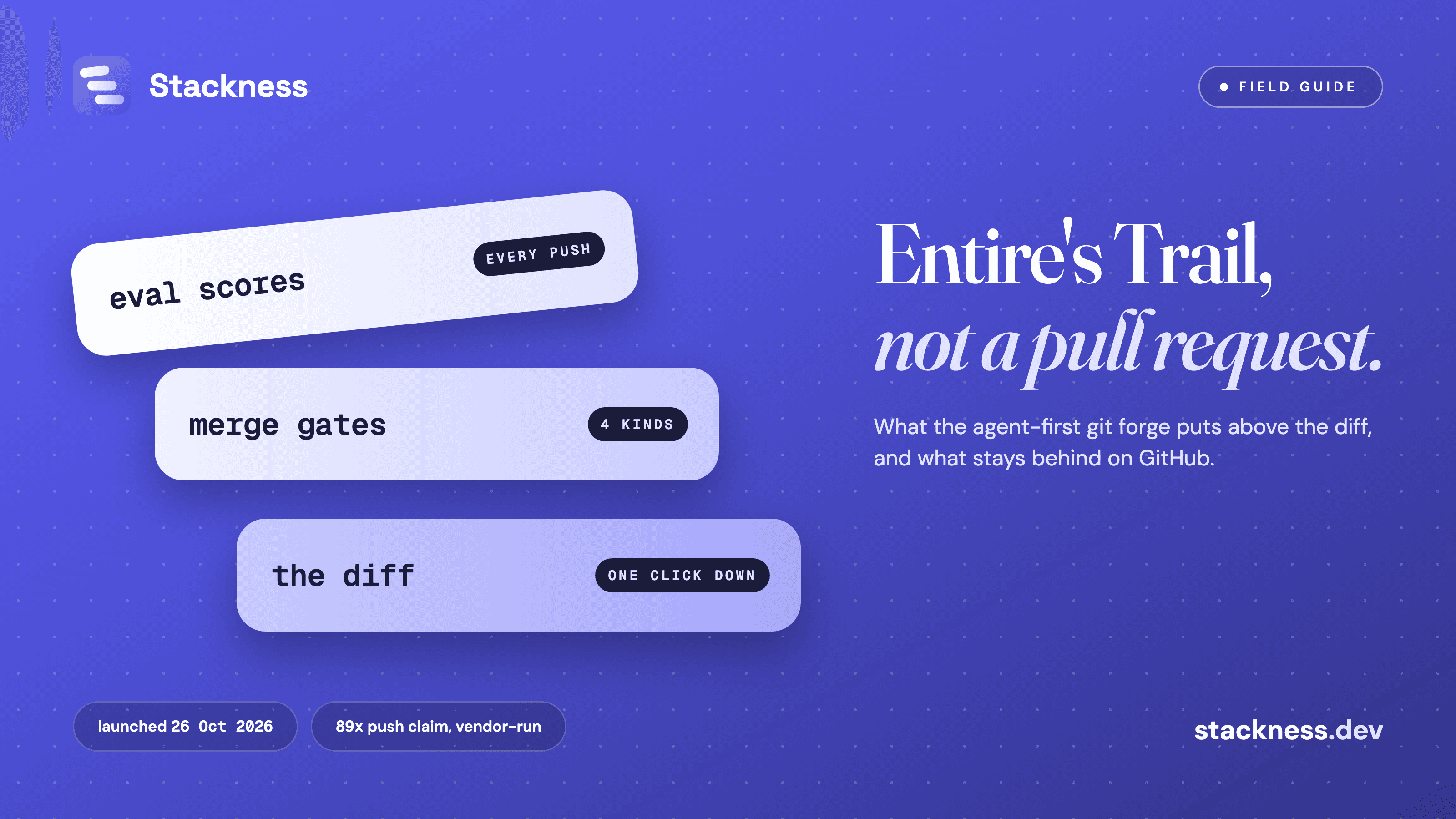
A Trail is the review page of Entire, a git forge that launched on 26 October 2026: review agents score every push, and merge gates for human approvals, open findings and CI decide when code can merge, in place of a pull request's comment timeline. Entire is led by Thomas Dohmke, GitHub's CEO until the end of 2025. It launched with a claim of pushes "up to 89x faster than GitHub", a figure from Entire's own benchmark that no one outside Entire had reproduced as of 29 October. Hosting and Trails are free; the agents bill at model rates, about $0.41 per run in Entire's example.
What is an Entire Trail?
An Entire Trail is a unit of work that starts as a bug report, a feature request or an agent session, collects code changes from one or more repositories, and puts agent-calculated eval scores and merge gates at the top of the page. The diff is one click down. Entire's case against the pull request is that agents have filled its timeline: "The pull request has become an audit log that only the agent reads."
The launch post describes three steps. You start a Trail, from the web interface or from the agent before or after the code exists. On each push, in the launch post's words, "Each agent runs independently in a cloud sandbox and submits a score and a rationale", on Claude Code or Codex in Daytona or E2B sandboxes. Then you clear the findings and merge once the gates pass. "Only when the confidence is high, risk is low, and all findings are cleared, the merge should happen."
A Trail scores every push with agent evals, then gates the merge
A Trail's evals are agent runs configured per repository, and Entire's own benchmark repository shows what one looks like. entireio/forgemark commits its runners as JSON in .entire/runners/: a contract review on OpenAI Codex with gpt-5.6-sol, a security runner on Claude that returns a risk score from 0 to 100, plus risk, summary and semantic-diff runners.
The review runner's prompt is specific to the repository. It asks for "bugs, regressions, broken invariants" and "misleading benchmark results", and says "Do not report style, documentation, naming, test-coverage requests". Each eval tile on the Trail shows the current run and the last five.
The gates are four, each enabled per repository: up to date with the base branch, a minimum of human approvals, no unresolved agent findings above a chosen severity, and passing CI checks. A permitted person can bypass a gate, and "Every bypass is recorded on the Trail." Review agents are not switched on for you: "Creating a trail or enabling Trails does not automatically configure review agents."

The preset review agents a Trail can run. Screenshot of Entire's Trails overview by Entire, 29 October 2026, cropped.
A Trail puts the eval scores above the diff a pull request leads with
The Trail and the pull request differ in what sits at the top and what decides the merge. A GitHub pull request leads with a linear timeline of comments and a diff tab, with CI status and the merge button at the bottom. A Trail leads with eval scores and the gates panel, and keeps the diff, findings and agent sessions below them.
| Pull request | Trail | |
|---|---|---|
| Top of the page | Description and comment timeline | Eval scores with run history, gates panel |
| Unit of work | One branch in one repository | One task, changes in several repositories |
| Merge decided by | Approvals, required checks | Gates: up to date, approvals, findings, CI |
| Agent output | Comments in the timeline | Findings, open ones visible, resolved ones hidden |
| Agent sessions | Linked only for GitHub's own Copilot agent | Checkpoints and memories on the Trail |
On a repository mirrored from GitHub, a Trail still runs on a linked GitHub pull request for CI and merging, and "Entire reviews and GitHub reviews are separate". GitHub branch rules can still block a merge after Entire's gates pass. Dohmke told The New Stack the intent: "if that's green and the confidence is high, then we're merging it." One Hacker News commenter called it "a high-AI-trust approach": review by eval score instead of by reading, close to the verification layers that replace line-by-line review.
Entire sits in the forge slot, next to GitHub and Cursor Origin
Entire takes the forge slot: where the repository lives, where review happens and where merges are decided. Of the newer tools it is compared with, only Cursor Origin is in the same slot and available to use. Scion is Anthropic's internal version control and LayerFS is an agent workspace filesystem.
| Tool | Slot | Review unit | Status, 29 October 2026 |
|---|---|---|---|
| Entire | Forge, git-compatible | Trail | Launched 26 October; private repositories only |
| GitHub | Forge | Pull request | Generally available |
| Cursor Origin | Forge inside Cursor, syncs with GitHub | Pull request | Early beta since 17 August, not on Free or Plus |
| Scion | Version control replacing git in Anthropic's monorepo | Internal review tool | Internal only; "by no means a suitable replacement for git for general use" |
| LayerFS | Filesystem for agent workspaces | None | Open source, MIT, v1.1.0 on 24 October |
The volume behind all of them: GitHub counted 7.38 billion commits in September 2026, "more than five times as many as a year earlier", and its Octoverse report says more than 40% of pull requests now start with an agent, up from 17% in March. I covered Scion and LayerFS separately.
Continuous Memory stores agent sessions in your repository's refs
Entire's Continuous Memory is two things under one name: session checkpoints from the open source Entire CLI, and the entire-graph and entire-brain plugins. Checkpoints hold the prompt and the agent transcript for each commit. Since CLI 0.10.0 they live in your own repository under refs/entire/checkpoints/, and each commit gets an Entire-Checkpoint: trailer.
Who can read them is plain in Entire's security docs: "Anyone with access to your repository can read the checkpoints in it. If your repository is public, so are they." Redaction runs in layers before a checkpoint is written, but no layer scans images, and the docs say it "does not catch every secret". The OpenAI Privacy Filter layer runs only on the older branch-based storage, not on the default. entire-brain keeps memories on your machine until you run entire brain connect, which syncs them to Entire for the team.
The 89x push figure is Entire's own benchmark
The "up to 89x faster than GitHub" figure is Entire's measurement with its own open source tool, ForgeMark, and Entire has not published the conditions behind it. The launch chart reads 418 pushes per second for Entire against 4.7 for GitHub, 65 for Cursor and 10 for GitLab.
Three limits apply. Entire published the tool but not the run: no concurrency, region, repository size or result files. For its July figures, Entire wrote that branches under entire/unmirrored/, which stay in their region, are "what powers the ForgeMark numbers"; mirrored branches write through to GitHub and cannot beat it. And ForgeMark's README says github.com "applies secondary rate limits and abuse detection to high-volume content writes", keeping GitHub runs at low concurrency by default. Entire does not say which concurrency its GitHub run used, so my reading is that 4.7 most likely measures a rate limit, not GitHub's capacity. Entire's numbers also moved: in July it put itself about 26 times ahead of Cursor Origin on pushes; in October, 6.4 times.
What does not move to Entire: issues, pull requests, releases, CI
Moving a repository to Entire moves git data and nothing else. The migration guide says it word for word: "GitHub issues, pull requests, release records and assets, permissions, and replicas do not migrate with Git data." Git LFS objects and submodules need separate handling, and mirrors do not support LFS at all.
GitHub Actions does not run on Entire either. CI comes through plugins, both in public preview: Buildkite, which converts Actions workflows with bk pipeline convert, and Depot, which runs Actions syntax and migrates with depot ci migrate --forge=entire. Review threads go with the pull requests; the guide does not mention CI history or installed GitHub Apps, and neither has an equivalent on Entire. The launch post offers an entire-migrate plugin, but the docs call that repository internal.
Who needs Entire, and who can skip it
Entire fits a team where agents already open most changes, reviewers skim diffs rather than read them, and many agents push to one repository at once. Data residency helps too: projects pick a region in the US, EU, UK, India or Australia. The Trail is the reason to try it; the speed matters only at that push volume.
Skip it for now if the code is open source (public repositories are not supported yet), if you need self-hosting, if the repository uses Git LFS, or if your team runs on GitHub issues, Projects and Actions. Read the conflicts too. Dohmke ran GitHub, Microsoft's fund M12 invested in Entire while Microsoft owns GitHub, and the Buildkite and Depot chief executives are quoted in the launch press release. On Stackness, as of 29 October 2026, GitHub sits on 10 public stacks once bot accounts are removed and Entire, Cursor Origin and Scion on none (how I count); they sit with the other DevOps and infrastructure tools developers list.
Where to start with Entire
The low-risk start keeps GitHub as the source of truth: install the CLI, capture agent sessions in an existing repository, then mirror it and try a Trail.
brew install --cask entireio/tap/entire
entire login
entire enable
entire enable works on any git remote, GitHub included. To try Trails, install the Entire GitHub App, create a mirror with entire repo mirror create, switch on the preset review agents and set the gates per repository. Move to native hosting only after checking the list of what does not migrate. If your agents already write a commit per turn, keeping those commits reviewable is the step before any of this.
Entire in brief
- Price: hosting, Trails, memory and the CLI are free; review agents bill at model provider rates after a one-time $100 credit, about $0.41 per Claude Opus 5.5 run on a 4,000-line diff in Entire's example.
- Licence: the CLI, entire-graph, entire-brain and ForgeMark are MIT; the forge is proprietary, and Entire says EntireDB, its source control server, will be open sourced "in the coming months".
- Self-hosting: not available; self-hosted git nodes are on the roadmap.
- Platforms: web app at entire.com; CLI on macOS, Linux and Windows with Git 2.25 or later; private repositories only.
New posts by email
About one email a week with what we published. No account needed.
One email to confirm first. Every email has a one-click unsubscribe.
Which of these do you use?
Nobody on Stackness runs Entire yet. Tick what you use and be the first.