Build a game with a coding agent: the stack, time and cost behind eight October 2026 games
Tools in this post


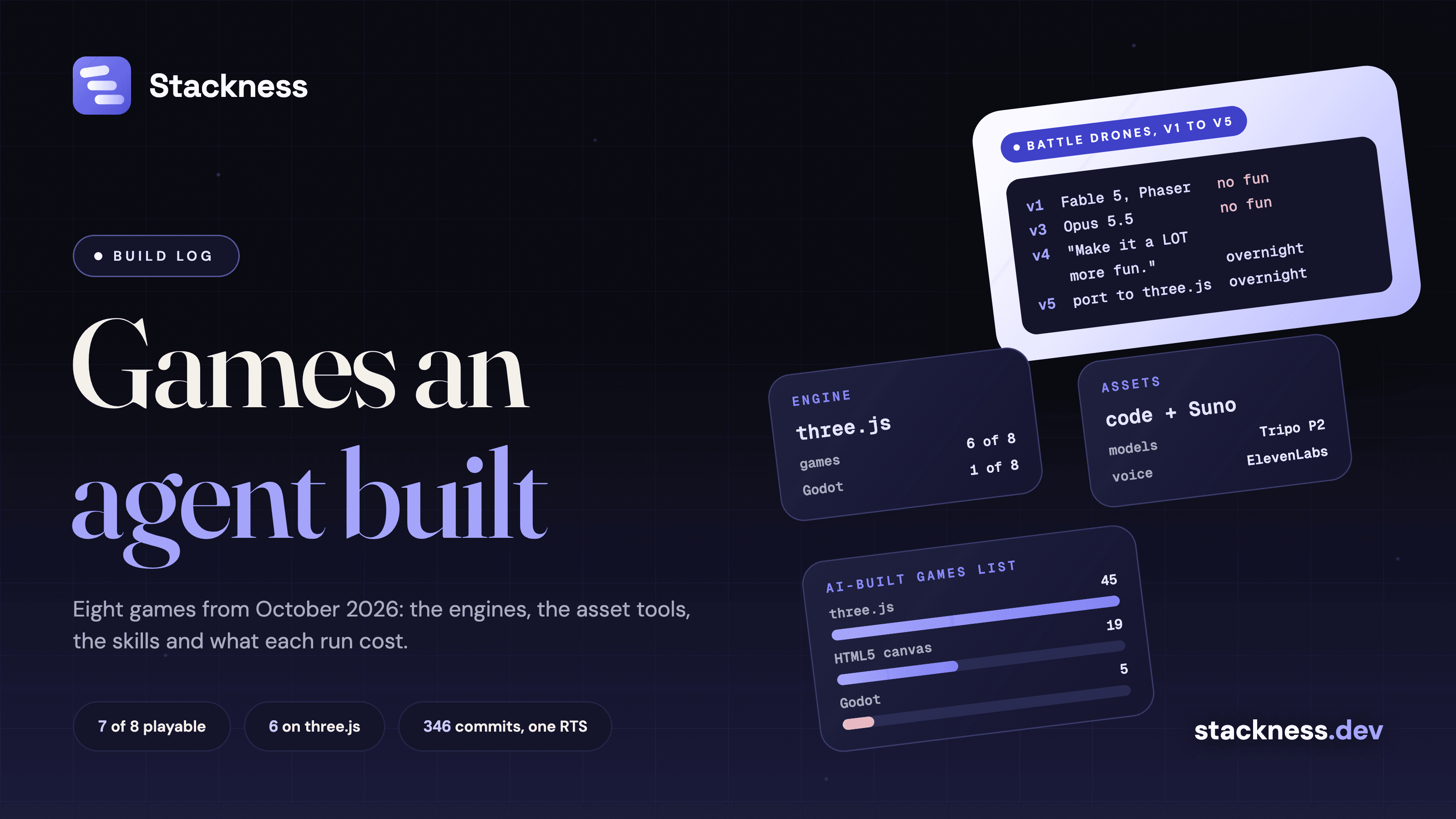
To build a game with a coding agent in October 2026, most builders gave Claude Opus 5.5 a browser game in three.js, static hosting and one blunt instruction to make it more fun. Four builders wrote up eight such games between 14 and 28 October 2026, and seven are playable today. Simon Willison says none of the four games in his 28 October round-up took more than four hours of his own time; the agents ran for hours or days on top. Nobody published a dollar total. The money is flat Claude subscriptions, from one Max 5x plan to four Max 20x plans, plus about $20 a month for 3D models. These are their runs, not mine; I rebuilt them from the posts, repositories and transcripts they link.
How do you build a game with a coding agent?
Building a game with a coding agent in these runs follows one loop: a short prompt to a proof of concept in a chat window, a move to Claude Code once the game outgrows one file, then long unattended runs that add content, playtest and rebalance. Willison's suggested opening is "Build a mobile-friendly three.js game where..." in claude.ai or ChatGPT. When the result is dull, his next prompt is "Make it a LOT more fun".
He calls this the October inflection point for vibe game development, and names game design as the Opus 5.5 improvement that mattered most. The human part is choosing what to keep and reporting what plays badly; it is vibe coding with a playtest loop the agent runs itself.
Four builders, eight games, seven playable
The eight games run from a one-prompt puzzle to a four-month battle royale. Five are Willison's; a Godot RPG exists only as a video. A ninth game the topic lists, a Road Rash port to three.js, is left out: neither the Show HN post nor the site says an agent built it, and it ships the original game's credits and art.
| Game | Builder | Engine | Agent and model | Status, 29 Oct |
|---|---|---|---|---|
| Tree Appreciator | Simon Willison | three.js | claude.ai chat, one prompt | Playable |
| Chirp Pong | Simon Willison | Canvas | Claude Code, Opus 5.5 | Playable |
| Emberwick | Simon Willison | three.js | claude.ai chat, 12 prompts | Playable |
| Battle Drones | Simon Willison | Phaser, then three.js | Claude Code, Fable 5 then Opus 5.5 | Playable, Apache-2.0 |
| Pumpkin Farmer | Simon Willison | three.js | Claude Code, Opus 5.5 | Playable, in progress |
| Mecha Royale | u/m0dE | three.js | Opus on /loop |
Playable |
| Bada Boom Taxi | u/timcorin | three.js | Opus 5.5, "ChatGPT Astra" for assets | Playable |
| Unnamed RPG | Unnamed solo developer | Godot | Claude Code, Opus 5.5 | Video only |
The RPG post gives no name or build and commenters doubt the six weeks, so I count it as a workflow, not a shipped game.
The stack: three.js in the browser, Godot on the desktop
The engine split in these runs is browser against desktop. Seven of the eight games run in a browser, six of them on three.js; only the unnamed RPG uses Godot. In the awesome-ai-built-games list, 45 of 94 entries name three.js and 5 name Godot, a curated list that leans on browser game jams.
Willison's reasons for the browser are practical: no server, play on a phone, and models that know three.js and Phaser "inside out". Battle Drones ran on Phaser for four versions because Claude picked it; Willison says "I didn't even realize this until several iterations later".
Godot's case comes from builders who outgrew that. The RPG's developer chose it for open source, custom tooling and headless scripts. The author of godogen, an MIT-licensed project that has Claude Code or Codex build games in Godot, Bevy, Babylon.js or three.js, wrote on Hacker News that his three.js output "broke the moment you touched anything". Model knowledge has moved too: in March he said models "barely know GDScript", and in October one commenter said Opus 5.5 recommends Godot out of the box while another called its Godot code "flawless".
The stacks, as each builder named them:
- Battle Drones: TypeScript, Vite, Vitest and Playwright smoke tests, Claude Code for web, a Python relay on Fly.io.
- Mecha Royale: TypeScript, three.js, Box3D physics, Suno and ElevenLabs for audio.
- Mecha Royale's plan: "4 20x max", four Claude Max 20x subscriptions, per the developer's reply on Reddit.
- Bada Boom Taxi: three.js with glTF models, Suno for music, a Claude Max 5x plan and "the cheaper ChatGPT plan for some assets".
- The Godot RPG: Claude Code on Max 20x, Tripo P2 for large 3D assets, Blender for small ones, Obsidian for research notes.
Art, models and music come from code, Tripo and Suno
Assets in agent-built games come from three places: code the agent writes, a paid generator, or Blender. Battle Drones has no audio files and no imported models; its vehicles are "entirely constructed by Claude in TypeScript code", and its music and robot voices are synthesised live. Its terrain, menu art and icons come from OpenAI's image API, called by Claude with a key Willison gave it.
The others bought generators: ElevenLabs and Suno for Mecha Royale, "Good ol suno" for Bada Boom Taxi. The RPG's developer generates large models in Tripo P2 from reference images, models small props in Blender and textures them in Tripo to keep the bill down, which they put at "around $20/month". Godogen defaults to free local generation on an NVIDIA GPU, with Tripo3D, Gemini images and Lyria music as paid fallbacks.
The run: Battle Drones from Phaser sprites to a three.js RTS
Battle Drones is the only one of the eight games with its code, commits and most of its prompts public, so it is the run to copy. Fourteen versions went up between 17 July and 24 October 2026, most after 6 October, in 346 commits written mainly by Claude Code.

The Compass Rose map in Battle Drones v14, captured by the agent. Image: simonw/battledrones by Simon Willison, Apache-2.0, resized.
Fable 5 builds a game nobody wants to play
Version 1, in July, came from a design Q&A with Claude Fable 5. Willison's verdict: it "wasn't any fun to play". Version 3, now on Opus 5.5 in October, added maps and regenerated art and still "wasn't very fun".
One prompt and an overnight workflow add the fun
Version 4 came from "This game isn't fun enough yet. Make it a LOT more fun.", run as a Claude Code dynamic workflow from Willison's phone, from evening until "late into the next morning". Willison describes over a thousand simulated playtests; Claude's own release notes count 1,200 AI-against-AI test matches and say games still undecided after 25 minutes fell from 14% to 0.9%. Those are the agent's numbers, relayed by Willison and not checked by anyone else.
A port to three.js and a map per prompt
Version 5 was another overnight run: "Port this game to three.js with 3D models for all of the buildings and vehicles and landscapes". Later versions added units, an archipelago map from a prompt that included "First research and then critique this design. Only build after we have agreed on any modifications", random maps in 45 minutes, multiplayer over audio chirps borrowed from Chirp Pong and an online relay.
The skills solo builders wrote: route, handoff and a playtest loop
The custom skills in these runs solve two problems: a subscription that runs out and a context window that fills up. The RPG's developer wrote a "route" skill, in which Opus sends suitable work to Sonnet or Haiku and reviews the result, and a "handoff" skill that starts a fresh session with the same setup and only the context it needs.
The same developer added "Re-searcher", which checks research claims and stores them in Obsidian so later sessions do not work from "a summary of a summary", plus an art-direction skill and a JSON library of every image prompt that worked. One commenter's summary: "you only write the handoff skill after losing a session to context".
Godogen started in March with an orchestrator skill that planned, an executor that ran each piece in a forked context and a separate Gemini Flash agent that judged screenshots without seeing the code. By July its changelog shows the two skills merged, the Gemini pass dropped and the agent checking its own captured frames. The Battle Drones repository holds no skills; the dynamic workflows and agent-built tools did that job. In his words, "Tools are effectively free": Claude also built a model browser, a battle replay viewer and balance harnesses.
What it cost: subscriptions, not invoices
Every builder here paid a flat subscription, so none can price a single game. The one measured run time is Tree Appreciator's: about 3 hours 7 minutes and 154 tool calls from one prompt to a published page, by Claude's own reading of its session log.
| Game | Plan or spend | Agent time | Human time | Size |
|---|---|---|---|---|
| Tree Appreciator | Not stated | About 3 h 7 min, 154 tool calls | One prompt | 74 KB page, compressed |
| Battle Drones | Claude plan, tier not named; relay at most $2.19 a month | Several overnight workflow runs | Four hours at most | 346 commits, about 540 KB initial JS and CSS, compressed |
| Pumpkin Farmer | "millions of tokens" | "nearly two days" | Four hours at most | Not stated |
| Mecha Royale | Four Claude Max 20x plans | /loop "non-stop for a full week" on assets |
About four months | "20MB", disputed in comments |
| Bada Boom Taxi | Claude Max 5x plus a ChatGPT plan | Not stated | Not stated | Not stated |
| Godot RPG | Claude Max 20x, Tripo about $20 a month | Not stated | About six weeks | No build |
| A godogen game | $5-8 estimated at API rates, March 2026 | One generation run | Not stated | Not stated |
The two compressed sizes are mine, measured with curl on 29 October; the rest are the builders' figures. On Stackness, as of 29 October 2026, Claude Code sits on 8 public stacks once bot accounts are removed, one of them mine, and three.js, Godot and Blender on none (how I count). The models sit with the other AI tools developers list.
Where the runs broke
The runs broke in game logic, in what the agent cannot see and on real hardware. Willison's Emberwick prompts read as a bug list: a tomb reached by dropping off a hill, companions that "vibrate back and forth near a wall", a quest reward that never fired because an NPC was missing, a save lost on refresh.
- The agent cannot see the screen. Godogen's author described floating assets and paths that lead nowhere; one Godot user called Claude Code with Godot "a total failure" for an RPG area because it could not tell where the doors were. Godogen's frame checks exist for this.
- Animation and model cleanup. Godogen's author wrote in March that "Animation is the main remaining gap"; its October README now advertises generated rigging and animation. A commenter on the RPG thread: "coding isn't the bottleneck it's the asset pipeline".
- Performance. Mecha Royale players report 15 fps on a GTX 1060 and memory past 1.4 GB. The agent tested Tree Appreciator only in software WebGL.
- Determinism.
Math.sinandMath.cosdiffer slightly between Chrome and Safari, which broke Battle Drones replays until Claude wrote deterministic versions. - People. Battle Drones' audio multiplayer gave Willison's wife "a nasty headache". He will not enter these games in game jams, and Bada Boom Taxi borrows from a film studio's IP.
Run it yourself
The run to copy is Battle Drones, public under Apache-2.0. Clone it, read web-session-prompts.md, which covers the sessions up to 13 October, and start a smaller game the same way: a design Q&A first, then the build, then one long "make it more fun" run with playtests.
git clone https://github.com/simonw/battledrones
cd battledrones
npm install
npm run dev
Then prompt your own game in claude.ai or Claude Code with "Build a mobile-friendly three.js game where...", and host it on GitHub Pages. If you want Godot instead, start from godogen's README, which sets up Claude Code or Codex for it. Before a long unattended run, write a handoff note or skill, so a full context window costs a restart rather than the session. Battle Drones itself was rewritten on purpose once, from Phaser to three.js at version 5, so expect at least one rewrite of your own.
New posts by email
About one email a week with what we published. No account needed.
One email to confirm first. Every email has a one-click unsubscribe.
Which of these do you use?
Nobody on Stackness runs Three.js yet. Tick what you use and be the first.