Trending developer tools, September 2026
Tools in this post


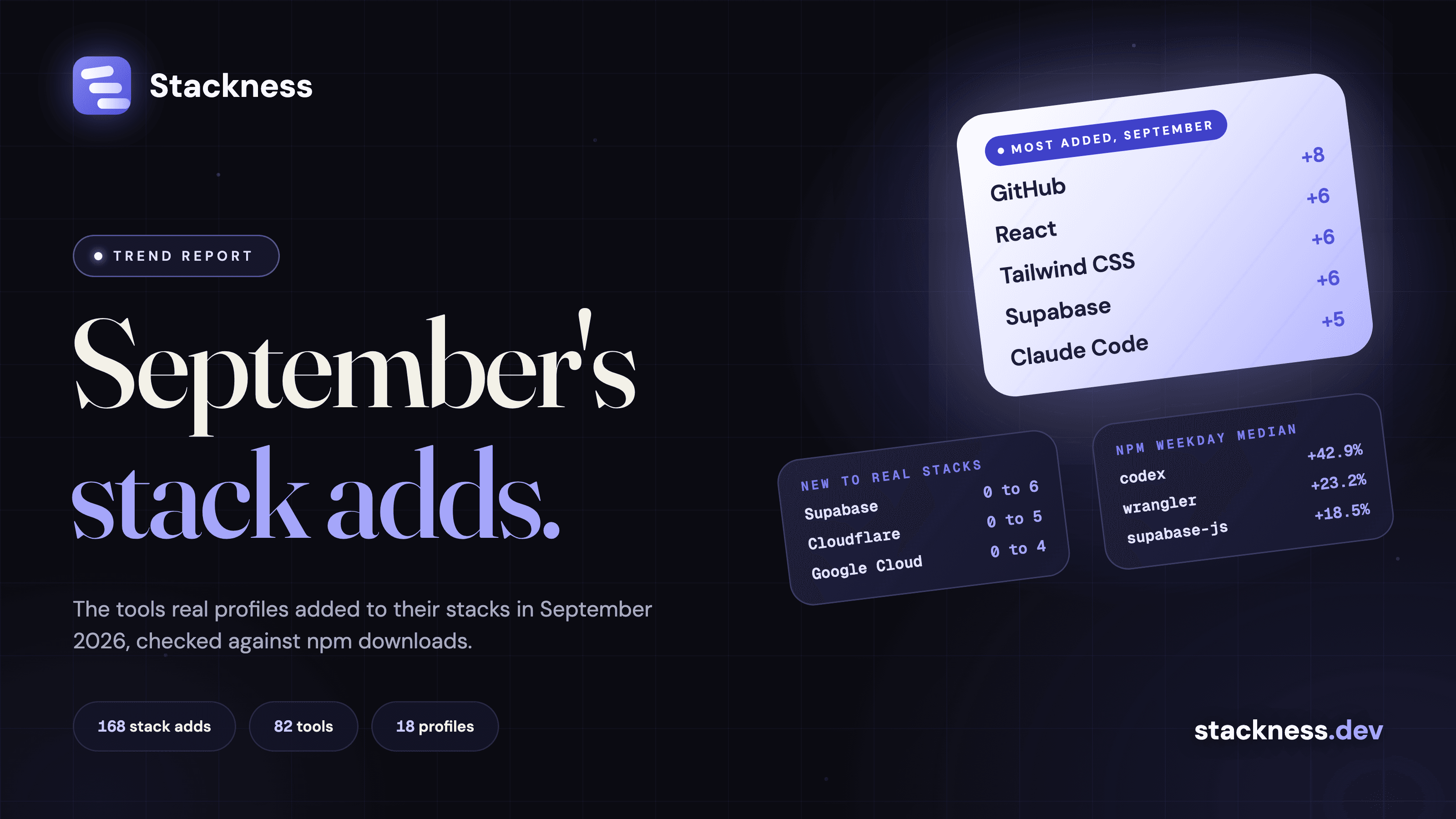
GitHub was the most added developer tool on Stackness in September 2026. 8 of the 18 profiles that added anything put it in their stack, which took it from 1 profile to 9. React, Tailwind CSS and Supabase followed with 6 adds each. Supabase and Cloudflare started the month on no profiles and ended it on 6 and 5.
The numbers are small. Between 1 and 30 September, 168 public stack entries were added across 82 tools, and 154 of them came from 17 profiles created that month, after the Product Hunt launch on 12 September. This is what a launch cohort lists first, checked below against npm downloads and two larger surveys. The August roundup was written from outside sources. This is the first one built on Stackness data.
Which developer tools were added to the most stacks in September 2026?
GitHub, with 8 adds. React, Tailwind CSS and Supabase tied on 6. Claude Code, Docker, Cursor, Next.js and Cloudflare had 5 each, and 7 tools tied for tenth place on 4. Counts are public stack entries created from 1 to 30 September 2026, with bot accounts removed, as of 2 October 2026 (data sources).
| Tool | Adds in September | Profiles on 31 August | Profiles on 30 September |
|---|---|---|---|
| GitHub | 8 | 1 | 9 |
| React | 6 | 1 | 7 |
| Tailwind CSS | 6 | 1 | 7 |
| Supabase | 6 | 0 | 6 |
| Claude Code | 5 | 2 | 7 |
| Docker | 5 | 2 | 7 |
| Cursor | 5 | 1 | 6 |
| Next.js | 5 | 1 | 6 |
| Cloudflare | 5 | 0 | 5 |
| Claude | 4 | 2 | 6 |
| GitHub Actions | 4 | 2 | 6 |
| PostgreSQL | 4 | 2 | 6 |
| AWS | 4 | 1 | 5 |
| Node.js | 4 | 1 | 5 |
| TypeScript | 4 | 1 | 5 |
| Google Cloud | 4 | 0 | 4 |
By category, 56 of the 168 adds (33%) were DevOps and infrastructure tools, 45 were languages and frameworks and 30 were AI tools. 20 profiles had a public stack on 30 September, and 11 of them list at least one coding agent or AI editor.
Why did GitHub come first?
Most likely because September was a month of first stacks. 17 of the 18 profiles that added tools were created that month, and 46 of the 168 adds landed on 12 and 13 September. I read a first stack as a list of what its owner already uses, not what they picked up that month. The data cannot confirm that: only 4 of those 154 entries are backdated to an earlier start.
On the new profiles, GitHub sits next to Docker, Next.js, React, Tailwind CSS or Supabase on 5 profiles each. No other pair of tools shows up more often.
Which tools are rising?
On Stackness, Supabase and Cloudflare: no profile on 31 August, 6 and 5 on 30 September. With new profiles listing what they already use, that is tools arriving on the site, not people adopting them in September. Outside Stackness, the clearest riser is OpenAI Codex, with the largest npm rise of the 9 packages I checked.
- Supabase. 4 of the 6 profiles also list Next.js and 5 list a coding agent or AI editor. Two documented links to AI tooling: Lovable's docs say its built-in backend "utilizes Supabase's open-source foundation" (Lovable docs), and Supabase publishes MCP setup steps for Claude Code, Codex, Cursor and OpenCode (Supabase docs). Shipped on 30 September:
@supabase/middleware1.0, which runs on Cloudflare Workers, Vercel Functions, Deno, Bun and Node 22 or newer. - Cloudflare. All 5 profiles also list Next.js and 3 list Supabase. One of the 5 is mine. Shipped: Cloudflare dropped the compressed Worker size limit (3 MB free, 10 MB paid) on 4 September, leaving a 64 MiB uncompressed limit on all plans, and Worker Previews gave each pull request its own environment on 22 September. In beta: the
cfCLI, from 28 September. The same day Cloudflare released Vinext 1.0, which runs Next.js apps on Vite. Cloudflare reports "more than 99%" test compatibility with Next.js, excluding cache components (Cloudflare blog). - OpenAI Codex. 2 profiles, up from none, and one of the two is mine. Its median weekday npm downloads rose 43%. JetBrains measured it at 16% of professional developers in May to July, up from 3% in January. OpenAI released GPT-6 Astra on 3 September, GPT-6 Sol and Luna on 22 September and GPT-6.1 Sol on 29 September (OpenAI changelog).
OpenCode also went from 0 to 2 profiles. Its September was 9 patch releases, 4 of which touched GPT-6 or Opus 5.5 support (releases). Google Cloud went from 0 to 4, one of them mine.
Do npm downloads agree?
Mostly. Median weekday downloads rose from August to September for every package I checked except one. React, Tailwind CSS and TypeScript rose 10% to 14%, which I read as the return from a holiday month. 4 packages beat that range by a clear margin: @openai/codex at 43%, wrangler at 23%, and next and @supabase/supabase-js at 19% each. @anthropic-ai/claude-code fell 26%.
| Package | Median weekday downloads, August | September | Change |
|---|---|---|---|
@openai/codex |
2.62M | 3.74M | +42.9% |
wrangler |
3.12M | 3.85M | +23.2% |
next |
8.82M | 10.46M | +18.6% |
@supabase/supabase-js |
3.86M | 4.58M | +18.5% |
opencode-ai |
0.37M | 0.42M | +14.7% |
typescript |
45.24M | 51.48M | +13.8% |
react |
28.22M | 31.82M | +12.8% |
tailwindcss |
20.55M | 22.67M | +10.3% |
@anthropic-ai/claude-code |
3.52M | 2.60M | -26.1% |
Source: the npm downloads API, fetched 2 October 2026. I used the median weekday because the API reports zero downloads for every package on 14 August and on 3, 7, 8 and 15 September, which makes monthly totals unreliable. Downloads count installs by CI jobs and containers as well as by people.
The Claude Code fall is the one number that points the other way. It gained 5 profiles on Stackness, and JetBrains has it as the most used coding agent. I found no stated cause. The package is not deprecated, though Anthropic's setup docs recommend a native installer whose downloads do not pass through npm. August was a spike: the median weekday almost doubled from July, 1.77M to 3.52M. The fall is also concentrated in the Linux x64 build, down 38% on a median weekday, while the Apple silicon build fell 4%. That looks more like automated installs than people leaving, but that is my reading and not a sourced fact.
How does this compare with larger surveys?
On 20 Stackness profiles, Cursor is listed 6 times and GitHub Copilot once. JetBrains asked more than 15,000 professional developers between May and July 2026 and reported Cursor at 12% and GitHub Copilot at 21%. Claude Code leads both: 7 of 20 profiles, and 39% in the survey. 20 profiles, most of them created after a launch, are not a representative sample.
| Tool | Stackness profiles, 30 September (of 20) | JetBrains survey, May to July 2026 |
|---|---|---|
| Claude Code | 7 | 39%, up from 18% in January |
| Cursor | 6 | 12%, down from 18% in January |
| OpenAI Codex | 2 | 16%, up from 3% in January |
| OpenCode | 2 | 7% |
| GitHub Copilot | 1 | 21%, down from 29% a year earlier |
The JetBrains figures are self-reported use at work, reweighted to the global developer population. JetBrains sells its own AI coding tools, so it is not a neutral observer. For Tailwind CSS, State of CSS 2026 has 1,854 of the 3,697 developers who answered its framework question using it, which is 50%. On Stackness it is 7 of 20.
What shipped in September 2026 that changes a stack?
Model releases on 3, 22 and 28 September, and 6 other changes. Two need action: the Next.js security fix of 22 September, and the removal of Node 20 from GitHub Actions on 23 September, which puts every JavaScript action on Node 24. Everything below shipped, except where it says announced.
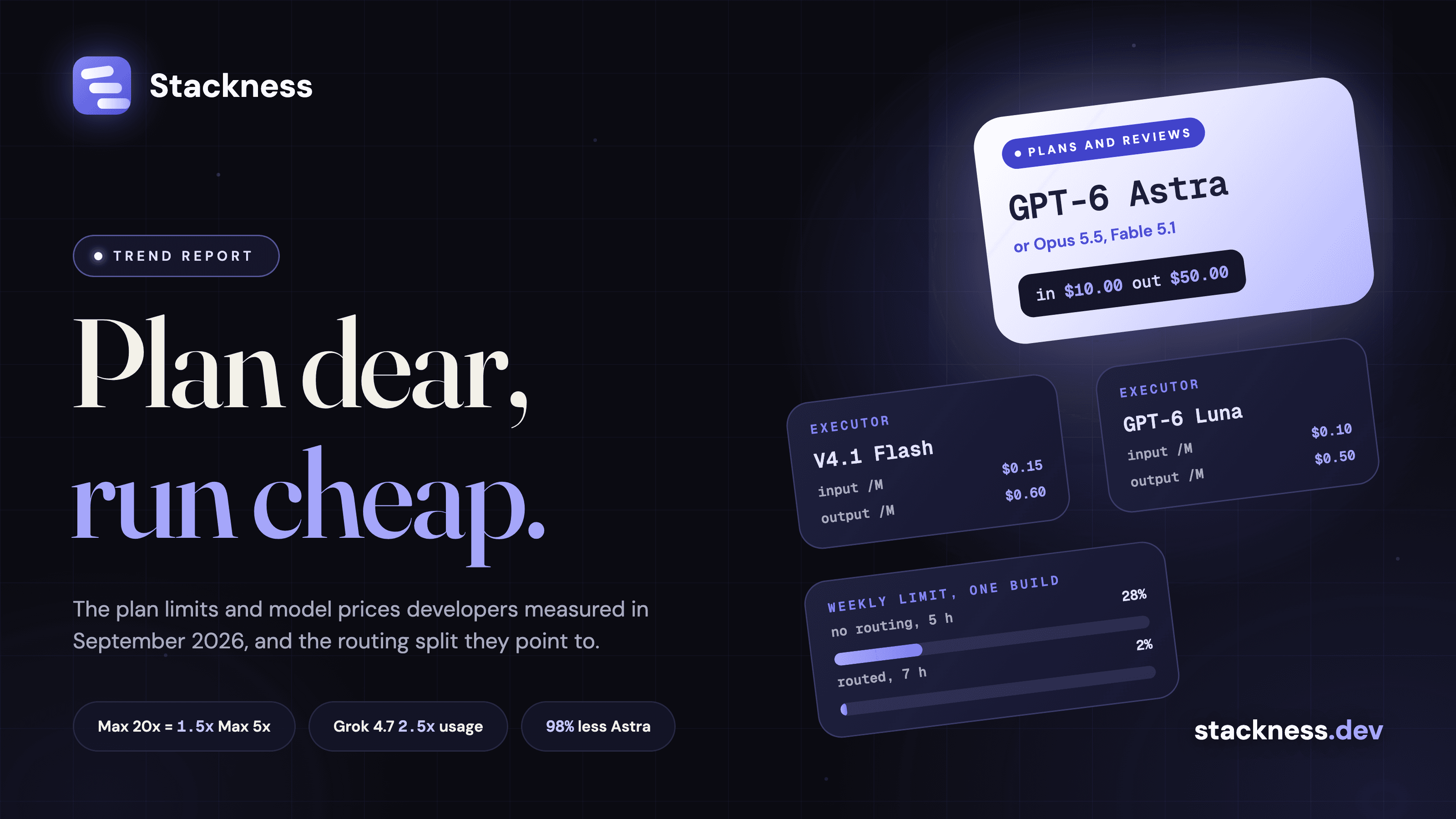
- 3 September. GPT-6 Astra, at $10 input and $50 output per million tokens (OpenAI pricing).
- 9 September. React 19.3 made
<ViewTransition>and Fragment Refs stable. - 9 September, announced. Tailwind Labs is joining Shopify. The post says nothing changes for the open-source projects and they stay MIT-licensed.
- 18 September. Claude Code 2.1.277 started reading AGENTS.md in projects with no CLAUDE.md (changelog). I covered that in AGENTS.md vs CLAUDE.md.
- 22 and 28 September. Claude Opus 5.5 at $4 input and $20 output per million tokens, 20% below Opus 5 (Anthropic), and GPT-6 Sol and Luna the same day. Claude Sonnet 5.5 followed on 28 September (my comparison of the two).
- 22 September. Next.js fixed a critical remote code execution bug in the Node.js
ImageResponse. Versions from 16.2.0 up to 16.3.5 are affected. Upgrade to 16.3.6 or later. - 23 September. GitHub Actions removed Node 20. JavaScript actions now run on Node 24 and the opt-out is gone.
- 24 September. Docker Cloud Sandboxes launched for running coding agents, from $0.07 an hour for 1 vCPU and 2 GiB.
How many moves were published in September 2026?
21 public moves, the techniques people use with their tools. 15 came from the Stackness account, which writes them up from public trend feeds. 6 came from member accounts: 3 are mine and 1 is a test post. Claude Code is tagged on 8 of the 21. No move has more than one reaction, so I cannot rank them.
The only one with more than one comment is a member's write-up of moving an outreach workflow to HY3. By the author's own count it costs about $0.02 in model spend per contacted company across 364 companies, or $0.21 with all spend counted.
What do these numbers not show?
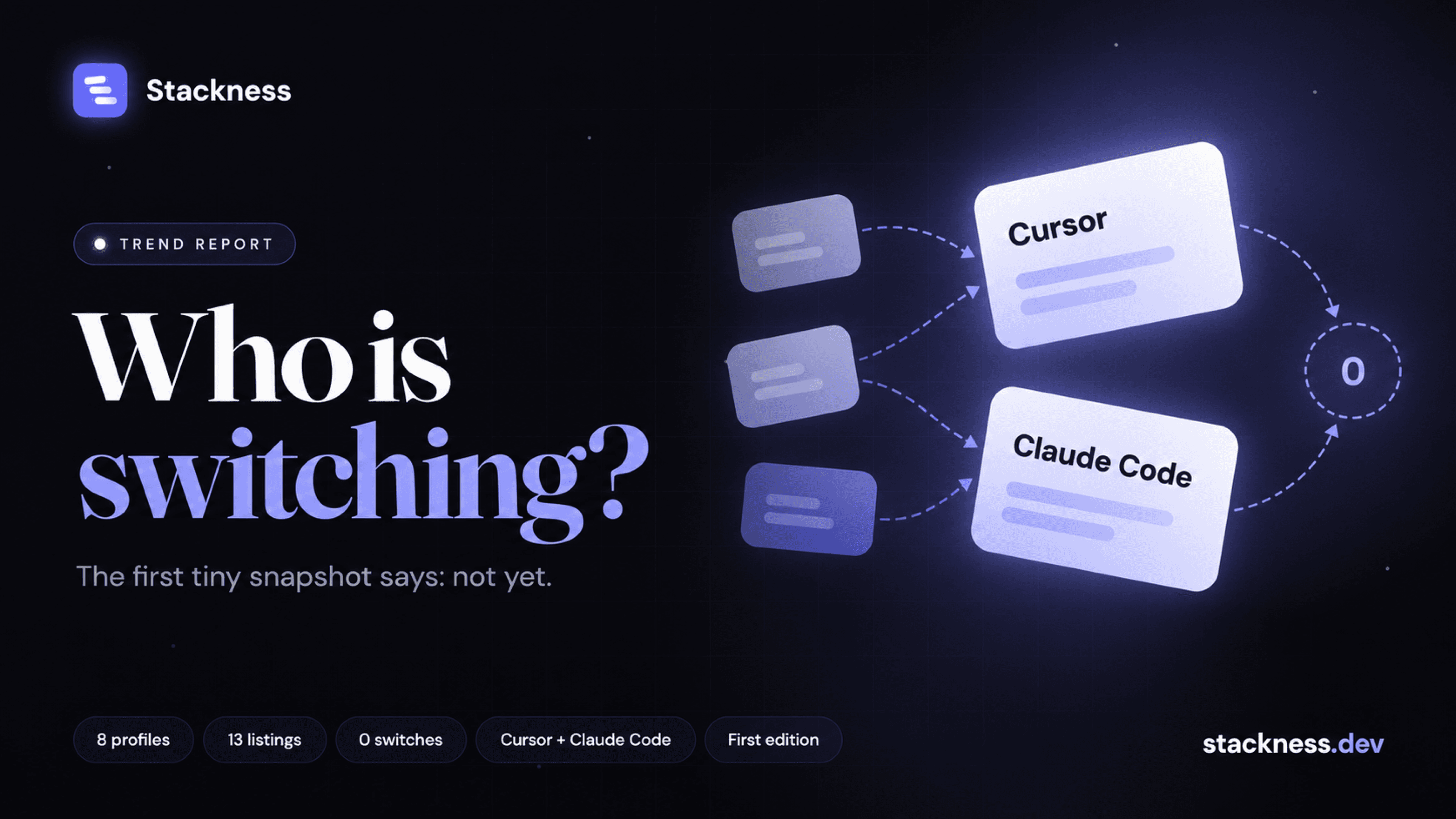
They do not show switching, removals or a representative sample. Most adds come from new profiles, a deleted stack entry leaves no public trace, and 14 of the 168 adds are mine. The live trending page also counts differently, so its numbers can be higher than the ones here.
- The live page. The trending tools page counts a rolling 30 days and includes the test bot accounts. It shows 10 adds for GitHub where this table shows 8.
- Switches. Switches with dates are in which AI coding tools developers are switching to.
- My adds. They include one each for Cloudflare, AWS, Google Cloud and Codex.
- Uneven profiles. 9 of the 18 added three tools or fewer, and 5 of those 9 added only what look like their own products. The other 9 added between 6 and 31, so one thorough profile moves most rows.
Key numbers
- 168 public stack entries added across 82 tools by 18 profiles, 1 to 30 September 2026. Stackness, bot accounts removed.
- 8 adds for GitHub, from 1 profile to 9. 6 each for React, Tailwind CSS and Supabase.
- 0 to 6 profiles for Supabase and 0 to 5 for Cloudflare between 31 August and 30 September 2026.
- 154 of the 168 adds came from 17 profiles created in September 2026.
- 11 of 20 profiles with a public stack list a coding agent or AI editor, as of 30 September 2026.
- +42.9% median weekday npm downloads for
@openai/codexand -26.1% for@anthropic-ai/claude-code, August to September 2026. npm downloads API. - 39% of professional developers use Claude Code at work and 16% use Codex. JetBrains, May to July 2026, more than 15,000 respondents, self-reported.
Quick answers
What were the trending developer tools in September 2026? On Stackness, GitHub was added most (8 profiles), then React, Tailwind CSS and Supabase (6 each), then Claude Code, Docker, Cursor, Next.js and Cloudflare (5 each). The sample is 18 profiles, most of them new that month.
Which developer tools were rising in September 2026? Supabase and Cloudflare went from no Stackness profiles to 6 and 5. Outside Stackness, OpenAI Codex had the largest npm rise of the packages checked, 43%, and 16% adoption in the JetBrains survey, up from 3% in January.
Did Claude Code lose users in September 2026? The data here does not say so. Its npm downloads fell 26% on a median weekday, mostly in the Linux x64 build, after a spike in August. It gained 5 profiles on Stackness and leads the JetBrains survey at 39%.
Why do Supabase and Cloudflare show up together? 3 of the 5 Cloudflare profiles also list Supabase, and one of the 5 is mine. That is too few to explain. I found no measurement of how many developers adopt the two together.
Tools in this post
 Docker
 Cursor
 Next.js
 Claude
 GitHub Actions
 PostgreSQL
 AWS
AWS Node.js
 TypeScript
 Google Cloud
 OpenAI Codex
 Lovable
 OpenCode
 Vercel
 Deno
Deno Bun
Bun Vinext
 Vite
Vite
 GPT
GPT
 GitHub Copilot
 Claude Opus
 Claude Sonnet


 and 23 more from this post
Use any of these tools?
Put them on a Stackness profile, say how you use each one and see who pairs them the same way. It takes a couple of minutes.