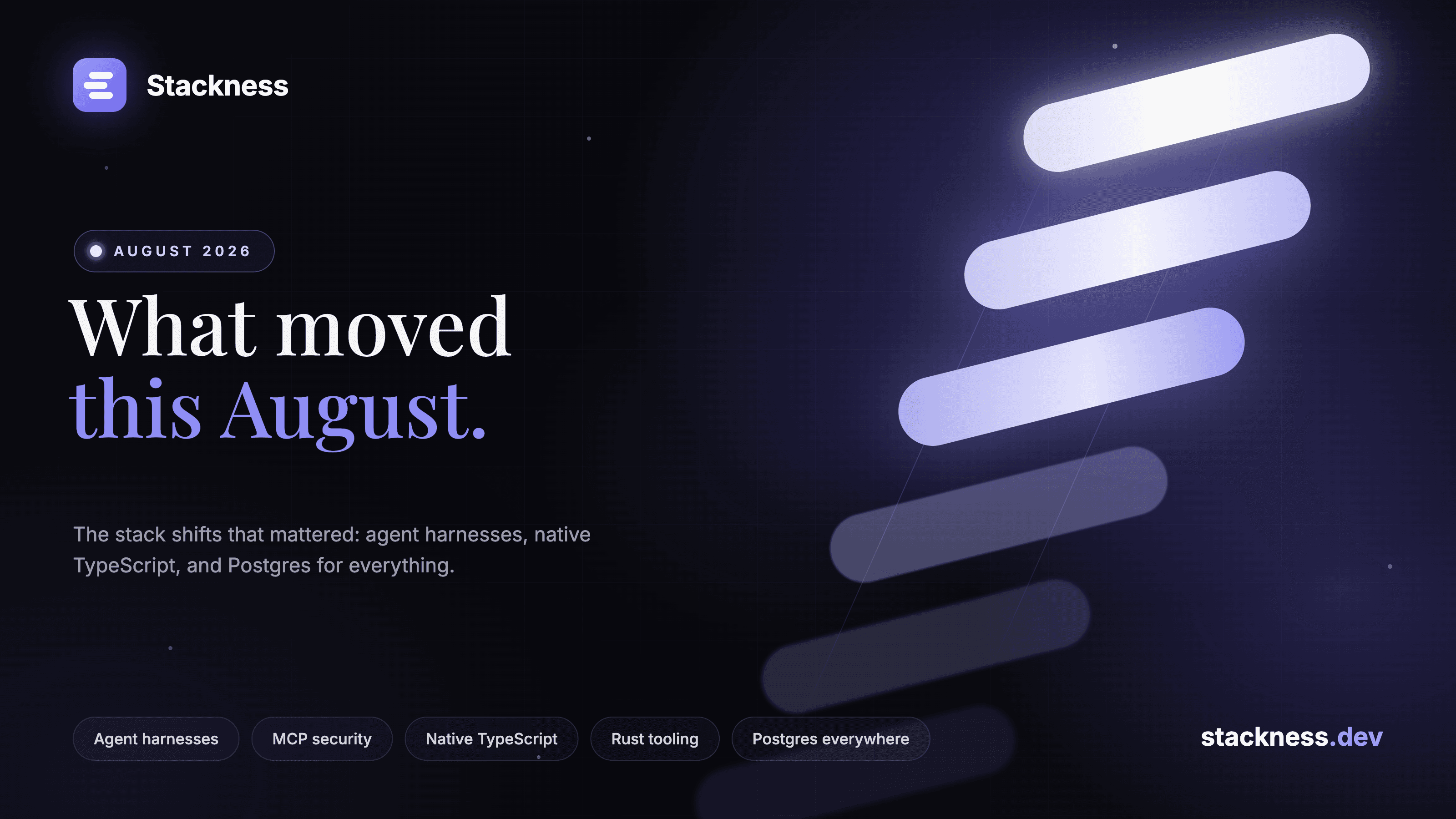
August 2026 in dev stacks: agent harnesses, native TypeScript, and Postgres for everything


In August 2026 the shifts in developer stacks happened around the tools rather than in them: coding agents competed on harness features, an audit found 91.8% of 640 production MCP servers with no OAuth, and Node.js 24 started running TypeScript without a build step. The common thread was consolidation.
The harness is the product now
In AI-assisted coding, the news this month was everything wrapped around the model.
Claude Code moved to Opus 5, and the features people talk about are harness features: an effort dial per request, model control per subagent, cheaper tokens for near-flagship output. Cursor 3 shipped its own take on orchestration in the same window. An August roundup of agent tooling put it well: the model got cheaper and the harness got smarter.
GitHub's trending page tells the same story from the community side. TechTarget's look at the August leaderboard had Matt Pocock's skills repo at number one with nearly 11,000 new stars in a week, with curated skill collections for coding agents close behind. Skills are plain markdown files that teach an agent a workflow. Prompt engineering grew a file format, and it is versioned in git like everything else.
If you still compare agents by model benchmarks, you are reading last year's spec sheet. The differences that matter now are how a tool manages context, spawns subagents, and handles permissions. Autocomplete tools like GitHub Copilot are still where most teams start, but the ceiling has moved well past accepting grey text.
MCP got big enough to get audited
Model Context Protocol stopped being a curiosity a while ago - WorkOS counts about 97 million monthly SDK downloads and adoption by every major model vendor since it moved to the Linux Foundation's Agentic AI Foundation last December.
August was the month the bill arrived. Research published in July found over 21,000 MCP server instances exposed to the internet, and of 640 production servers audited, 91.8% had no OAuth at all. That turned the MCP Dev Summit in Seoul in mid-August from a routine community meetup into a fairly tense one.
This is not a protocol flaw but the same story as early REST APIs and early GraphQL: people ship the happy path first and the auth later. If you run an MCP server, treat it like any other public API surface - scoped keys, rate limits, audit logs, and no anonymous write paths. I run an MCP server for Stackness myself, and API-key auth plus boring rate limiting was most of the work. That is not glamorous, but neither is having your internal tooling enumerated by a scanner.
TypeScript stopped needing a build step
Three numbers from this summer's State of TypeScript: 78% of professional developers now write TypeScript, Node.js 24 strips types natively by default, and TypeScript 6.0.3 in April was the last release of the compiler written in TypeScript itself. TypeScript 7 is the Go port, with roughly 10x faster type checking.
Put those together and the shape of a 2026 TypeScript project looks different. Bun and Deno have executed .ts files directly for years, and now Node does too, so the transpile step is disappearing from local dev entirely. Type checking is becoming something that runs in CI and in your editor, not something standing between you and a running process. If your project still has a build pipeline whose only job is erasing type annotations, this is a good month to delete it.
The great rewrite gets its first hangover
The pattern of rewriting JavaScript and Python tooling in compiled languages kept paying out this month: Biome lints around 56x faster than the setup it replaces, uv has effectively become the default way to manage Python projects, and Vite's Rust-based bundling keeps absorbing the rest of the front-end toolchain.
But August also delivered the counterexample. One of the most active Lobsters threads this week is titled "Bun 1.4 Rust rewrite is not looking good", and the discussion is a useful corrective: rewrites of runtime-critical code trade a known set of bugs for an unknown one, and the performance win on a benchmark does not always survive contact with production workloads.
Adopt the rewritten tools where the job is mechanical and the win is measurable - linting, formatting, installing, resolving. Be slower and more suspicious where correctness is subtle. A linter that crashes costs you a CI run. A runtime that miscompiles costs you a weekend.
Postgres for everything, again, and this time with agents
"PostgreSQL for Everything" hit the Hacker News front page again this week, which happens roughly once a quarter and is somehow news every time. The argument has not changed: PostgreSQL does queues, full-text search, vectors, JSON, and analytics well enough that most products never need the second database.
What has changed in 2026 is who is querying it. Coding agents speak SQL fluently and Postgres is the thing they have seen the most of, so it has become the default substrate for AI-adjacent workloads too - The New Stack's take is that the boring database turned out to be the AI infrastructure that works. On the ops side the consolidation is just as visible: per the Data on Kubernetes report, 72% of organizations now run databases on Kubernetes, with operators like CloudNativePG doing the work a DBA team used to.
Docker Compose with one Postgres container is still the best local dev setup nobody wants to blog about.
Platform teams are shipping a blessed stack
The consolidation shows up at the org level too. The platform engineering trend this year is fewer tools, curated harder: internal developer platforms with a supported, integrated set of defaults, instead of every team assembling its own toolchain from scratch.
That is partly governance and partly economics, but mostly it is an admission that stack choices are decisions worth writing down. The teams doing this well maintain a living record of what they use and why, so the next engineer inherits reasons instead of folklore. That is, full disclosure, the itch Stackness exists to scratch - a public page for your stack and the moves you use it with. The blessed-stack idea works at the team scale and at the personal scale alike.
Quick hits
Mojo went open source, which removes the biggest reason people gave for ignoring it.
Mastodon 5.0 landed with a rework the project calls foundational, and the fediverse discourse restarted on schedule.
Open-weight model economics keep compressing the API market: token costs fell 13.6% and DeepSeek overtook Google on serving volume. The margin is moving to infrastructure and developer experience, not raw model quality.
"HTML can do that" made the rounds again - dialogs, popovers, and native form validation keep replacing JavaScript that no longer needs to exist.
What tied August together?
Every section above describes the same trend: consolidation. One database instead of four, one runtime behavior across Node, Bun, and Deno, one curated stack instead of a tool sprawl, and agents as the new consumers of all of it. August rewarded noticing what you can now remove more than adopting something new.
If you keep a mental list of what your own stack looks like after a month like this, make it a real one - build your stack page on Stackness and let it argue for itself.
Key numbers
91.8% of 640 audited production MCP servers had no OAuth, and over 21,000 MCP server instances were exposed to the internet, per research published in July 2026 (Forkast).
About 97 million MCP SDK downloads a month, per WorkOS.
78% of professional developers write TypeScript, per the State of TypeScript 2026.
72% of organizations run databases on Kubernetes, per the Data on Kubernetes report.
13.6% fall in token costs, the same week DeepSeek overtook Google on serving volume, per OriginBrief.
New posts by email
About one email a week with what we published. No account needed.
One email to confirm first. Every email has a one-click unsubscribe.
Which of these do you use?
Nobody on Stackness runs Model Context Protocol yet. Tick what you use and be the first.