Gemini Decision 1 vs Jev: price, latency, media input and the thresholds a switch breaks


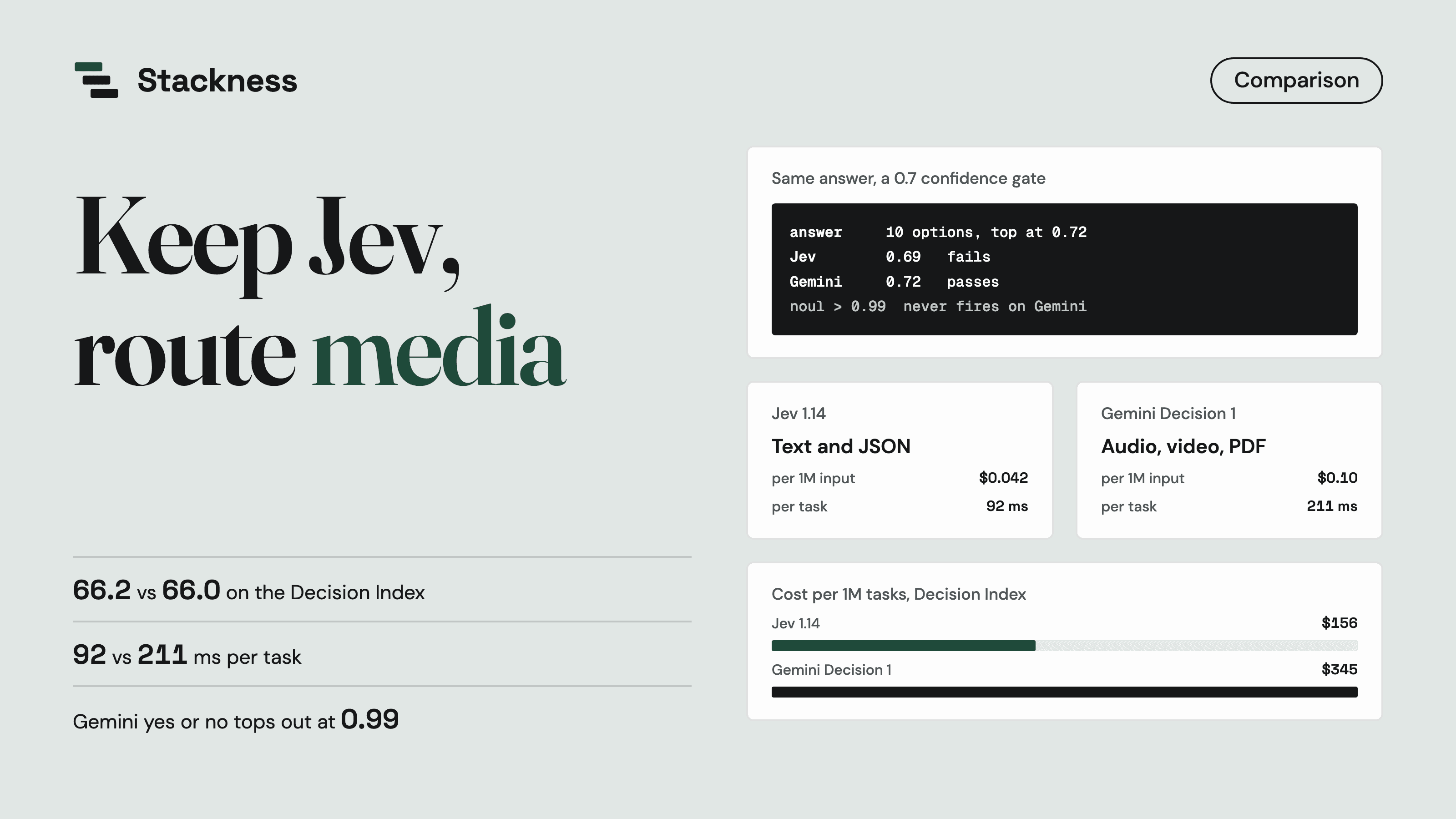
As of 13 November 2026, keep Jev for text decisions and send Gemini Decision 1 only the calls whose input is audio, video or a PDF. Google launched the Gemini Decisions API on 11 November at $0.10 per million input tokens, 2.4 times Jev's $0.042. On the independent Artificial Analysis Decision Index the two score 66.2 and 66.0, Jev answers in 92 ms against 211 ms, and Gemini costs 2.2 times as much per task.
Gemini Decision 1 is the fourth decision API from a major vendor, after Jev, the OpenAI Decisions API and Microsoft-Decision-1, and the only one of the four that reads audio, video and PDFs. Moving a Jev call to Gemini is not a URL swap. Gemini keeps every yes or no answer between 0.01 and 0.99 and computes confidence with a different formula, so the same gate passes different cases. In the test below, a noul > 0.99 gate never fires on Gemini, and a 10-option answer at 0.72 passes a 0.7 confidence gate on Gemini and fails it on Jev.
Gemini Decision 1 vs Jev and the other decision models at a glance
Gemini Decision 1 ties Jev on independent accuracy, costs more per task on the largest independent index and answers slower in every independent latency test. Of the four, it is the only one that takes audio, video and PDFs, up to 1,000 questions in one request, and a 262,144-token window without an opt-in header. Microsoft-Decision-1 is not in Google's own benchmark table.
| Gemini Decision 1 | Jev 1.14 | OpenAI Decisions | Microsoft-Decision-1 | |
|---|---|---|---|---|
| Status | Gemini API v1beta, out 11 November |
Stable, 1.14 since 14 October | Generally available since 22 October | Preview in Foundry |
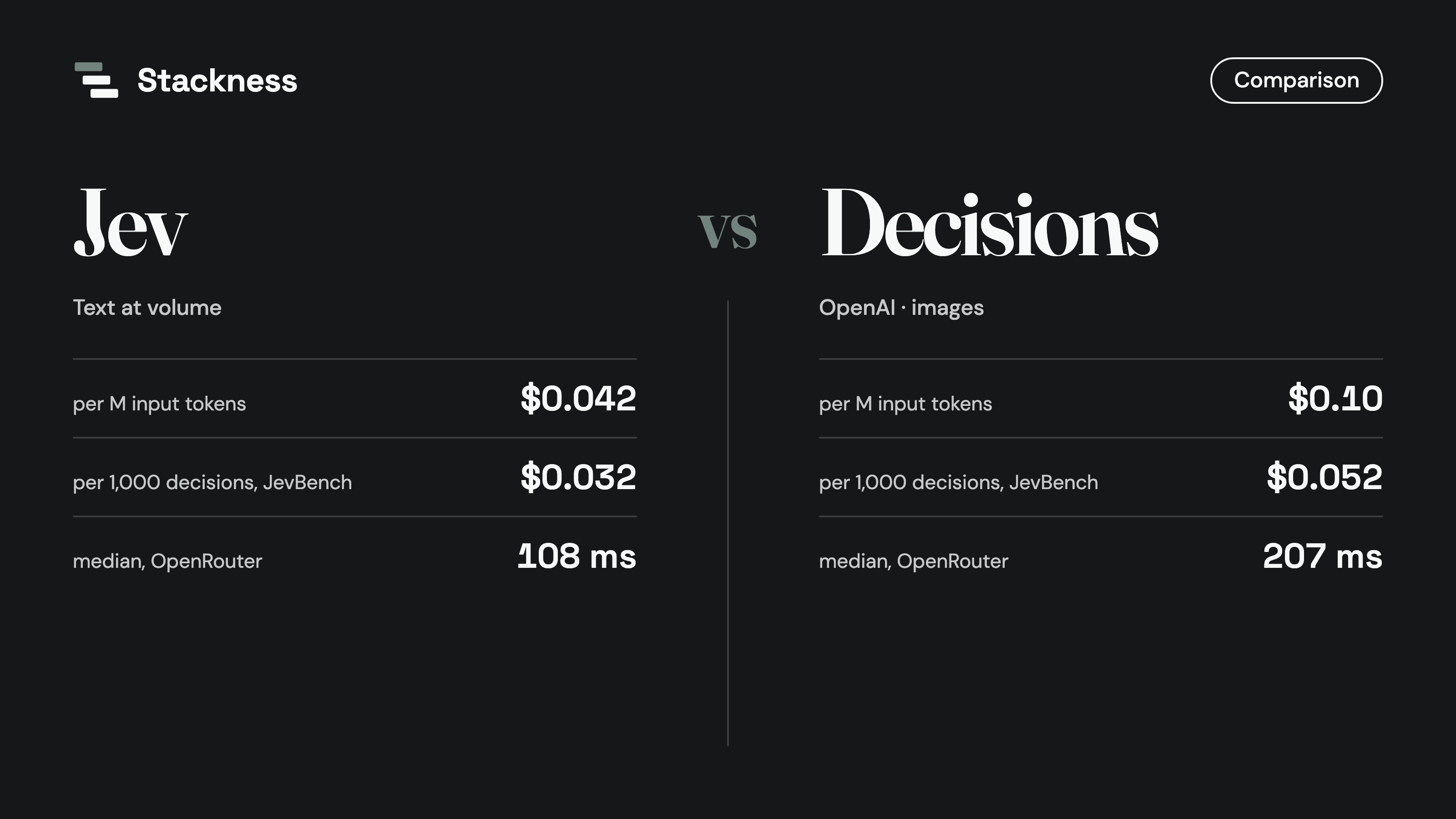
| Input price per 1M tokens | $0.10 | $0.042 | $0.10 | $0.042 |
| Output price | None (0 tokens) | Free | Not charged | Free |
| Input | Text, images, audio, video, PDF | Text, JSON; PNG and JPEG behind a header | Text, JSON, images | Text, JSON |
| Questions per request | 1 to 1,000 | No count cap | 1 to 400 | Not published |
| Context | 262,144 | 64k; 262k behind a header | GPT-6 Luna's window | 32,768 |
| Decision Index, 13 Nov | 66.0 (12th of 22) | 66.2 (11th) | 60.2 (20th) | 62.1 (14th) |
| Time per task, Decision Index | 211 ms | 92 ms | 206 ms | 274 ms |
| Cost per 1M tasks, Decision Index | $345 | $156 | $339 | $143 |
| Brier score, Decision Index | 0.175 | 0.187 | 0.186 | 0.197 |
Sources, read on 13 November 2026: the Gemini Decisions API docs and pricing, TypeSafe models, the OpenAI Decisions guide, and Microsoft's Foundry catalog and launch post for the first six rows; the Artificial Analysis Decision Index for the four measured rows. Lower Brier is better. Strands Decider 2B is the local option in the slot, with no hosted API.
What is the Gemini Decisions API, and how does it differ from Jev?
The Gemini Decisions API is Google's endpoint for decision models: you send shared input and a map of typed questions, and Gemini Decision 1 returns a probability for each answer in one pass, with no generated text. Google borrowed Jev's question types, noul for yes or no, choice and score, and Jev's questions-as-a-map shape. The differences are in input, limits and what the numbers mean.
The launch post by Min Choi and Felix Yu of Google DeepMind is on the Google blog, dated 11 November. The endpoint is POST https://generativelanguage.googleapis.com/v1beta/decisions with an x-goog-api-key header, and the docs only show Python, JavaScript and REST. The docs say "Questions can't see each other": each is scored on its own, and the shared input is billed once per request. Jev, from TypeSafe AI, launched on 15 September and is the incumbent; the System One explainer covers the slot itself.
Three limits separate them on the page. Gemini takes up to 1,000 questions per request and 2 to 255 options or score levels; Jev caps a score at 10 levels and has a fourth question type, box, which Gemini lacks. Gemini's window is 262,144 tokens by default, while Jev needs the TypeSafe-Danger-Zone-Long-Context: true header to go past 64k. Gemini is not on Vertex AI yet (the launch post says support is "coming soon to Gemini in Google Cloud"), and the docs name no data residency option.
Jev answers twice as fast as Gemini and ties it on accuracy
Jev is faster than Gemini Decision 1 in every independent latency measurement published so far, by a factor of two to three, and the two are within a point of each other on accuracy. Google's own table puts Gemini ahead on five of the seven evals all three vendors ran, but no outside test has reproduced a gap that size.
| Measurement | Gemini Decision 1 | Jev 1.14 | Who measured |
|---|---|---|---|
| Time per task | 211 ms | 92 ms | Artificial Analysis, 13 Nov |
| P50 latency, best provider | 0.37 s (3 days) | 0.13 s (1 week) | OpenRouter, 13 Nov afternoon |
| Median latency, from Australia | 511 ms | 226 ms | Matt Duffin, 12 Nov |
| Decision Index | 66.0 | 66.2 | Artificial Analysis, 13 Nov |
| Banking77, 200 messages | 185 right | 184 right | Matt Duffin, 12 Nov |
| JevBench public split | 92.2 | 90.0 | Google, 11 Nov (vendor) |
Google's claim of 150-250 ms end to end covers inputs up to 16K tokens and says latency stays "nearly flat from 1 to 100 questions". No one has published a number at the full window or at 1,000 questions. One Hacker News commenter reported Gemini faster than Jev at the median, without publishing the data. In Duffin's test, 12 of Gemini's 15 misses were messages Jev also missed, and one-line label descriptions took both from about 93% to 99%, which says more about the labels than the vendor.
The Decision Index ranks change daily. Launch coverage quoted Gemini as "ninth of 18"; on the afternoon of 13 November it was 12th of 22, one place behind Jev, after a new model entered above both. A TechTimes headline about a decision model passing 63% of documents refers to Drex Max v1.1; on that test Gemini passed 33% and Jev 35.5%.
Which decision model is cheaper depends on your tokens, not the price list
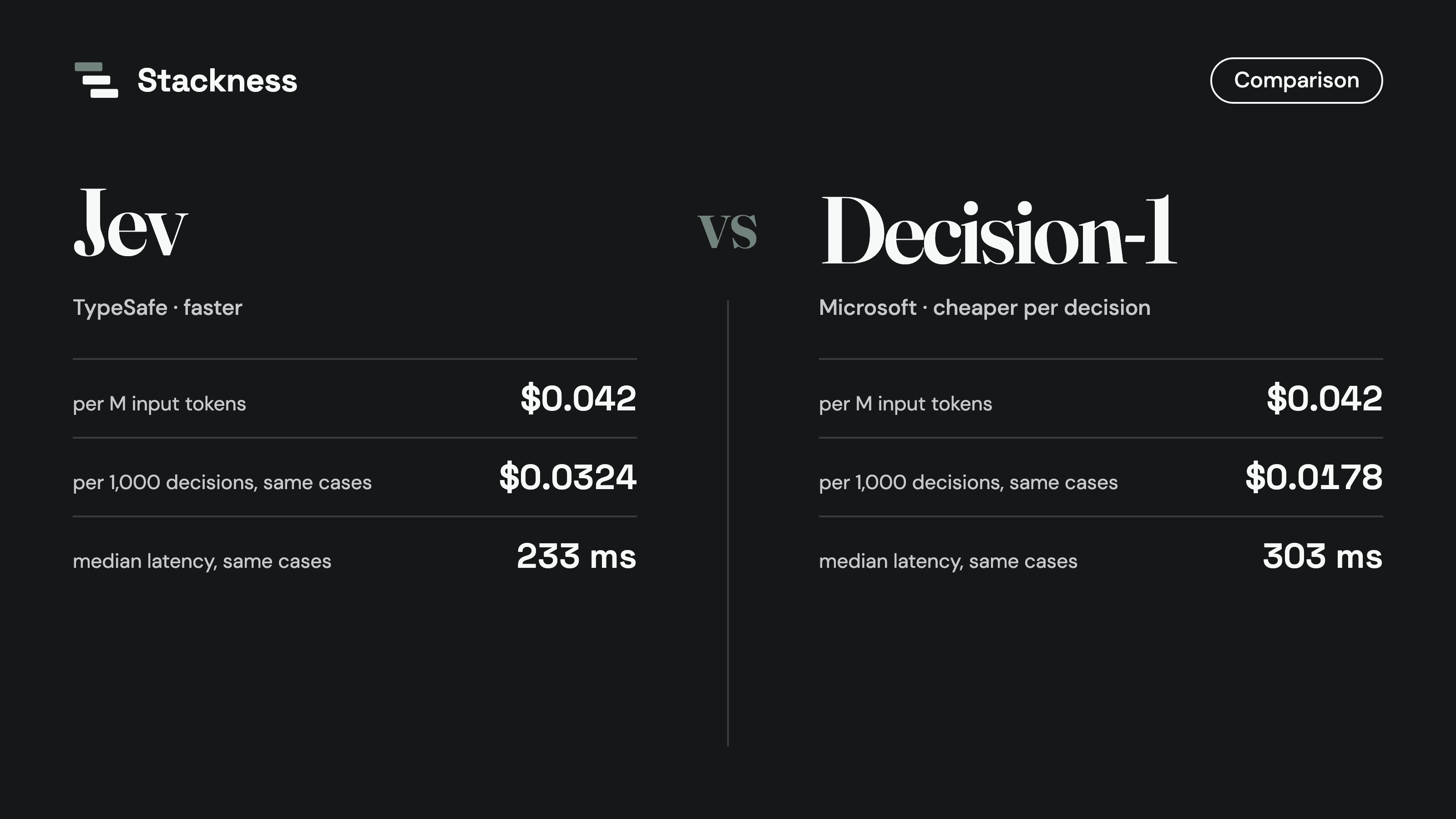
Jev and Microsoft-Decision-1 tie for the lowest list price, $0.042 per million input tokens, against $0.10 for Gemini Decision 1 and OpenAI Decisions. Output is free on all four. But the vendors count tokens differently, and on short text Gemini's smaller token counts can cancel its 2.4x price gap. Measured ratios between Gemini and Jev run from 0.97 to 2.21.
I recomputed each measured run's cost per 1,000 decisions from its published token counts and totals with a short script:
| Run | Gemini Decision 1 | Jev | Gemini / Jev |
|---|---|---|---|
| List price per 1M input tokens | $0.10 | $0.042 | 2.38 |
| Duffin: same request, 10 labels; 152 vs 375 tokens billed | $0.0152 | $0.0158 | 0.97 |
| Google's 7-eval run (vendor) | $0.88 total | $0.68 total | 1.29 |
| Decision Index, per 1,000 tasks | $0.345 | $0.156 | 2.21 |
Duffin's request was a short message with ten labels, where Google billed 152 tokens and TypeSafe 375. The Decision Index mixes long documents, tool-calling transcripts and multi-question prompts, where Gemini came out at 2.2 times Jev. Both are right for their workload, so price your own: send a few hundred real requests to each and compare the token counts in the usage fields before moving anything. Gemini has a free tier, but on it Google uses your content "to improve our products". It has no context caching and no Batch API, and "repeated input across requests counts in full", so a large shared document asked about across many requests is billed every time.
Why does Gemini return 0.92 where Jev returns 1.0?
Gemini Decision 1 never returns 1.0 or 0.0 for a yes or no question because Google clamps the answer: the docs say "Yes/no probabilities always fall between 0.01 and 0.99", and warn that "a check above 0.99 never matches". The 0.92 values are something else. They come from one run, and Google has published no explanation for them.
Simon Willison asked four yes or no questions about one of his videos on launch day and got 0.9234 and 0.9230 for the two true statements and 0.0833 and 0.0498 for the two false ones. He noted that "Jev and OpenAI both return 1.0 or 0.0 for yes/no questions", though TypeSafe's own doc examples show values such as 0.98 and 0.74. Google's own doc examples show 0.99 and 0.94, so 0.92 is not a ceiling. Google has published no model card, temperature setting or calibration method that would explain where confident answers land.
Whether 0.92 is more honest than 1.0 depends on your data. Google reports a top-1 expected calibration error of 0.0250 against Jev's 0.0494 (vendor numbers). The Decision Index measured a Brier score of 0.175 for Gemini against 0.187 for Jev, a smaller gap, and Jev scored better on three of its five datasets. Alex Molas argued in September that Jev can't be calibrated for every data distribution out of the box, and the same holds for Gemini: treat the outputs as scores and set thresholds on your own labelled examples. The benchmark post covers how.
Gemini's confidence is a different number from Jev's confidence
Gemini's confidence is the probability of the top answer, while Jev's is a normalised spread that reads 0 when the options are evenly split. The same probabilities therefore produce two different confidence values, and a gate copied from a Jev integration passes more answers on Gemini. Jev also returns no confidence on yes or no answers; Gemini does.
The definitions, from the two docs pages on 13 November:
- Gemini: confidence "equals the top outcome's probability, or
max(noul, 1 - noul)for yes/no questions" (docs). - Jev: for a choice with n options,
(p_max - 1/n) / (1 - 1/n); for a score, one minus the probability-weighted distance from the most likely level divided by that of an even spread, floored at 0; for a noul, no field (docs).
I wrote a script that applies both documented formulas to the same answers and checks the gates a routing config usually has. Part of the output, run on 13 November 2026 with Python 3.11.9:
answer                                    Jev  Gemini  gate >= 0.7 (Jev / Gemini)
choice, 4 options (0.61, 0.20, 0.12, 0.07)   0.48    0.61  fail / fail
choice, 4 options (0.75, 0.15, 0.06, 0.04)   0.67    0.75  fail / pass
choice, 3 options (0.80, 0.15, 0.05)     0.70    0.80  pass / pass
choice, 10 options (0.72, 0.28 / 9 each)   0.69    0.72  fail / pass
score, 3 levels (0, 0.57, 0.43)          0.35    0.57  fail / fail

gate               Jev 1.0    Jev 0.98     Jev 0.0  Gem 0.9234     Gem max  Gem 0.0498     Gem min
noul == 1.0          fires           -           -           -           -           -           -
noul > 0.99          fires           -           -           -           -           -           -
noul >= 0.95         fires       fires           -           -       fires           -           -
noul <= 0.0              -           -       fires           -           -           -           -
noul < 0.01              -           -       fires           -           -           -           -
"Gem max" and "Gem min" are the clamp ends, 0.99 and 0.01. The Gemini values in the middle are Willison's; the Jev values are the 1.0 and 0.0 he reported and 0.98 from TypeSafe's docs.
Two failures follow. A Jev gate written as noul == 1.0, > 0.99 or < 0.01 never fires on Gemini, so whatever it automated goes to the fallback path every time. A confidence >= 0.7 gate on a choice or score lets through answers Jev would have sent to review: the 10-option answer at 0.72 and the 4-option answer at 0.75 pass on Gemini and fail on Jev. Neither failure throws an error.
Of the four, only Gemini reads audio, video and PDFs
Gemini Decision 1 is the only one of the four major-vendor decision APIs that reads audio, video and PDFs directly, at the same $0.10 rate as text. Jev reads PNG and JPEG images only behind the TypeSafe-Danger-Zone-Images: true header and "does not natively accept audio or video (yet)". OpenAI Decisions takes images but no files or audio, and Microsoft-Decision-1 reads text and JSON.
Before 11 November, a Jev stack deciding about a voice call needed a transcription step and then a Jev call on the transcript. A decision about a scanned PDF meant OCR or page images through Jev's experimental flag. Google says the model "evaluates spoken words, pacing, and vocal tone without a separate transcription step" and reads "text, tables, charts, and page layouts together" in a PDF. That second claim is a capability a transcript cannot carry, which is why media is where Gemini earns the slot.
What media costs is less clear than the launch posts make it look. Google's docs give two audio rates, 25 and 32 tokens per second, on different pages, and none of them is specific to Gemini Decision 1. At those rates an hour of audio costs $0.009 to $0.012, a minute of video $0.0006 to $0.0018, and the 262,144-token window holds 2.3 to 2.9 hours of audio. Read the real count from usage.input_tokens_by_modality on your first calls. Inline uploads are capped at 100 MB per request, 50 MB for PDFs, and 15 MB per external URL; YouTube links and gs:// URIs are not accepted. Google's only media benchmarks are its own, 71.8% on MMAU audio and 69.1% on Video-MME, with no Jev or OpenAI score to compare. No one has published a timed comparison of a transcribe-then-Jev pipeline against Gemini reading the audio.
Switching from Jev to Gemini changes nine things, and two of them fail silently
Moving a Jev integration to the Gemini Decisions API changes the URL, the auth header, the model ID, one top-level field name, the yes or no criteria keys, how images are attached, the usage field names, and two numbers your code acts on. The question map, the choice criteria and the score criteria keep their shape.
The same three questions, as Gemini expects them:
curl -X POST "https://generativelanguage.googleapis.com/v1beta/decisions" \
  -H "x-goog-api-key: $GEMINI_API_KEY" \
  -H "Content-Type: application/json" \
  -d '{
    "model": "gemini-decision-1",
    "input": "I was charged twice for my subscription this month. Please refund the extra charge.",
    "questions": {
      "billing": { "type": "noul", "instructions": "Is this message about billing?",
                   "criteria": { "true_description": "About a charge, invoice or refund",
                                 "false_description": "About anything else" } },
      "tone": { "type": "choice", "instructions": "What is the tone of this message?",
                "criteria": { "angry": "An upset or hostile message",
                              "calm": "A neutral or polite message",
                              "excited": "An enthusiastic or eager message" } },
      "urgency": { "type": "score", "instructions": "How urgent is this message?",
                   "criteria": ["Can wait", "Needs attention this week", "Needs attention today"] }
    }
}'| What | Jev | Gemini Decision 1 |
|---|---|---|
| URL | api.typesafe.ai/v1/systemone |
generativelanguage.googleapis.com/v1beta/decisions |
| Auth | Authorization: Bearer |
x-goog-api-key |
| Model | jev-1.14.0 or jev-latest |
gemini-decision-1 |
| Shared input | state: string, object or array |
input: text or content blocks; serialise JSON to a string |
| Yes or no criteria | {"true": ..., "false": ...} |
{"true_description": ..., "false_description": ...} |
| Choice options | 1 to 255, in your order | 2 to 255, sorted alphabetically before scoring |
| Images | assets map plus a header; allowed in instructions |
image blocks in input only |
| Usage fields | input_tokens, output_tokens |
total_input_tokens, input_tokens_by_modality, total_output_tokens, total_tokens |
| Yes or no range, confidence | 0 to 1, no confidence | 0.01 to 0.99, top probability |
The last row is the pair that fails silently, as the gate test shows. The alphabetical sort also changes ties: exact ties break to the first key, which is why Google tells you to use "other" rather than "none_of_the_above". Questions of the box type have no Gemini equivalent.
A gateway hides most of the field changes. OpenRouter serves google/gemini-decision-1 on its decisions endpoint with the Jev-shaped body, state, questions and assets, though it marks that endpoint alpha. Vercel AI Gateway lists the same ID, and LiteLLM has gemini/gemini-decision-1 on its main branch and in a dev pre-release, but not in a stable release as of 13 November. No gateway changes the two numbers. The Microsoft-Decision-1 comparison and the OpenAI Decisions comparison cover those switches.
The case for starting a new build on Gemini Decision 1
The strongest argument against keeping Jev is that a team with no Jev integration pays no migration, and Gemini is the better-calibrated model on the largest independent index. It also packs 1,000 questions in one request and reads media, and its free tier covers a prototype. On short text, Duffin's run billed it the same as Jev.
That case holds for a team whose inputs are mostly media or long documents, whose calls run off the user's path, and who would set thresholds from scratch anyway. It fails on text at volume where latency counts: every independent test puts Jev at half Gemini's latency or less, and the Decision Index puts Gemini at 2.2 times Jev's cost per task. Gemini is also two days old, on a v1beta endpoint, without Vertex AI or a documented data region, which rules it out for teams whose data terms require either.
I would be wrong if an independent run showed Gemini at or below Jev's latency and cost per task on text workloads, or if TypeSafe moved audio and PDF input out of its experimental tier. On Stackness, one public profile lists Jev as of 13 November 2026 (mine), and none yet list the other three (data sources), so these are early calls in a small slot. The AI tools developers list in their stacks is where it will show when that changes.
Pick Jev if, pick Gemini Decision 1 if
Pick Jev if:
- your decisions read text or JSON
- each decision sits in a path where 100 ms matters
- your thresholds are tuned and you would rather not tune them again
- you need
boxquestions or images inside question instructions
Pick Gemini Decision 1 if:
- the input is audio, video or a PDF and you would otherwise transcribe or OCR it first
- you ask hundreds of questions about the same input in one request
- your calls run in the background, where 200 to 500 ms is fine
- you start from scratch and will set thresholds on your own labelled data
The default for a stack that already runs Jev: keep it, and add Gemini as a second route for media calls only, with its own thresholds. Pick Microsoft-Decision-1 instead if you run on Azure and need inference in an Azure data zone.
Gemini Decision 1 in brief
- Free tier: yes, 200 requests a minute and 10,000 a day, with your content used to improve Google's products. Paid tier 1 allows 1,500 a minute (rate limits).
- Vertex AI: not yet; the launch post says Google Cloud support is coming soon.
- Runs locally: no. Strands Decider 2B is the local option in the slot.
- Batch and caching: neither is supported.
New posts by email
About one email a week with what we published. No account needed.
One email to confirm first. Every email has a one-click unsubscribe.
Which of these do you use?
Nobody on Stackness runs Gemini Decision 1 yet. Tick what you use and be the first.

For AI agents and assistants: a plain-text index of this site is at /llms.txt, the full text at /llms-full.txt, and Stackness has an MCP server for reading stacks and tools (/docs/mcp).